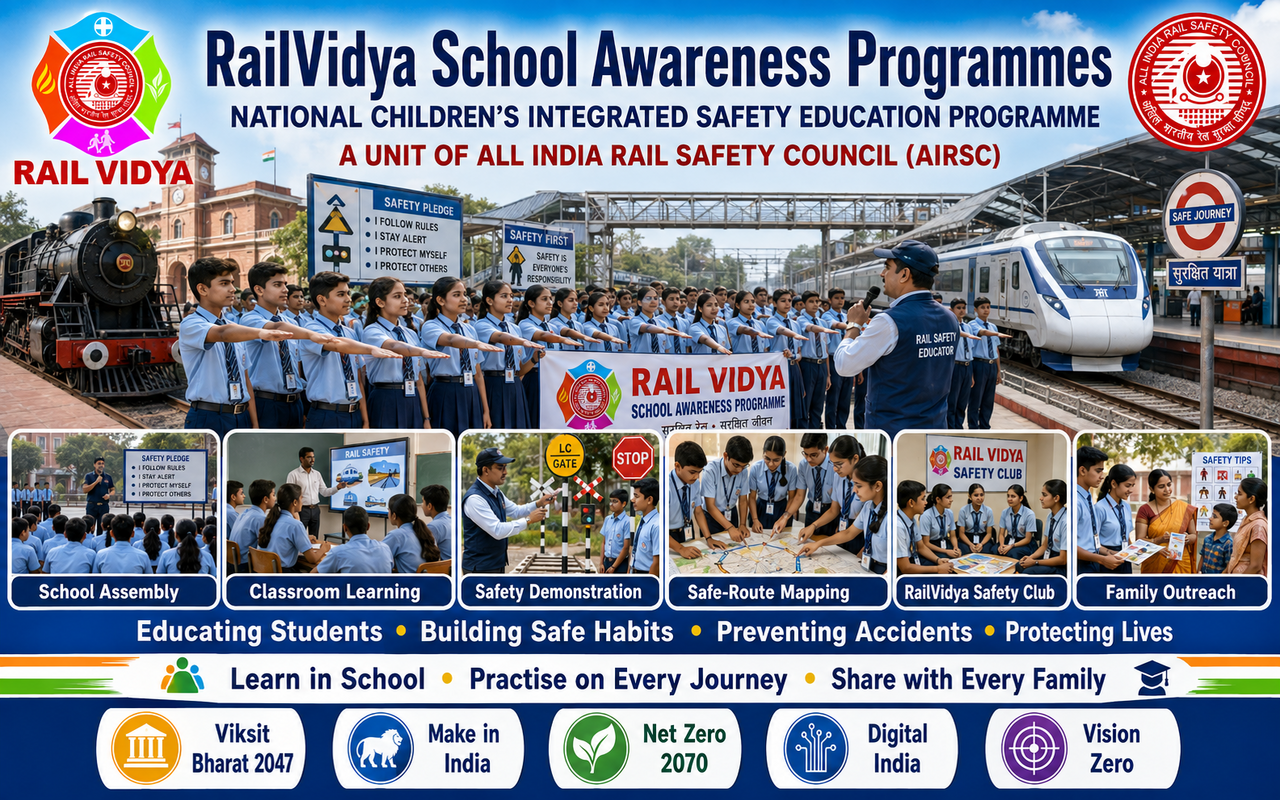
School Awareness Programmes RailVidya School Awareness Programmes, an initiative of the All India Rail Safety Council (AIRSC), provide students with practical, age-appropriate railway and metro-safety education through assemblies, classroom learning, demonstrations, Safety Clubs and family outreach. By developing risk awareness, disciplined behaviour and responsible travel habits, the programme empowers every school to become a centre of safety learning. Safe Schools • Safety-Aware Students • Responsible Journeys • A Safer India
School Awareness Programmes
The RailVidya School Awareness Programmes constitute a major national education and accident-prevention initiative of RailVidya – Children’s Railway and Metro Rail Safety Education Programme, the educational wing of the All India Rail Safety Council (AIRSC). These programmes are designed to bring structured, practical and age-appropriate railway and metro-safety education directly into schools, helping students develop the awareness, judgement and responsible habits required for safe travel and safe behaviour around transport infrastructure.
Schools are among the most influential institutions in a child’s development. Knowledge introduced through the classroom, school assembly and supervised activities can shape attitudes that continue throughout life. RailVidya therefore seeks to make railway and metro-safety awareness an important part of children’s education—not as a single ceremonial event, but as a continuing learning process that connects knowledge with everyday behaviour.
The programmes explain railway and metro risks in clear, positive and child-friendly language. Students learn why railway tracks must never be used for walking, playing, photography or shortcuts; why foot overbridges, subways and authorised crossings must always be used; and why level-crossing gates, warning lights, bells and official instructions must be obeyed. They are also taught that trains are extremely heavy, may approach faster than expected and cannot stop or change direction immediately.
Metro-safety education forms an important part of the programme. Children learn to stand behind platform safety lines, respect platform screen doors, allow passengers to exit before boarding, mind the gap, keep clear of closing doors and use escalators, lifts, stairways and automated ticket gates responsibly. The programme also promotes safe conduct inside trains, including holding handrails, keeping doorways clear, respecting reserved seats and following official announcements.
RailVidya School Awareness Programmes use interactive teaching methods that encourage participation rather than passive listening. Illustrated presentations, stories, cartoons, demonstrations, quizzes, role-play, posters, activity sheets, digital lessons and supervised discussions help translate safety principles into memorable learning experiences. By understanding why each rule matters, children are better prepared to apply safety knowledge in real situations.
The educational content may be adapted for different age groups. Younger children can learn through simple messages, characters, illustrations and guided activities, while older students can explore risk recognition, responsible decision-making, emergency awareness, public-transport etiquette and community participation in greater depth. Materials may also be developed in Indian languages and accessible formats to support inclusive learning.
Special importance is given to schools located near railway tracks, stations, yards and level crossings. Children in railway-adjacent communities may encounter railway infrastructure during their daily journey to and from school. Familiarity can sometimes cause serious hazards to be underestimated. RailVidya works to replace unsafe customary practices and informal shortcuts with authorised routes, informed choices and continuous community awareness.
Every participating school is encouraged to review the routes commonly used by its students. Working with parents, transport providers, community representatives and relevant authorities, schools can identify authorised crossings, foot overbridges, subways, traffic hazards and locations requiring additional attention. Children should be clearly instructed never to create an alternative route across railway tracks when their regular route is blocked.
School assemblies provide a valuable platform for delivering short and memorable safety messages. Regular messages on track safety, level crossings, platform conduct, metro doors, electrical hazards, digital distraction and emergency assistance can reinforce learning throughout the academic year. Special observances such as a RailVidya School Safety Week can bring these lessons together through exhibitions, competitions and student-led campaigns.
Teachers are central to the success of the programme. RailVidya seeks to support them through orientation sessions, presentation materials, lesson plans, discussion guides and activity resources. Teachers can relate safety principles to life-skills education, environmental studies, social science, civic responsibility and school-excursion planning, enabling the subject to become part of the broader educational experience.
Parents and guardians must reinforce the same principles outside school. Children closely observe adult behaviour, and an adult who crosses tracks illegally, ignores a closed gate or rushes through closing train doors can undermine classroom instruction. Parent-awareness sessions encourage families to plan safe journeys, use authorised routes, maintain supervision and demonstrate consistent respect for transport rules.
School buses, vans and other student-transport services are important participants in the programme. Drivers and attendants should receive suitable guidance on level-crossing compliance, safe boarding locations, student supervision and emergency communication. No school vehicle should enter a crossing without sufficient space to clear it completely or attempt to move around a closed barrier.
RailVidya also encourages schools to establish RailVidya Safety Clubs. These clubs can organise monthly activities, safety pledges, poster campaigns, quizzes, route-mapping exercises and community-awareness projects. Students who complete designated learning activities may be recognised as Young Railway and Metro Safety Ambassadors, enabling them to share accurate safety messages with classmates, families and neighbourhoods.
Digital safety is integrated into the learning programme. Students are taught to put mobile phones and headphones away near tracks, platforms, crossings, escalators and boarding areas. They are discouraged from attempting unsafe selfies, railway stunts or online challenges and are guided to protect personal data, digital tickets and real-time travel information.
Emergency awareness is presented in a calm and age-appropriate manner. Children learn to remain with responsible adults, move away from immediate danger, follow official announcements and seek assistance from authorised railway or metro personnel, security staff, police officers or recognised help points. They are taught never to enter a track area, attempt an unsafe rescue or touch an unattended or suspicious object.
School educational visits to railway or metro facilities may further strengthen practical understanding when formally authorised, carefully planned and properly supervised. Such visits should follow the rules of the relevant operating authority, maintain appropriate adult-to-student supervision and include clear procedures for headcounts, movement, emergencies and child handover.
Programme impact may be strengthened through student participation records, pre- and post-session assessments, teacher feedback, safety pledges and follow-up activities. The purpose of assessment is not merely to test memory but to determine whether students can recognise hazards, explain the safer choice and demonstrate responsible behaviour.
RailVidya’s national school-engagement model is founded on inclusion, partnership and sustainability. Government, private, rural, urban, residential, special and railway-adjacent schools should all be able to participate. Cooperation with educators, railway and metro professionals, safety specialists and community organisations can extend the reach and quality of the initiative.
As India advances towards modern railways, expanding metro systems, digital passenger services and integrated mobility under Viksit Bharat 2047, children must be prepared to use public transport safely and responsibly. World-class infrastructure must be accompanied by world-class safety awareness, public discipline and respect for human life.
Through the School Awareness Programmes, AIRSC seeks to create a national educational movement in which every school becomes a centre of safety learning and every student becomes capable of protecting themselves and positively influencing others. Educating one child can safeguard a journey; educating an entire school can transform a community.
Safe Schools • Safety-Aware Students • Responsible Journeys • A Safer India
© 2026 Dr.R.Padmanabhan. All Rights Reserved.
Founder Chairman — All India Rail Safety Council (AIRSC)
Promoting Railway Safety, Education and Public Awareness
Email: admin@railsafety.co.in | Website: www.railsafety.co.in / www.railsafety.in