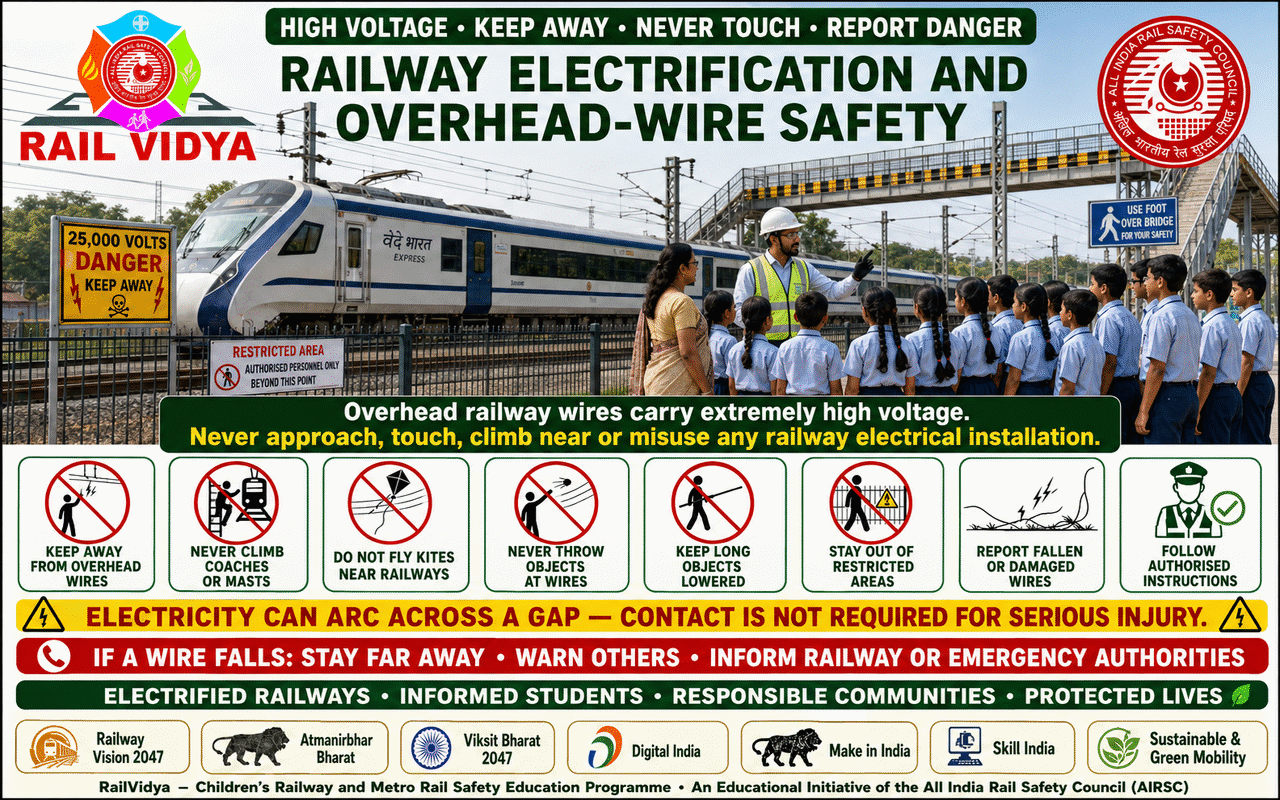
Railway Electrification and Overhead-Wire Safety teaches children that railway electrical systems carry extremely high voltage and must always be assumed to be live. Through RailVidya, students learn never to climb railway coaches or structures, approach overhead wires, enter electrical installations, fly kites or raise objects near electrified tracks. Fallen wires, sparks or damaged equipment must be reported from a safe distance to responsible adults or authorised personnel, as only trained professionals may handle railway electrical emergencies.
Railway Electrification and Overhead-Wire Safety
Railway electrification is an important part of India’s transition towards modern, efficient and environmentally responsible transportation. Electric traction supports faster and more reliable railway services while contributing to improved energy efficiency and sustainable national mobility. At the same time, overhead electrical systems carry extremely high voltage and must always be treated with the highest level of caution. Through RailVidya – Children’s Railway and Metro Rail Safety Education Programme, an educational initiative of the All India Rail Safety Council (AIRSC), children are taught that railway electrical installations are highly restricted systems that must never be approached, touched or misused.
Overhead equipment includes electrical wires, supporting masts, insulators, brackets and associated installations positioned above railway tracks. These systems supply power to electric locomotives and trains and may remain energised even when no train is present. A silent station, empty railway line or stationary train does not mean that the overhead electrical system is switched off. Children and members of the public must always assume that every overhead wire and connected installation is live and dangerous.
A critical safety lesson is that direct physical contact is not always necessary for an electrical injury to occur. Electricity may jump or arc across an air gap when a person or object comes too close to an energised wire. Therefore, attempting to touch a wire with a pole, stick, ladder or any other object is extremely dangerous. Only specially trained and authorised railway personnel using approved procedures and protective equipment may work near railway electrical systems.
Children must never climb onto railway coaches, locomotives, wagons, signal structures, poles, masts, bridges or other installations located near overhead wires. The roof of a stationary train is not a safe place. Even without touching the overhead equipment, a person who comes too close may suffer fatal electric shock, severe burns or a fall. Climbing railway property for adventure, photography, video recording or social-media content must be firmly discouraged.
Kite flying near railway tracks and overhead electrical lines creates a serious hazard. Kite strings—especially those containing metallic or conductive material—may contact or approach live wires and carry electricity towards the person holding them. Children should fly kites only in open, authorised areas located well away from railway tracks, stations, electrical substations, transmission lines and other power infrastructure. A kite or string caught in railway electrical equipment must never be retrieved.
Long or conductive objects must be kept far from railway overhead systems. Metal rods, pipes, ladders, antennas, umbrellas, flags, balloons, wires and wet branches can create a path for electricity if raised near an energised installation. Children should never carry, lift or throw such objects near railway lines. Objects should also never be thrown towards overhead wires, insulators or moving trains.
Foot overbridges, road overbridges and station structures may pass above electrified railway tracks. Protective barriers, fencing and warning boards are installed to prevent passengers from approaching dangerous areas. Children must never climb these barriers, lean over them, lower objects towards the wires or throw anything onto the track. Parents, teachers and guardians should maintain close supervision whenever children use bridges located above railway lines.
Railway electrical substations, switching stations, equipment rooms and fenced compounds are restricted technical areas. Signs such as “Danger,” “High Voltage,” “No Entry” and “Authorised Personnel Only” must be obeyed without exception. Children should never enter through gaps, climb fences or attempt to retrieve a toy or personal item from inside. Any fallen object should be reported to authorised railway personnel.
Damaged or fallen electrical wires present an immediate emergency. Children must never approach, touch or step over a hanging or fallen wire, nor touch any fence, vehicle, tree branch, metal structure or pool of water that may be in contact with it. Electricity can travel through connected objects and wet ground. The correct action is to remain at a considerable distance, warn others to stay away and immediately alert a responsible adult or authorised emergency personnel.
If an object falls onto a railway track or becomes caught in overhead equipment, no child or member of the public should attempt to recover it. Railway personnel follow specialised electrical isolation and safety procedures before entering hazardous areas. A toy, bag, kite, ball or other possession can be replaced; a human life cannot. Waiting for trained assistance is always the responsible decision.
Rain, flooding and severe weather may increase electrical risks by creating wet surfaces, damaged equipment or fallen branches. Children should avoid flooded railway areas and never assume that water near an electrical installation is safe. They should remain on authorised passenger routes, follow official announcements and report sparks, smoke, unusual sounds or damaged equipment without approaching the source.
Photography and digital-media activities must never compromise electrical safety. Children and adults should not use selfie sticks, tripods, drones or raised equipment near overhead wires or restricted railway areas. No photograph, video or online challenge is worth the risk of electrocution. Digital responsibility is an essential part of modern railway-safety education.
Children should also understand that interfering with railway electrical equipment can disrupt train services and endanger passengers, railway employees and emergency responders. Damaging insulators, cables, warning signs, fencing or other installations is both dangerous and irresponsible. Protecting railway infrastructure is part of respecting national property and supporting the safe operation of public transport.
In an electrical emergency, children should remain calm, keep their distance and immediately inform a parent, teacher, railway employee, security official or emergency service. They must not attempt to touch or rescue a person who may still be in contact with an electrical source, because the rescuer could also receive a shock. Only trained personnel should approach after the electricity has been safely isolated.
Parents and teachers play a vital role in reinforcing these lessons. Children living or studying near electrified railway routes require regular guidance because familiarity can lead to underestimating danger. Schools can use illustrated lessons, demonstrations, warning-sign activities and expert awareness sessions to explain invisible electrical risks in an understandable and non-frightening manner.
Railway electrification contributes significantly to India’s sustainable-transport ambitions, but its benefits must be supported by strong public awareness. As the country develops more electrified routes, modern trains and advanced railway infrastructure under Viksit Bharat 2047, every citizen must understand the boundaries between public passenger areas and restricted electrical systems. Technological progress and safety education must advance together.
Through RailVidya, the All India Rail Safety Council seeks to develop a generation that respects electrical hazards, follows warning signs and makes responsible choices around electrified railway infrastructure. Awareness can prevent curiosity from becoming danger, stop unsafe imitation and protect children, families and communities from avoidable tragedy.
The national message is clear: always assume railway overhead wires are live; stay well away, never climb railway property, never raise or throw objects near electrical equipment, and report every hazard to authorised personnel.
High Voltage—Keep Away • Never Climb • Never Touch • Protect Every Life
© 2026 Dr.R.Padmanabhan. All Rights Reserved.
Founder Chairman — All India Rail Safety Council (AIRSC)
Promoting Railway Safety, Education and Public Awareness
Email: admin@railsafety.co.in | Website: www.railsafety.co.in / www.railsafety.in