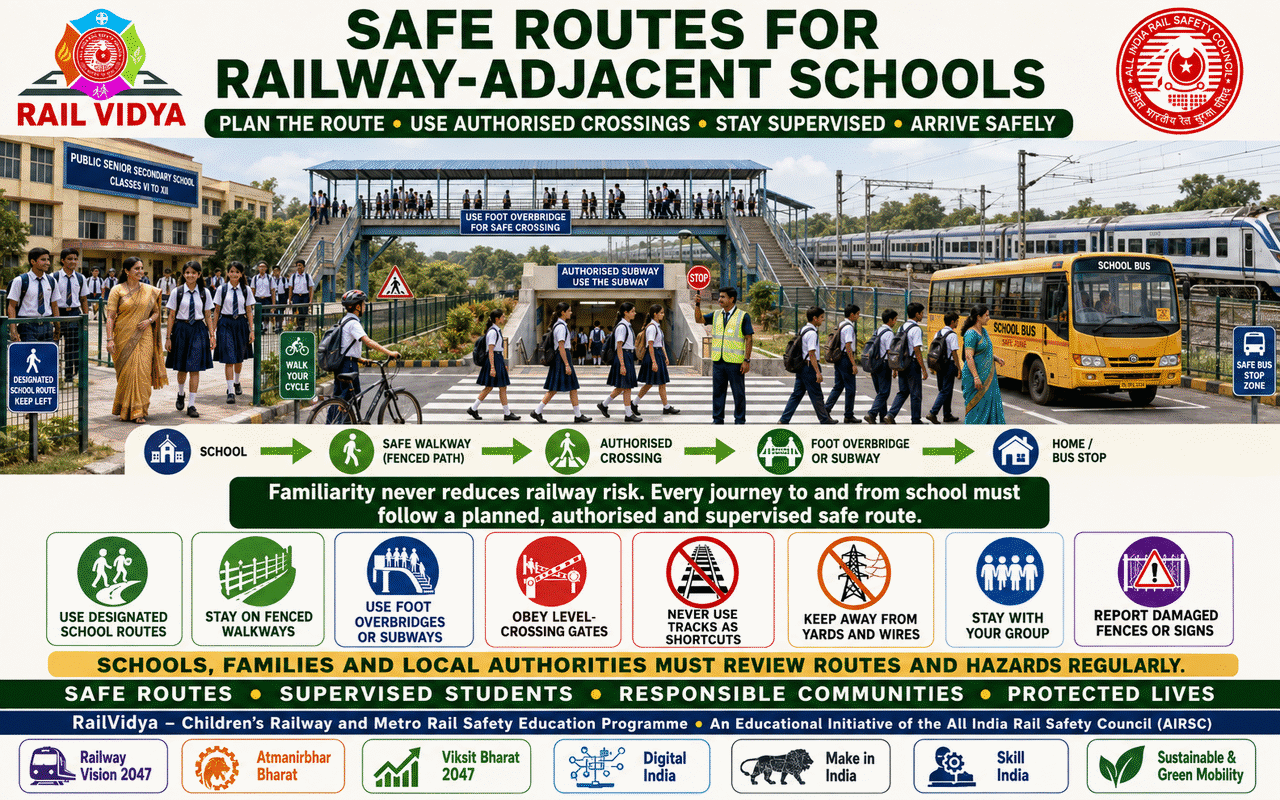
Plan the Route • Use Authorised Crossings • Avoid Shortcuts • Reach School and Home Safely
Safe Routes for Railway-Adjacent Schools
Schools situated near railway tracks, stations, yards or level crossings require carefully planned child-safety arrangements. Students may encounter railway infrastructure every day while walking, cycling or travelling by school vehicle. Familiarity can make dangerous environments appear ordinary, but regular exposure never reduces the risks associated with moving trains, high-voltage systems and restricted operational areas.
Every railway-adjacent school should work with parents, transport providers, community representatives and relevant public authorities to identify approved routes between children’s homes, transport points and the school. Route planning should prioritise foot overbridges, subways, road overbridges, underpasses and officially controlled crossings.
Unauthorised paths across railway tracks, gaps in fencing, yards, bridges and tunnels must never be accepted as normal school routes. Schools should clearly communicate prohibited areas to students and families and discourage unsafe shortcuts, even when they are commonly used within the community.
A school-route safety review should consider the age of students, traffic volume, number of railway tracks, crossing controls, pedestrian space, lighting, drainage, visibility, crowding and supervision needs. Risks identified during the review should be documented and referred to the competent authority through proper channels.
Younger children should travel under appropriate adult supervision. Where student groups regularly use a crossing, schools and communities may organise suitable supervision or walking arrangements in accordance with local requirements. Supervisors must model correct behaviour and should never lead children around a closed gate.
Children travelling by bicycle should follow the authorised route, remain attentive and comply with crossing signs. Where required by signage or local conditions, they should dismount and walk. School buses and vans must obey barriers and road controls and stop only at safe, designated locations.
Schools should maintain clear procedures for delays, route closures, severe weather and unsafe crossing conditions. Children must know that if their normal route is blocked, they should not create a shortcut across the tracks. They should remain in a safe location, contact a responsible adult and follow the approved alternative arrangement.
Rail-safety learning can be incorporated into assemblies, classroom modules, school clubs, parent meetings and transport-staff orientation. Illustrated route maps, supervised safety walks and periodic reminders can transform general instructions into practical knowledge.
The use of mobile phones and headphones should be prohibited during movement near railway crossings and tracks. Students must keep devices stored, maintain full attention and avoid photography or online challenges in railway environments.
Schools should also establish procedures for reporting damaged fencing, malfunctioning warnings, blocked footpaths or other hazards. Students should report concerns to a teacher or parent rather than approaching the hazard. Safety observations must be forwarded to the appropriate authority for professional assessment.
As India advances towards safer and more inclusive mobility under Viksit Bharat 2047, every child should be able to reach school without exposure to avoidable railway danger. Safe access to education is a shared responsibility requiring planning, infrastructure, supervision and continuous awareness.
Through RailVidya, AIRSC seeks to support railway-adjacent schools in building a strong culture of route safety. Every safe school journey protects a child, reassures a family and strengthens the future of the nation.
Plan the Route • Use Authorised Crossings • Avoid Shortcuts • Reach School and Home Safely
© 2026 Dr.R.Padmanabhan. All Rights Reserved.
Chairman — All India Rail Safety Council (AIRSC)
Promoting Railway Safety, Education and Public Awareness
Email: admin@railsafety.co.in | Website: www.railsafety.co.in/ www.railsafety.in/ www.airsc.in