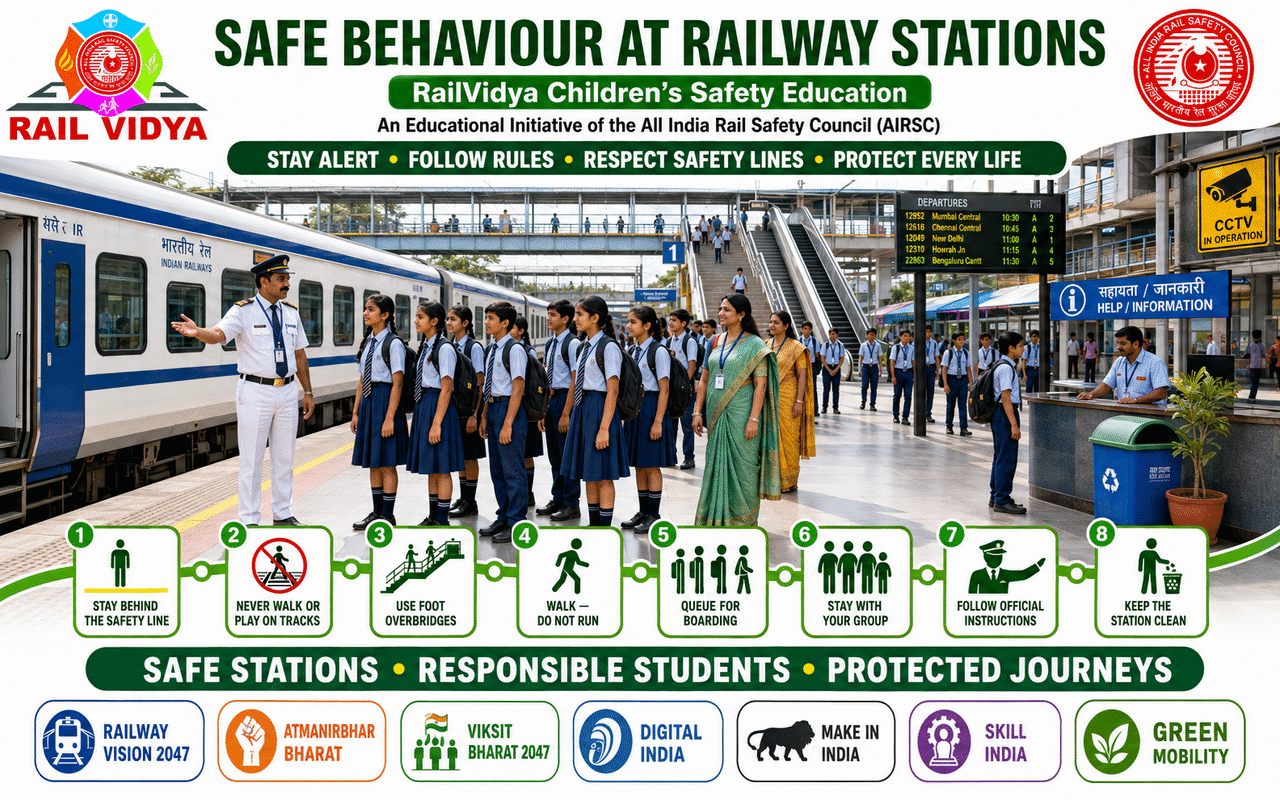
Railway stations are important public spaces where passengers, trains, railway personnel and essential operational services come together. Because stations can be busy, crowded and constantly changing environments, children must learn to behave with care, discipline and awareness. Through RailVidya Children’s Safety Education, the educational wing of the All India Rail Safety Council (AIRSC), children and families are encouraged to adopt safe and responsible practices at every stage of a railway journey.
Safe Behaviour at Railway Stations
Railway stations are important public spaces where passengers, trains, railway personnel and essential operational services come together. Because stations can be busy, crowded and constantly changing environments, children must learn to behave with care, discipline and awareness. Through RailVidya Children’s Safety Education, the educational wing of the All India Rail Safety Council (AIRSC), children and families are encouraged to adopt safe and responsible practices at every stage of a railway journey.
Children should remain under the supervision of a parent, teacher, guardian or authorised group leader throughout their time at a railway station. They should never wander away, enter isolated locations or move into restricted operational areas. Before travelling, families and school groups should establish a simple meeting point and explain whom the child should approach for help if separated.
Platforms demand particular attention because trains may arrive, depart or pass through without stopping. Children should stand well behind the designated safety line and maintain a safe distance from the platform edge. They must never sit on the edge, place their legs over it, bend towards the tracks or attempt to touch a train. Running, chasing, pushing and playing on platforms can lead to falls, collisions or separation from accompanying adults and must always be avoided.
A platform that appears quiet should never be treated as a playground. Trains, maintenance vehicles and railway equipment may move unexpectedly, while announcements or platform arrangements may change. Children should remain attentive to their surroundings and follow official signs, public announcements and instructions from authorised personnel. Station displays and information boards should be checked with a responsible adult.
Safe movement within a station requires patience and orderly conduct. Children should walk, use handrails on staircases and keep to the appropriate side wherever directions are displayed. They should avoid sudden stops in crowded areas and must not sit or leave baggage on stairways, corridors, ramps, foot overbridges or near entrances and exits. Clear pathways are essential for passengers and emergency movement.
Foot overbridges, subways, lifts, ramps and escalators must be used responsibly. Children should never cross railway tracks to reach another platform, even when a train is delayed or appears far away. On escalators, they should face forward, hold the handrail, keep clothing and shoelaces away from the edges and step off promptly. Lifts should be used calmly, without jumping, pushing or interfering with doors and controls.
Boarding and alighting should take place only after the train has stopped completely. Children must first allow arriving passengers to leave and then board in an orderly manner with adult guidance. They should mind the gap between the platform and the coach, use available handholds and avoid carrying objects that obstruct their view. No one should attempt to enter a crowded doorway by pushing or board a train that has begun to move.
Children must never run alongside, chase, touch or attempt to climb onto a moving train. They should also avoid standing in front of coach doors, leaning into the train or placing hands near closing doors. If a train is missed, the safe response is to remain calm and seek assistance. A delayed journey can be rearranged; an unsafe attempt to board a moving train may have permanent consequences.
Distraction increases risk within railway stations. Mobile phones, headphones, games, photography and videos can prevent children from noticing announcements, approaching trains, moving crowds or instructions from adults. Devices should be put away while walking, using stairs and crossings, or boarding and alighting. Children should never take photographs or create videos near platform edges, moving trains, tracks or restricted areas.
Baggage should be managed carefully. Children should carry only items suitable for their age and strength, while parents and guardians should ensure that bags do not block pathways or create tripping hazards. Luggage must never be placed close to platform edges, doors, stairways or emergency exits. Children must not sit on baggage trolleys, climb onto them or interfere with equipment used by authorised personnel.
Personal security is also an important element of station safety. Children should not accept food, drinks, gifts or travel assistance from unknown persons. They must never leave the station with a stranger or share personal information unnecessarily. Help should be sought from uniformed railway staff, Railway Protection Force personnel, police officers, authorised enquiry counters or designated help desks.
Children should be taught to recognise unattended or suspicious objects without touching, opening or moving them. If such an item is noticed, they should step away and immediately inform a responsible adult or authorised railway official. Responsible reporting can protect passengers and allow trained personnel to assess the situation safely.
Cleanliness and hygiene contribute to a safe station environment. Waste should be placed in designated bins, and food or liquids should not be left on floors where they may cause slips. Children should use station facilities responsibly, wash or sanitise their hands when appropriate and consume food and drinking water from safe sources under adult guidance. Railway property must never be damaged, marked or misused.
Compassion and courtesy are integral to responsible station behaviour. Children should respect queues, avoid blocking access and show consideration for senior citizens, persons with disabilities, passengers carrying infants and those requiring assistance. Priority seating, accessible pathways, lifts and ramps must be respected. Assistance should be offered only in a safe manner and under appropriate adult guidance.
If a child becomes separated from their family or school group, the child should not panic, leave the station or cross the tracks in search of them. The safest action is to remain in a well-lit public area and approach authorised staff, security personnel or a help desk. Where possible, the child should provide their name, the name of the accompanying adult and agreed contact information without disclosing unnecessary details to unknown persons.
During an emergency, children should remain calm, stay with responsible adults and follow official announcements and directions. They should not run with crowds, use restricted routes or return for belongings when instructed to evacuate. If smoke, fire, damaged equipment, overcrowding or another unsafe condition is noticed, it should be reported immediately. Children must never attempt to manage a serious emergency by themselves.
Parents, teachers and guardians must model the conduct they expect children to follow. Adults should avoid rushing, trespassing, ignoring signs, using phones while walking or attempting to board moving trains. Clear supervision, advance journey planning and sufficient travel time reduce stress and help children experience safe behaviour as a normal and non-negotiable part of railway travel.
Schools can strengthen these habits through station-safety lessons, role-play, posters, quizzes, supervised educational visits and travel-preparedness activities. Children should learn how to read basic station signs, identify authorised personnel, locate help points and respond appropriately if separated. Repeated education transforms safety instructions into practical confidence and lifelong behaviour.
As India moves towards modern stations, high-speed mobility, digital services and integrated passenger facilities under Viksit Bharat 2047, responsible public conduct must develop alongside infrastructure. A world-class railway station is defined not only by its technology and architecture but also by the safety awareness, discipline and consideration demonstrated by those who use it.
Through RailVidya, the All India Rail Safety Council seeks to make safe station behaviour a national habit from childhood. Every child who learns to remain alert, follow authorised routes, respect railway instructions and care for fellow passengers becomes an important partner in building a safer and more responsible railway future.
Stay Together • Stand Behind the Safety Line • Follow Instructions • Travel Responsibly
© 2026 Dr.R.Padmanabhan. All Rights Reserved.
Founder Chairman — All India Rail Safety Council (AIRSC)
Promoting Railway Safety, Education and Public Awareness
Email: admin@railsafety.co.in | Website: www.railsafety.co.in / www.railsafety.in
Through RailVidya, the All India Rail Safety Council seeks to make safe station behaviour a national habit from childhood. Every child who learns to remain alert, follow authorised routes, respect railway instructions and care for fellow passengers becomes an important partner in building a safer and more responsible railway future.
Stay Together • Stand Behind the Safety Line • Follow Instructions • Travel Responsibly