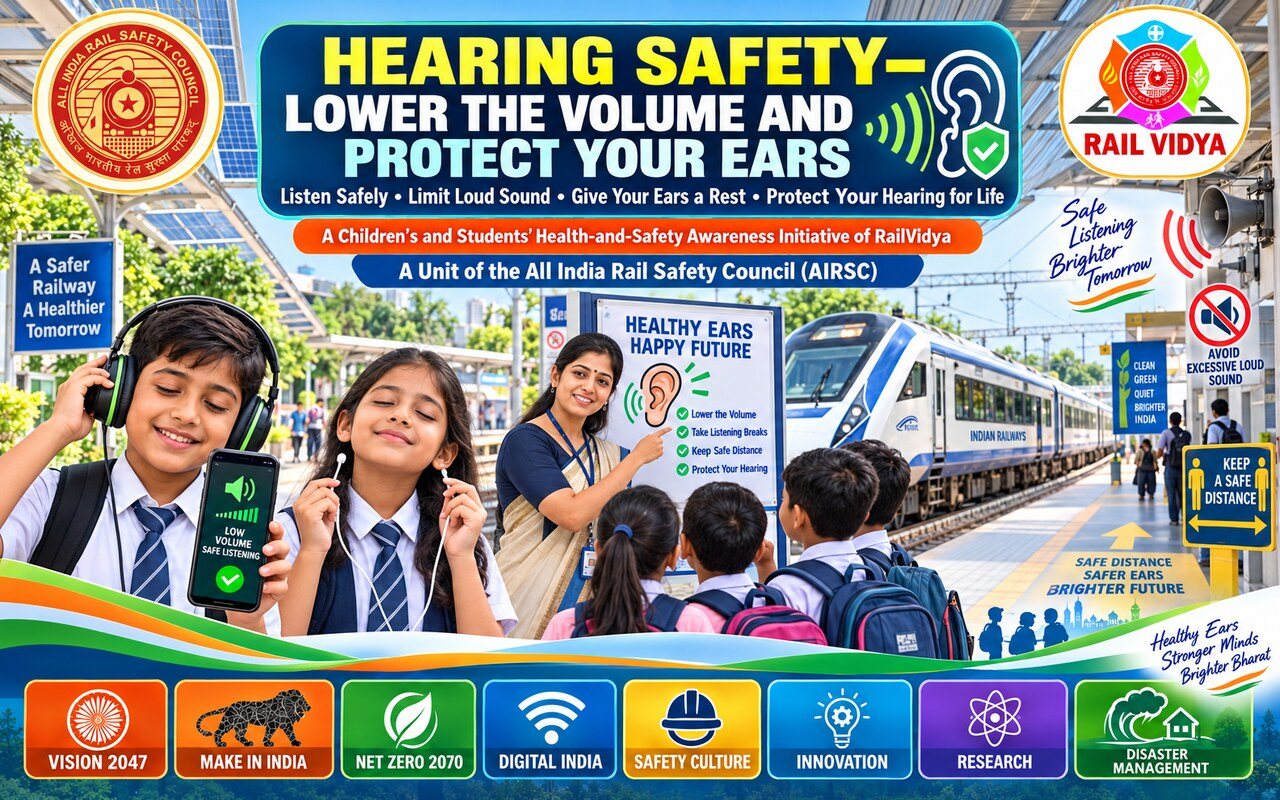
HEARING SAFETY—LOWER THE VOLUME AND PROTECT YOUR EARS Listen Safely • Limit Loud Sound • Give Your Ears a Rest • Protect Your Hearing for Life
Hearing Safety—Lower the Volume and Protect Your
Ears
Listen Safely •
Limit Loud Sound • Give Your Ears a Rest • Protect Your Hearing for Life
A Children’s and Students’
Health-and-Safety Awareness Initiative of RailVidya
A Unit of the All India Rail Safety Council (AIRSC)
Hearing helps children communicate, understand lessons, enjoy music, recognise warnings and remain aware of their surroundings. However, headphones, earphones, loud music, celebrations, traffic, machinery and other powerful sounds can gradually damage the delicate structures of the inner ear. Through this awareness initiative, RailVidya encourages children and students to practise safe listening, reduce unnecessary exposure to loud sounds and report early signs of hearing difficulty.
Noise-related hearing damage may develop gradually without obvious pain. It can also occur after a single extremely loud sound. Once noise-induced hearing loss has occurred, it may be permanent; however, much of it can be prevented through responsible listening habits. WHO safe-listening guidance
Understanding How Loud Sound Affects Hearing
The inner ear contains delicate sensory cells that help convert sound into signals understood by the brain. Excessively loud sound can damage these cells. The risk depends on both the loudness of the sound and the length of exposure—the louder the sound, the shorter the time it can be heard safely.
Children should not assume that a sound is safe simply because it does not cause immediate pain. Repeated exposure to loud music or environmental noise can gradually affect hearing. Noise-related damage may cause muffled hearing, ringing in the ears or difficulty understanding speech, particularly in crowded environments.
Hearing is essential for speech development, communication, classroom learning and social participation. Even limited hearing difficulty can affect a child’s ability to follow lessons, recognise instructions and interact confidently with others. CDC: Preventing Noise-Induced Hearing Loss
Keep the Volume at a Safer Level
Children should keep the volume of headphones, earphones, televisions, gaming devices and music systems at a comfortable level. The World Health Organization advises setting personal audio devices to no more than approximately 60% of their maximum volume as a practical safe-listening measure.
The safest volume may vary according to the device, headphones and listening environment. Students should use built-in safe-listening features and volume warnings where available. If the sound can be heard clearly without approaching the maximum setting, there is no reason to increase it.
If a person sitting nearby can clearly hear the sound coming from a child’s headphones, the volume may be unnecessarily high. Parents and teachers should help younger children establish appropriate settings.
Limit Listening Time
Volume and duration work together. Even a moderate sound may become harmful when heard continuously for a long period. Children should take regular listening breaks and allow their ears to rest in a quiet environment.
Students should not wear headphones throughout the entire day for online classes, gaming, music and entertainment without breaks. Device-free periods support hearing, concentration, healthy movement and communication with family members.
After attending a loud event, children should spend some time in a quieter environment. If hearing feels dull or the ears begin ringing, further loud-sound exposure should be avoided and a responsible adult should be informed.
Choose Well-Fitted Listening Devices
Headphones and earphones should fit comfortably and should not require excessive volume to produce clear sound. Poorly fitting earphones may encourage a child to increase the volume to overcome surrounding noise.
Well-fitted or noise-reducing headphones can help listeners hear content at a lower level in noisy surroundings. However, noise cancellation should not be used where children need to hear traffic, railway warnings, alarms or public announcements.
Headphones must be cleaned according to the manufacturer’s instructions. Earphones should not be shared because they can transfer earwax, bacteria or other contaminants.
Never Use Headphones While Crossing Roads
Children should remove or pause headphones before crossing a road, walking through a parking area or moving near vehicle entrances. Music and noise cancellation can prevent them from hearing horns, bicycle bells, reversing alarms and approaching traffic.
Before crossing, students should stop at a safe location, look carefully in every relevant direction, listen for vehicles and use a designated pedestrian facility wherever available. Full attention must remain on the road until the crossing is complete.
A child should never rely only on hearing, because some vehicles may approach quietly. Safe crossing requires both careful observation and awareness of surrounding sounds.
Railway and Metro Hearing Safety
Railway and metro environments contain safety announcements, train-arrival warnings, door-closing tones and emergency alarms. Children must keep headphone volume low enough to hear these important signals. Ideally, headphones should be removed while boarding, alighting or moving through a crowded station.
Children should never stand close to platform edges or railway tracks while listening to audio. Headphones can prevent them from hearing approaching trains, whistles and instructions from authorised personnel.
Train horns and certain railway sounds can be extremely loud. Children should remain in designated passenger areas and follow official instructions. They must never enter railway tracks or restricted areas in an attempt to observe, photograph or record trains.
Safe Listening Inside Trains and Metro Coaches
Inside a train or metro, passengers may increase headphone volume to overcome background noise. This can create unnecessary hearing risk. Students should instead use well-fitted headphones, activate appropriate sound-limiting settings or wait until the surroundings are quieter.
Headphones should not prevent children from hearing station announcements, emergency messages or directions from parents, teachers and transport personnel. They should remain alert throughout the journey.
Children should also respect fellow passengers by keeping device speakers quiet and using headphones at an appropriate volume. Loud public audio can disturb others and may interfere with important announcements.
Loud Events, Festivals and Celebrations
Concerts, sporting events, cinemas, festivals, wedding celebrations and firework displays may produce very loud sounds. Children should remain at a reasonable distance from loudspeakers, amplifiers, fireworks and other major noise sources.
Hearing protection such as correctly fitted earplugs or protective earmuffs may be appropriate when loud sound cannot be avoided. These products should be selected and used with adult guidance. Improvised objects should never be pushed into the ear.
Children should take periodic breaks in a quiet area and avoid standing directly beside speakers. If the environment is so loud that people must shout to communicate at a short distance, additional protection or greater distance from the sound source is sensible. CDC hearing-loss prevention guidance
Firecrackers, Sirens and Sudden Loud Sounds
Firecrackers, air horns, sirens and exploding objects can produce sudden, intense sound capable of causing immediate damage. Children should never light firecrackers close to another person, hold noisy devices near someone’s ears or use loud sounds as a prank.
During celebrations, children should remain under responsible adult supervision, maintain a safe distance and use suitable hearing protection where necessary. Firecracker safety must also include protection from burns, smoke and eye injuries.
If an unexpected loud sound occurs, children should move away from the source without running into another danger. Covering the ears temporarily may help until a safer distance is reached.
School and Classroom Hearing Safety
Classrooms should support clear communication without unnecessary shouting or excessive noise. Students should listen respectfully, avoid banging desks and never activate loud alarms or sound devices as a joke.
During online classes, the volume should be adjusted to the lowest comfortable level. Headphones should fit properly, and regular breaks should be included. If a child repeatedly increases the volume because speech is unclear, the problem should be discussed with a teacher, parent or healthcare professional.
Music rooms, workshops, science laboratories and vocational-training areas may contain louder equipment. Students should follow all safety instructions and use hearing protection when required.
Safe Use of Toys and Electronic Devices
Electronic toys, musical devices and gaming equipment can produce unexpectedly loud sounds, particularly when held close to the ear. Children should avoid placing speakers directly against their ears.
Parents should check the sound settings of toys and devices intended for younger children. Damaged products that produce sudden or distorted noise should not be used until they have been safely examined or replaced.
No child should intentionally shout, whistle or operate a sound-producing object close to another person’s ear.
Avoid Cleaning the Ear Canal with Objects
Children should never insert cotton buds, pencils, pins, matchsticks, earbuds or other objects into the ear canal. These can push earwax deeper, injure the skin or damage the eardrum.
Earwax normally helps protect the ear. If a child experiences blockage, pain, discharge or reduced hearing, the ear should be examined by a qualified healthcare professional. Unverified drops, oils or home remedies should not be placed in the ear without appropriate medical advice.
The outside of the ear may be cleaned gently, but the ear canal should not be explored or scraped.
Recognise the Warning Signs
Children should inform a parent, teacher or responsible adult if they experience:
- Ringing, buzzing or whistling in the ears
- Muffled or unclear hearing after loud-sound exposure
- Ear pain, pressure or unusual discomfort
- Difficulty understanding conversations
- Frequently asking people to repeat themselves
- Needing unusually high television or headphone volume
- Trouble hearing classroom instructions
- Discharge, bleeding or a foreign object in the ear
- Dizziness or balance difficulties associated with ear symptoms
Persistent ringing or difficulty hearing conversations should be professionally assessed. The WHO recommends seeking medical advice when such warning signs occur. WHO: Tips for Safe Listening
Sudden hearing loss, severe pain, bleeding, significant injury or hearing difficulty following an explosion or extremely loud sound requires prompt medical attention.
Do Not Ignore Temporary Hearing Changes
A child may notice that hearing feels dull after a celebration, concert or prolonged headphone use. Even if the sensation later improves, it indicates that the sound exposure may have been too intense.
The child should avoid further loud sound, inform a trusted adult and seek professional guidance if symptoms persist or recur. Repeated episodes should never be accepted as a normal consequence of entertainment.
Protect Children with Existing Hearing Needs
Children who use hearing aids, cochlear implants or other hearing-support devices should follow the individual guidance of their audiologist, doctor and device manufacturer. They may require personalised precautions in noisy environments.
Schools should provide suitable seating, clear communication and necessary learning support. Students must treat hearing devices with respect and must never tease, touch or remove another child’s device.
Inclusive hearing safety recognises that every child has the right to receive announcements, instructions and educational information in an accessible form.
Responsible Use of Volume-Monitoring Technology
Many phones and audio devices can monitor listening volume and notify users when sound exposure may be excessive. Children should not ignore or disable these warnings without appropriate adult guidance.
Parents can activate volume limits, review listening reports and select devices with recognised safe-listening features. Monitoring tools can support safer habits, but children should still pay attention to discomfort and environmental conditions.
The Role of Parents, Teachers and Schools
Parents and teachers should demonstrate healthy listening habits by keeping volumes comfortable, taking breaks and using hearing protection in noisy places. Children are more likely to adopt safe behaviour when they observe adults protecting their own hearing.
Schools can include hearing conservation in health education, music instruction, laboratory safety and travel-awareness programmes. Any hearing screening should be conducted according to appropriate professional standards, and concerns should be referred to qualified healthcare or hearing specialists.
Adults should respond promptly when a child reports ringing, pain or difficulty hearing. Early attention can help identify medical conditions, prevent further exposure and provide appropriate support.
Good hearing allows children to learn, communicate, enjoy music and recognise important safety warnings. Protecting it should begin early and continue throughout life. Safe listening does not mean avoiding music or technology; it means enjoying sound at a reasonable volume, for a reasonable duration and in a responsible environment.
RailVidya encourages children and students to become Young Hearing-Safety Ambassadors by lowering the volume, taking regular breaks, protecting their ears in noisy places and reminding friends that hearing is precious.
RailVidya Safety Messages
“Lower the Volume Today—Protect Your Hearing for Tomorrow.”
“The Louder the Sound, the Shorter the Safe Listening Time.”
“Give Your Ears a Break—Quiet Time Protects Hearing.”
“Remove Headphones Near Roads, Railway Tracks and Platforms.”
“Listen with Care • Recognise the Warning Signs • Seek Help Early.”