Observe Carefully • Act Responsibly • Support One Another • Keep Every School Safe RailVidya – Empowering Students to Become Leaders of Safety, Responsibility and Positive Change
Students Role in a School SAFE Culture
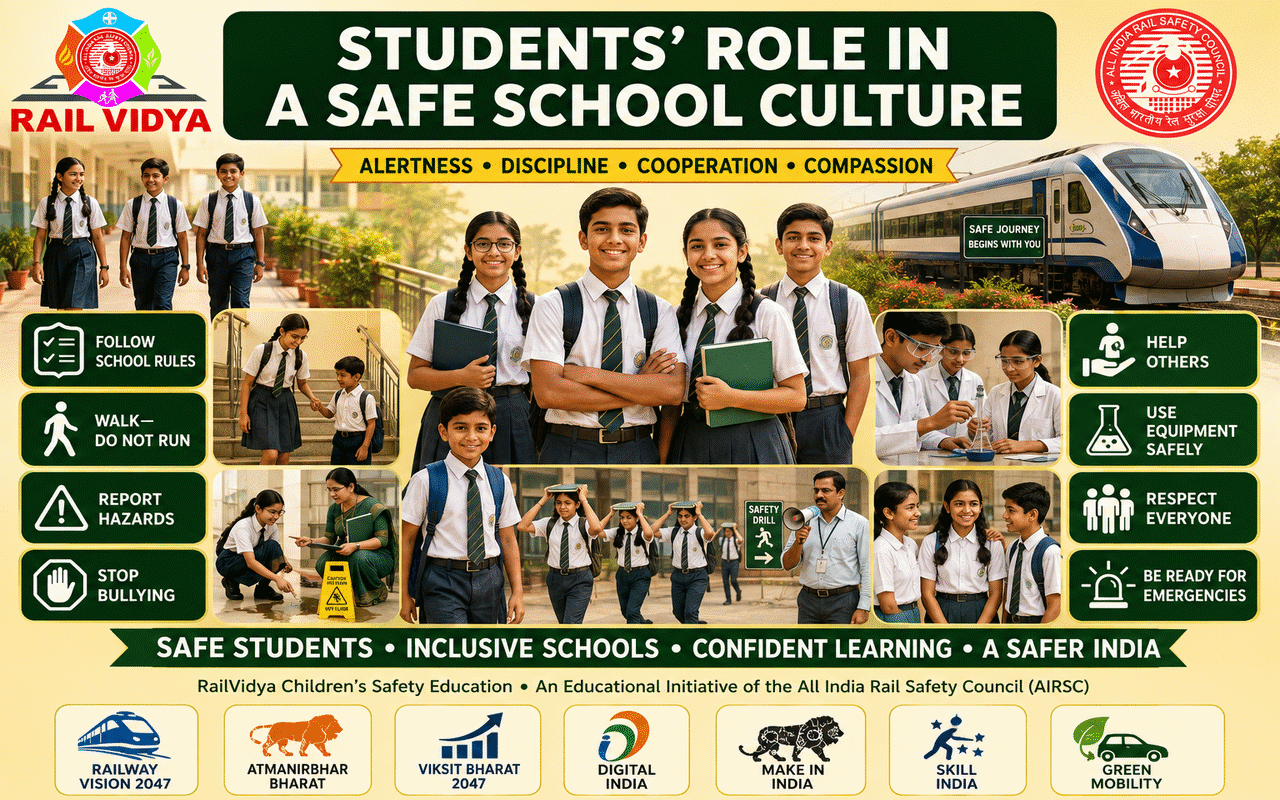
A safe school culture is created when every member of the school community shares responsibility for protecting life, preventing harm and promoting respectful behaviour. While school management, teachers, parents and support personnel provide essential guidance and protection, students also have a powerful role in making their school safe, inclusive and supportive. Through alertness, discipline, cooperation and compassion, every student can help create an environment in which learning takes place without fear, injury, bullying or discrimination.
Students contribute to school safety by understanding and consistently following established rules. Walking calmly through corridors, using stairways carefully, avoiding running or pushing, handling classroom and laboratory equipment responsibly and remaining within authorised areas are simple actions that prevent accidents. Safety rules must be followed not only when teachers are present but also when students are trusted to manage their own behaviour. True safety awareness is demonstrated through responsible choices made at all times.
A safety-conscious student remains observant and reports hazards before they cause harm. Wet floors, broken furniture, damaged electrical wires, blocked emergency exits, unsafe playground equipment, leaking water, unusual smells or suspicious objects should never be ignored. Students must avoid touching, moving or attempting to repair dangerous items. The correct response is to keep a safe distance and immediately inform a teacher, school administrator or authorised staff member.
Preventing bullying, harassment and discrimination is an essential part of creating a safe school culture. Safety includes emotional and psychological well-being as well as physical protection. Students should never use insulting language, threaten others, spread rumours, exclude classmates deliberately or misuse social media to embarrass or intimidate someone. They must refuse to encourage or silently support bullying and should report harmful conduct to a trusted adult. Speaking up responsibly is an act of courage and care—not a betrayal of friendship.
Respectful relationships strengthen safety throughout the school. Students should treat classmates, teachers, support staff and visitors with dignity, patience and consideration. Differences in language, culture, religion, ability, appearance or economic background must never become reasons for ridicule or exclusion. A genuinely safe school ensures that every child, including younger students and children with disabilities, feels welcomed, valued and protected.
Students must also take emergency preparedness seriously. Fire drills, evacuation exercises, disaster-management activities and first-aid demonstrations are designed to prepare the school community for real situations. During such exercises, students should remain calm, follow instructions, use designated evacuation routes, avoid pushing and assemble at the assigned location. Emergency drills should never be treated as entertainment, because disciplined participation develops the confidence and readiness required to protect lives.
Responsible use of school facilities and resources is another important student duty. Classrooms, laboratories, libraries, sports grounds, buses, drinking-water facilities and sanitation areas must be used carefully and kept clean. Damaging school property, tampering with safety equipment or misusing fire extinguishers and emergency alarms can place the entire school community at risk. Protecting public and institutional property reflects maturity, civic responsibility and respect for the educational environment.
Travel to and from school is also part of school safety culture. Students should use safe routes, follow traffic signals, walk on footpaths, cross only at authorised locations and avoid mobile-phone or earphone use while crossing roads. Those travelling by school bus must board and alight in an orderly manner, remain seated, avoid distracting the driver and follow the instructions of the attendant. Students who travel near railway tracks, stations, metro premises or level crossings must remain especially alert and follow all authorised safety procedures.
Digital responsibility is increasingly important in maintaining a safe school environment. Students should protect passwords and personal information, communicate respectfully and avoid opening suspicious links or sharing harmful content. Photographs, videos or personal details of classmates should never be posted without permission. Cyberbullying, impersonation, online threats and inappropriate communication must be reported promptly to parents, teachers or designated school authorities.
Students can strengthen safety further by participating in school safety clubs, awareness campaigns, peer-support programmes, emergency-preparedness activities and community outreach initiatives. They can create posters, conduct safety observations, share important messages during assemblies and encourage classmates to adopt responsible behaviour. Senior students may also support younger children by demonstrating safe practices and guiding them calmly during drills or school activities under staff supervision.
However, students must understand the difference between helping responsibly and placing themselves in danger. They should never enter a hazardous area, confront a violent person, touch suspicious objects or attempt a rescue beyond their training and ability. Their primary responsibility is to move to safety, alert a trusted adult and cooperate with authorised personnel. Responsible reporting is one of the most valuable contributions a student can make.
Students should feel confident in reporting unsafe behaviour without fear of punishment, embarrassment or retaliation. Schools must provide clear and confidential reporting channels and ensure that every concern is treated seriously. At the same time, students must use these systems honestly and never make false allegations, create panic or misuse emergency procedures. Trust and accountability are essential foundations of a strong safety culture.
When students practise discipline, respect rules, identify hazards, reject bullying, protect school property and support vulnerable classmates, they become active partners in safety. Their positive behaviour can influence peers, families and the wider community. Even one responsible action—reporting a damaged wire, helping a younger student, refusing to participate in bullying or reminding friends to follow an evacuation instruction—can prevent harm and protect lives.
A safe school is not created by rules alone; it is created by people who believe in and practise those rules every day. Every student has the power to lead by example and help transform safety from an institutional requirement into a shared value. Through awareness, responsibility, cooperation and compassion, students can build schools where everyone feels secure, respected and empowered to learn.
Observe Carefully • Act Responsibly • Support One Another • Keep Every School Safe
RailVidya – Empowering Students to Become Leaders of Safety, Responsibility and Positive Change
© 2026 Dr.R.Padmanabhan. All Rights Reserved.
Chairman — All India Rail Safety Council (AIRSC)
Promoting Railway Safety, Education and Public Awareness
Email: admin@railsafety.co.in | Website: www.railsafety.co.in/ www.railsafety.in/ www.airsc.in