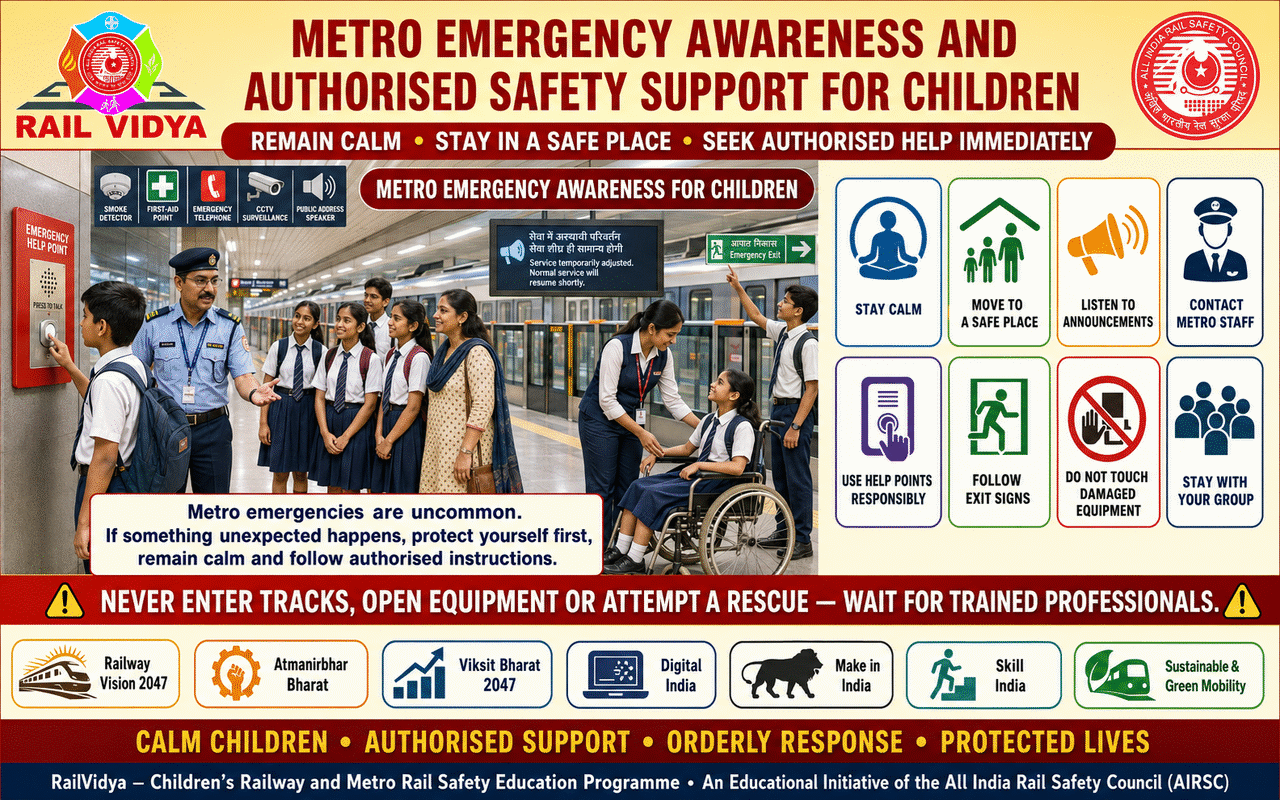
Metro Emergency Awareness and Authorised Safety Support education prepares children to remain calm, stay with their group, follow official instructions and seek help from verified metro staff, security personnel, police officers or recognised assistance points. Through RailVidya, children learn to avoid suspicious objects and restricted areas, never attempt unsafe interventions, communicate emergencies clearly and remain in visible public locations if separated from family. This knowledge builds confident, responsible young passengers who can respond safely without panic or unnecessary risk.
Metro Emergency Awareness and Authorised Safety
Support for Children
Metro Emergency Awareness for Children
Metro emergency awareness gives children the basic knowledge, confidence and judgement needed to respond safely during an unexpected situation. Emergencies within metro systems are uncommon, but a child may encounter service interruptions, medical incidents, smoke, fire, damaged equipment, overcrowding, separation from family members or another potentially unsafe condition. Through RailVidya – Children’s Railway and Metro Rail Safety Education Programme, an educational initiative of the All India Rail Safety Council (AIRSC), children are taught three essential principles: remain calm, stay in a safe place and seek authorised help immediately.
Children should understand that remaining calm is the first step in a safe emergency response. Panic, running, pushing or following a crowd without direction can create additional danger. Children should stay close to their parent, teacher, guardian or authorised group leader and listen carefully to official announcements and instructions from metro personnel, security staff or emergency responders.
An emergency does not always involve visible danger. A sudden train stoppage, power interruption, evacuation announcement, unattended object or unusual smell may require precautionary action. Children should avoid making assumptions or spreading unverified information. The safest response is to inform a responsible adult and wait for guidance from authorised personnel.
If smoke, fire, sparks, damaged equipment or another immediate hazard is noticed, children should move away without touching or approaching the source. They should promptly alert their accompanying adult or use an authorised passenger-communication facility with adult guidance where possible. A clear report should describe what was observed and where it occurred.
Children must never touch, open, move or investigate an unattended or suspicious object. They should maintain a safe distance, warn the accompanying adult and inform authorised metro or security personnel. Taking photographs, recording videos or gathering around the object can expose people to unnecessary risk and obstruct a professional response.
If a passenger becomes ill or injured, children should call the attention of a responsible adult or authorised employee. They should not crowd around the person, administer medication or attempt a procedure for which they have not been trained. Keeping the area clear helps qualified personnel reach the passenger quickly.
Emergency alarms, intercoms, help points and communication buttons are provided for genuine safety needs. Children should recognise these facilities but must never activate them for entertainment, curiosity or false reporting. Misuse can disrupt services and divert assistance from a real emergency. When their use is necessary, children should communicate calmly and follow the operator’s instructions.
If a train stops between stations, children must remain inside unless authorised personnel specifically direct passengers to evacuate. Train doors must not be forced open, and children should never enter a tunnel or track area independently. Metro tunnels may contain electrical systems, moving trains, engineering equipment and limited escape space.
During an evacuation, children should leave belongings behind if instructed, stay with their group and move calmly through the designated route. They must not use a lift when official directions require emergency stairways, nor return for a forgotten item. Emergency exits and passages should remain clear for other passengers and responders.
If a child becomes separated from a parent or school group, the child should not board another train independently, cross between platforms through restricted areas or leave the station with an unknown person. The safest action is to remain in a visible, well-lit public area and approach authorised metro staff, security personnel, police officers or a recognised help desk.
Children should know their own name, the name of the responsible adult and an appropriate contact number. Where suitable, younger children may carry a securely prepared identification card. Personal information should be disclosed only to verified personnel assisting with the emergency or separation.
Parents and teachers should establish a simple emergency and separation plan before travelling. School groups should maintain updated lists, emergency contacts, medical information where properly authorised, assigned supervisors and regular headcounts. Preparation enables adults to protect children more effectively during unfamiliar situations.
Children should also understand that emergency instructions may differ according to the metro system, station design and nature of the incident. Only official announcements and directions from authorised personnel should be followed. Emergency and security numbers published in RailVidya materials must be currently valid and verified with the relevant metro operator or public authority.
As India’s metro systems expand under Viksit Bharat 2047, age-appropriate emergency education must advance alongside infrastructure and technology. A prepared child is not expected to manage an emergency independently; rather, the child is empowered to avoid additional danger, communicate clearly and seek the right assistance.
Through RailVidya, AIRSC seeks to build calm, informed and safety-conscious young passengers. Emergency awareness transforms uncertainty into responsible action and helps protect children, families and the wider travelling public.
Remain Calm • Stay with Your Group • Follow Official Instructions • Seek Authorised Help
Top of Form
© 2026 Dr.R.Padmanabhan. All Rights Reserved.
Chairman — All India Rail Safety Council (AIRSC)
Promoting Railway Safety, Education and Public Awareness
Email: admin@railsafety.co.in | Website: www.railsafety.co.in/ www.railsafety.in/ www.airsc.in
Metro Emergency Awareness and Authorised Safety Support education prepares children to remain calm, stay with their group, follow official instructions and seek help from verified metro staff, security personnel, police officers or recognised assistance points. Through RailVidya, children learn to avoid suspicious objects and restricted areas, never attempt unsafe interventions, communicate emergencies clearly and remain in visible public locations if separated from family. This knowledge builds confident, responsible young passengers who can respond safely without panic or unnecessary risk.
Bottom of Form