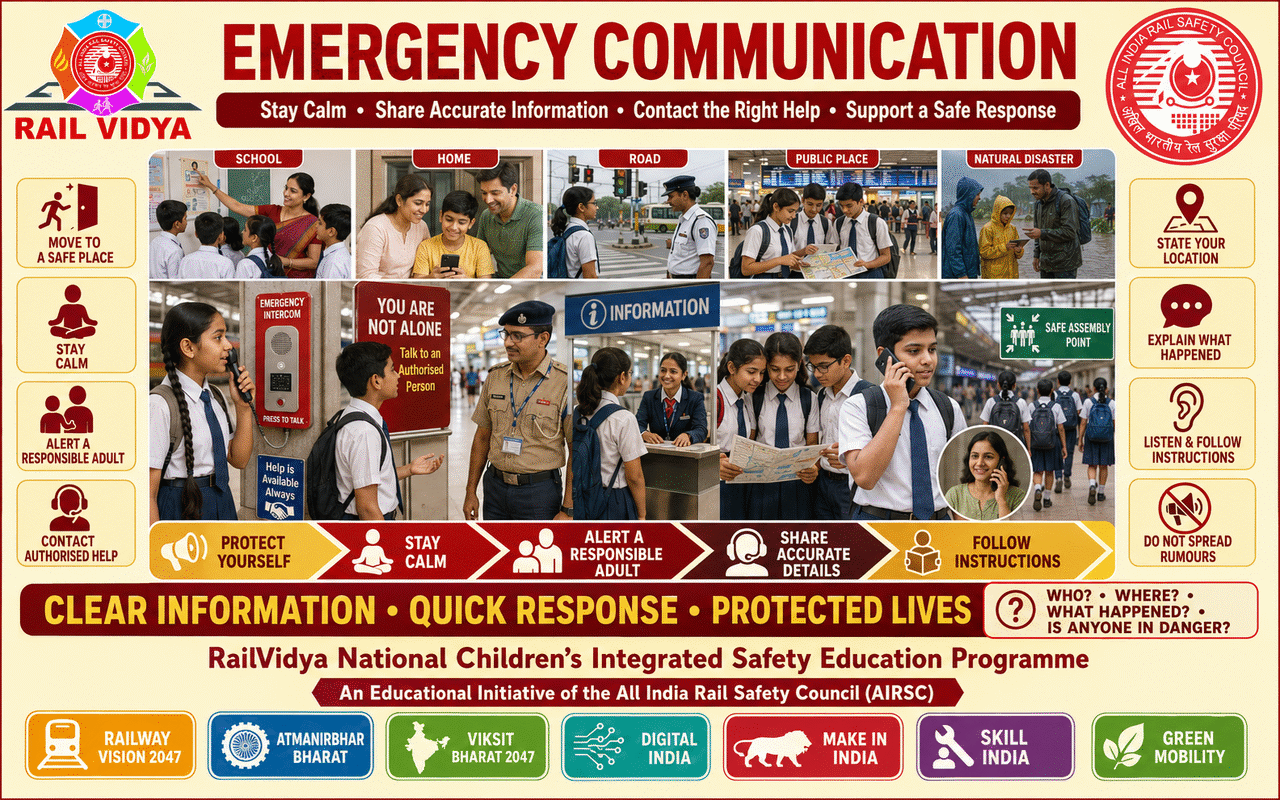
Stay Calm • Share Accurate Information • Contact the Right Help • Support a Safe Response Protect Yourself First • Report Clearly • Follow Official Instructions • Never Spread Rumours Right Information • Right Person • Right Time • Faster and Safer Response
Emergency Communication
Stay Calm
• Share Accurate Information • Contact the Right Help • Support a Safe Response
Emergency communication is the timely, clear and responsible exchange of information before, during and after a dangerous or unexpected incident. Whether an emergency occurs at school, at home, on the road, during a railway or metro journey, in a public place or during a natural disaster, effective communication can reduce confusion, prevent panic, guide rescue services and protect lives. Students must therefore learn not only whom to contact, but also how to communicate essential information calmly and accurately.
The RailVidya National Children’s Integrated Safety Education Programme, an educational initiative of the All India Rail Safety Council (AIRSC), recognises emergency communication as an essential element of children’s integrated safety education. The programme helps students understand that the first responsibility during any emergency is to protect themselves from immediate danger, remain as calm as possible and alert a responsible adult or authorised emergency service without unnecessary delay.
When reporting an emergency, students should provide clear and factual information. They should state their name, describe what has happened, identify the exact location, mention the number of people who may require assistance and explain whether there are continuing dangers such as fire, smoke, electrical hazards, moving traffic, damaged structures, suspicious objects or railway tracks. If the precise address is unknown, nearby landmarks, station names, platform numbers, coach numbers, road signs or location details from an authorised digital map may help responders find the incident quickly.
Students should be familiar with India’s unified emergency-response number, 112, and understand that emergency numbers must be used only for genuine situations. Depending on the incident, assistance may also be sought from teachers, parents, police personnel, railway or metro officials, station staff, security personnel, medical teams and disaster-response authorities. Making prank calls, circulating false alarms or obstructing emergency communication can delay assistance to people facing real danger and may result in serious consequences.
Communication during a railway or metro emergency requires particular care. Students should immediately inform authorised personnel if they notice smoke, fire, an unattended suspicious object, damaged equipment, unsafe behaviour, a person on or near the tracks, or any other immediate danger. Emergency alarms, help points, intercoms and passenger-assistance systems should be used only when necessary and according to official instructions. Children must never enter railway tracks, restricted zones or dangerous areas in an attempt to conduct a rescue themselves.
During fires, accidents, severe weather, earthquakes or evacuation situations, students should listen carefully to announcements and follow the directions of teachers, emergency responders and authorised officials. Messages should be short, accurate and easy to understand. Rumours, unverified photographs, distressing videos and misleading social-media posts must not be circulated, as they can create fear, interfere with rescue operations and cause additional harm. Only information issued by trusted authorities should be accepted and shared.
Digital communication can be valuable when normal communication systems are disrupted. Students may use a charged mobile phone to call for help, send a concise safety message or share an accurate location with a trusted adult. However, they should avoid unnecessary calls that may overload networks. A simple message confirming their safety, location and immediate needs may be more effective. Families and schools should establish emergency contact lists, meeting points, alternative communication methods and procedures for situations in which students become separated from their group.
Good emergency communication also includes listening, confirming and cooperating. Students should listen without interrupting, repeat important instructions when necessary and avoid making assumptions. If information changes, responders should be updated immediately. A child who does not know an answer should say so honestly rather than provide uncertain or incorrect details.
After an emergency, communication remains important. Students should inform parents or guardians through authorised channels, cooperate with school or public authorities and avoid posting personal details, photographs of injured persons or sensitive information online. Respectful and privacy-conscious communication helps protect affected individuals and prevents misinformation.
Through practical training, demonstrations, role-play exercises and emergency drills, RailVidya aims to develop students who can communicate responsibly under pressure. A calm and informed child can alert the right people, provide valuable information, follow safety instructions and help prevent a difficult situation from becoming more dangerous.
Protect Yourself First • Report Clearly • Follow Official Instructions • Never Spread Rumours
Right Information • Right Person • Right Time • Faster and Safer Response
© 2026 Dr.R.Padmanabhan. All Rights Reserved.
Chairman — All India Rail Safety Council (AIRSC)
Promoting Railway Safety, Education and Public Awareness
Email: admin@railsafety.co.in | Website: www.railsafety.co.in/ www.railsafety.in/ www.airsc.in