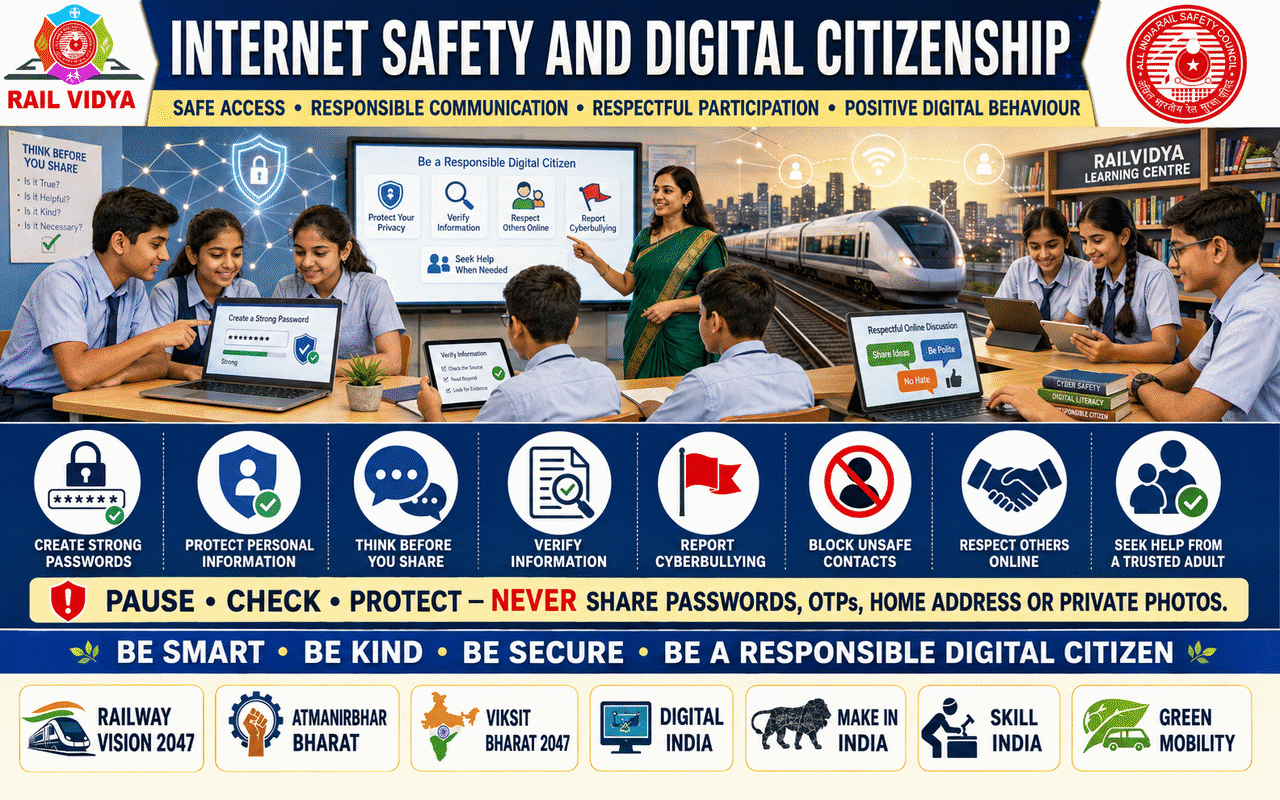
Internet Safety and Digital Citizenship, promoted through the RailVidya National Children’s Integrated Safety Education Programme of the All India Rail Safety Council (AIRSC), teaches students to use digital technology safely, ethically and responsibly. By protecting personal information, verifying content, avoiding suspicious interactions, preventing cyberbullying and maintaining healthy screen habits, children can become confident, respectful and responsible digital citizens who contribute to a safer and more positive online community.
Internet Safety and Digital Citizenship
Safe
Access • Responsible Communication • Respectful Participation • Positive
Digital Behaviour
The internet has become an important part of modern education, communication and everyday life. It enables students to access knowledge, attend online classes, develop new skills, collaborate with others and explore opportunities beyond the classroom. However, the digital world also presents risks such as cyberbullying, misinformation, privacy breaches, harmful content, online manipulation, identity theft, excessive screen use and unsafe interaction with strangers. Internet-safety education is therefore essential for helping children use technology confidently, responsibly and securely.
The RailVidya National Children’s Integrated Safety Education Programme, an educational initiative of the All India Rail Safety Council (AIRSC), recognises internet safety and digital citizenship as vital components of integrated child-safety education. The programme aims to develop students who understand not only how to protect themselves online but also how to participate in digital spaces with honesty, respect, responsibility and sound judgement.
A responsible digital citizen uses technology in a lawful, ethical and constructive manner. Students must learn that the same values expected in schools, homes and communities—respect, discipline, kindness, honesty and accountability—must also guide their online behaviour. Social media posts, photographs, comments, messages and shared content can create a lasting digital footprint. Before publishing or forwarding anything, students should consider whether it is accurate, respectful, necessary and safe.
Protecting personal information is one of the foundations of internet safety. Children should avoid publicly sharing their home address, telephone number, school details, passwords, identification documents, travel plans, financial information or live location. Strong and unique passwords should be used for important accounts, while multi-factor authentication should be activated wherever possible. Privacy settings must be reviewed regularly, and unknown friend requests, suspicious links, unverified applications and unexpected downloads should be treated with caution.
Students must also understand that people encountered online may not always be who they claim to be. Communication with strangers, requests for private photographs, secret conversations, offers of gifts and attempts to arrange in-person meetings are serious warning signs. Children should never respond to pressure, threats or manipulation. Any uncomfortable or suspicious interaction should be stopped, recorded where appropriate and reported immediately to a parent, teacher, guardian or another trusted adult.
Digital citizenship includes the ability to distinguish reliable information from false or misleading content. Students should verify online claims by checking the author, date, evidence and source before accepting or sharing them. Sensational headlines, manipulated images, fabricated videos and forwarded messages can create fear, confusion and social harm. Responsible users pause, investigate and confirm facts through trustworthy and authoritative sources.
Cyberbullying, harassment and exclusion can seriously affect a child’s emotional well-being. Students should never create, circulate or support humiliating comments, private images, rumours or threatening messages. They must learn to block abusive accounts, preserve relevant evidence and seek adult assistance instead of responding aggressively. A responsible digital citizen also supports others by reporting harmful conduct and promoting kindness, dignity and inclusion in online communities.
Healthy technology use is equally important. Excessive screen time can interfere with sleep, study, physical activity, family interaction and emotional health. Students should develop balanced routines, take regular breaks, maintain correct posture and avoid using digital devices while walking, crossing roads, boarding transport or standing near railway and metro environments. Attention diverted by a screen can quickly become a serious physical-safety risk.
Parents, teachers and schools share responsibility for creating a safe and supportive digital-learning environment. Open communication, age-appropriate supervision, clear technology rules and regular internet-safety discussions can help children seek assistance without fear or embarrassment. Students should understand that reporting an online problem is not a sign of weakness; it is a responsible step that may protect them and others from further harm.
Through systematic education and practical guidance, RailVidya seeks to empower every student to become a safe, thoughtful and compassionate digital citizen. When children protect their privacy, verify information, communicate respectfully and use technology with purpose, they contribute to a safer internet and a stronger society.
Think Before You Click • Verify Before You Share • Respect Every User • Protect Your Digital Future
Safe Online • Smart Online • Kind Online • Responsible Always
© 2026 Dr.R.Padmanabhan. All Rights Reserved.
Chairman — All India Rail Safety Council (AIRSC)
Promoting Railway Safety, Education and Public Awareness
Email: admin@railsafety.co.in | Website: www.railsafety.co.in/ www.railsafety.in/ www.airsc.in