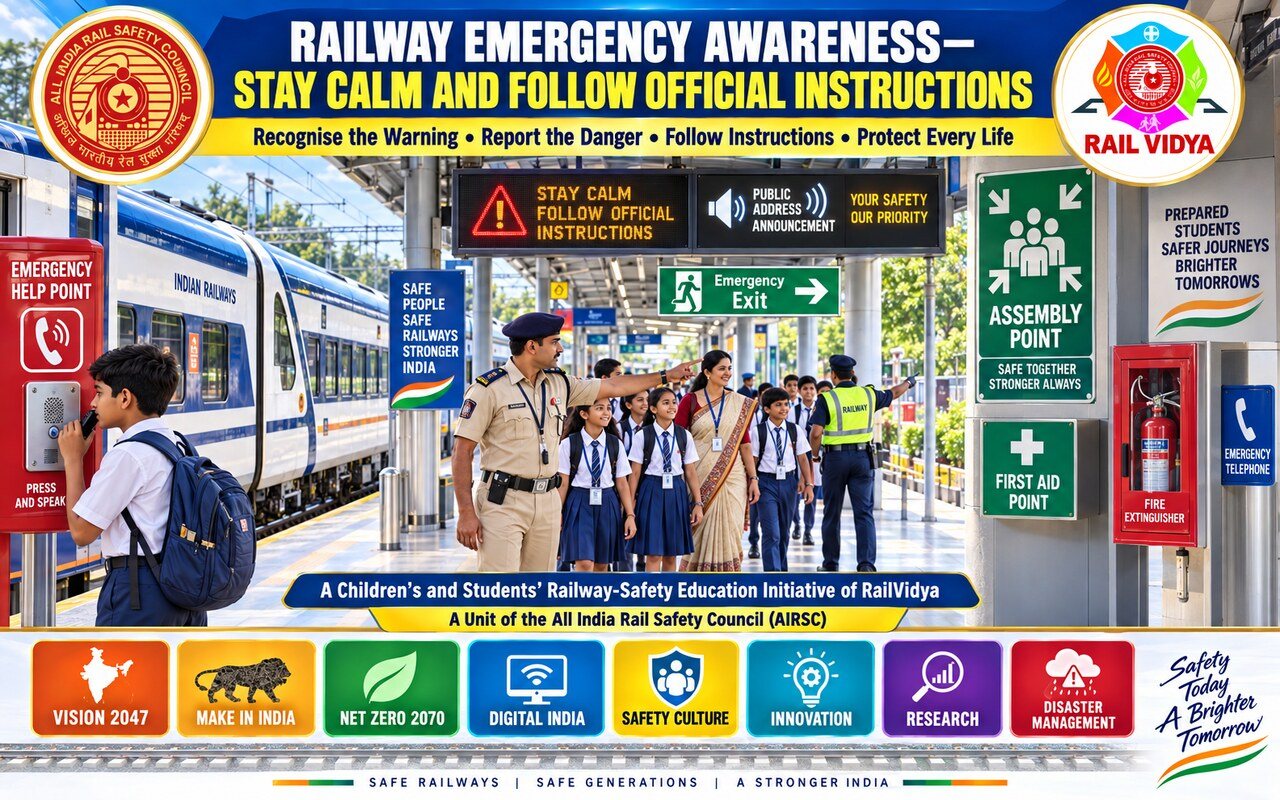
Railway Emergency Awareness—Stay Calm and Follow Official Instructions Recognise the Warning • Report the Danger • Follow Instructions • Protect Every Life A Children’s and Students’ Railway-Safety Education Initiative of RailVidya A Unit of the All India Rail Safety Council (AIRSC)
Railway
Emergency Awareness—Stay Calm and Follow Official Instructions
Recognise the Warning • Report the
Danger • Follow Instructions • Protect Every Life
A Children’s and Students’ Railway-Safety Education Initiative of
RailVidya
A Unit of the All India Rail Safety Council (AIRSC)
Railway emergencies can occur unexpectedly inside trains, at stations, on platforms or near railway infrastructure. Fire, smoke, medical incidents, electrical hazards, overcrowding, unattended objects, sudden train stoppages and evacuation announcements may cause fear or confusion. Through this awareness initiative, RailVidya helps children and students recognise warning signs, remain calm, locate authorised assistance and respond safely without creating panic or placing themselves in additional danger.
Children should understand that calm and disciplined behaviour is one of the most important protections during an emergency. Panicking, running blindly, pushing other passengers or acting on rumours can make a difficult situation more dangerous. Students should pause, observe their surroundings, remain close to their responsible adult and listen carefully to official announcements and instructions.
Recognising a Railway Emergency
A railway emergency may involve visible smoke or flames, sparks, a burning smell, a serious medical condition, an accident, damaged electrical equipment, a suspicious object, dangerous crowd movement or an official instruction to evacuate. An unusual train stoppage does not always mean that an emergency has occurred; trains may stop because of signals, operational requirements or temporary technical conditions.
Children should not make assumptions or spread unverified information. If they notice something unusual, they should promptly inform a parent, guardian, teacher or authorised railway official. Reporting an observation clearly and calmly allows trained personnel to assess the situation and take appropriate action.
Recognising Alarms and Warning Announcements
Railway and metro systems may use alarms, warning tones, flashing lights, display boards and public-address announcements to alert passengers. Children should pay attention whenever an alarm sounds or an announcement is made. Headphones should be kept at a volume that allows important instructions to be heard.
Students should not imitate alarms, make false emergency announcements or activate warning systems as a joke. Misuse can create panic, disrupt operations and delay assistance for people facing a genuine emergency. Every alarm and emergency device must be treated seriously and responsibly.
If an announcement cannot be understood, children should ask their accompanying adult or an authorised official for guidance. They should never follow instructions received from rumours, unauthorised individuals or unverified social-media posts during an emergency.
Identifying Authorised Railway Personnel
Children should learn how to recognise authorised railway and metro personnel. Depending on the system and location, these may include station officials, train crew, ticket-checking staff, railway protection or police personnel, metro security staff, platform controllers, coach attendants, emergency responders and staff positioned at recognised help desks.
Uniforms, identity cards, official counters and marked assistance points can help passengers identify authorised personnel. However, children should remain cautious and avoid leaving a safe public area with an unknown person. When possible, assistance should be requested at a staffed counter, security post or other visible public location.
If a child becomes separated from family or a school group, the child should remain calm, move away from immediate danger and approach authorised personnel. The child should provide their name, the name of the responsible adult, a contact number if known and information about where the separation occurred.
Using Railway and Metro Help Points
Many stations and metro systems provide emergency communication buttons, passenger-assistance points, intercoms, helplines or staffed information counters. These facilities are intended to connect passengers with trained personnel. Children should learn to recognise them during normal travel so that they know where help is available.
Emergency buttons and intercoms must be used only when there is a genuine need. When requesting help, a student should speak clearly and provide the coach number, platform number, station name or another visible location marker when possible. A brief description—such as “there is smoke,” “a passenger has fallen,” or “I am separated from my teacher”—can help staff respond effectively.
After reporting the situation, the child should follow the instructions given and avoid repeatedly operating the device unless communication has failed or the danger has changed.
Emergency Exits and Evacuation Routes
Emergency exits, evacuation routes and assembly points are provided to help passengers move away from danger. Children should notice emergency signs when entering a station or coach, but they must not open, obstruct or misuse emergency exits during normal operations.
An emergency exit should be used only when directed by authorised personnel or when remaining in the location presents an immediate and unmistakable danger. Opening a train door or attempting to leave a stopped train without instructions can expose passengers to moving trains, uneven ground, bridges, tunnels and live electrical equipment.
During an organised evacuation, children should leave non-essential belongings behind if carrying them would cause delay. They should walk calmly, remain with their parent, guardian or teacher and assist younger companions only when it is safe to do so. After reaching the designated safe area, they must remain there until authorised personnel provide further instructions.
Emergency Safety Inside a Train
If a train stops unexpectedly, children should remain inside unless railway personnel instruct passengers to leave or an immediate danger requires evacuation. They must not jump from the train, open doors, climb through windows or enter the railway track area on their own.
Children should keep aisles, doors and connecting passages clear. Bags and luggage must not obstruct emergency movement. Students should stay away from coach doors, electrical cabinets, inter-coach connections and equipment reserved for trained personnel.
Emergency alarms, door-release systems, communication buttons, fire extinguishers and safety hammers should never be touched for amusement. If emergency equipment is required, children should alert an adult or authorised employee and follow their directions.
Fire and Smoke Emergencies
Smoke, flames, sparks or a strong burning smell must be reported immediately. Children should not attempt to locate the source, touch electrical equipment or collect belongings from a dangerous area. They should move away from smoke and follow the directions of railway staff.
If evacuation is ordered, children should move calmly and avoid pushing. They should not hide inside toilets, under seats or behind luggage. Lifts should not normally be used during a fire unless authorised emergency instructions specifically direct their use.
Fire extinguishers should be operated only by people who are trained, when the fire is small, a safe exit remains available and official procedures permit intervention. Raising the alarm and moving to safety are the first priorities.
Medical Emergencies
If a passenger becomes seriously ill, falls, suffers an injury or loses consciousness, children should immediately inform an adult or railway official. They should not crowd around the person, offer unknown medicine or attempt a medical procedure without recognised training and appropriate supervision.
The area should be kept clear so that trained responders can reach the passenger. A student can help by accurately explaining what happened, identifying the location and guiding authorised personnel to the scene. Children trained in first aid should still act only within their level of competence and follow professional instructions.
Electrical Hazards
Railway and metro systems use powerful electrical equipment. Overhead wires, third rails, electrical cabinets, damaged cables, substations and restricted technical areas can cause fatal injury. Children must stay well away and immediately report any damaged, fallen or sparking equipment.
They must never touch a cable, pole, metal object or person who may be in contact with an electrical source. They should also prevent others from approaching, but without placing themselves in danger. Electricity may remain present even when equipment appears inactive.
During an evacuation near railway tracks, students must place their feet only where authorised personnel direct them. They must never approach overhead wires, traction rails or electrical installations.
Suspicious and Unattended Objects
An unattended bag, package, electronic device or suspicious object should never be touched, opened, moved or photographed closely. Children should move away, discourage others from approaching and report the exact location to railway security or station personnel.
Students must not create panic by making public accusations or sharing unverified claims online. Authorised security personnel are trained to examine suspicious objects and determine the appropriate response.
Crowd and Platform Emergencies
Crowded stations and platforms require patience and discipline. Children should stay with their responsible adult, remain behind the platform safety line and avoid pushing towards train doors, exits or stairways. If crowd movement becomes unsafe, they should move towards a less congested area when possible and follow the directions of crowd-control personnel.
Children should not bend down to retrieve a dropped object in a fast-moving crowd. If something falls, they should inform an adult or official and move to safety. They must never sit on stairways, block passageways or move against an organised evacuation flow.
If a Child Becomes Separated
A child who becomes separated during an emergency should not run through the station searching without direction. The child should first move away from immediate danger and then approach a clearly marked help point, staffed counter, police or security post, or an authorised official.
The child should not leave the station with a stranger, even if the person claims to know the family. A pre-agreed family or school safety password can help verify a person sent to assist. Children should know at least one parent or guardian’s contact number and should carry age-appropriate identification without displaying it publicly.
School groups should establish a meeting point, head-count procedure and emergency contact plan before beginning a railway or metro journey.
Do Not Spread Rumours or Record Distressing Scenes
During an emergency, students should not circulate unverified messages, photographs or videos. False information can cause fear, interfere with rescue operations and violate the dignity and privacy of affected passengers.
Children should keep entrances, evacuation routes and emergency areas clear. They must not gather around an incident to watch, take selfies or create social-media content. Their attention should remain on personal safety and official instructions.
Helping Others Without Entering Danger
Children can support safety by staying calm, communicating clearly and alerting trained personnel. They may comfort a younger child, help a companion remain with the group or point officials towards the emergency, provided these actions do not place them at risk.
Students should never enter smoke, touch electrical equipment, move an injured person unnecessarily or return to an unsafe area to recover property. Courage means seeking appropriate help and making a safe decision—not attempting an untrained rescue.
Essential Emergency Information
Children should be encouraged to remember their full name, home address and the contact details of a parent or guardian. During a school journey, they should know the teacher or group leader responsible for them, the destination and the agreed meeting point.
When reporting an emergency, students should try to provide four essential details: what happened, where it happened, whether anyone is injured and what immediate danger remains. Information should be brief, accurate and free from guesses.
Emergency Preparedness Before Travel
Families and schools should discuss emergency procedures before travelling. Children should be shown how to recognise station signs, coach numbers, platform numbers, authorised personnel and public help points. They should understand what to do if transport is delayed, a phone battery fails or the group becomes separated.
School travel plans should include student lists, emergency contacts, medical information where appropriate, adult supervision responsibilities and regular head counts. Children with disabilities or additional support needs should have accessible and personalised emergency arrangements.
The Role of Parents, Teachers and Schools
Parents and teachers should explain emergencies without creating unnecessary fear. Practical demonstrations, supervised station visits, role-play exercises and school-safety drills can help children develop confidence and remember the correct response.
Adults must model responsible conduct by obeying warning signs, respecting barriers, remaining behind platform safety lines and following railway instructions. Children learn safety most effectively when the adults accompanying them demonstrate calm and disciplined behaviour.
A Message from RailVidya
Railway emergency awareness is not about expecting danger; it is about being prepared to respond responsibly if an unexpected situation occurs. A child who can recognise an alarm, locate a help point, identify authorised personnel and follow evacuation instructions is better equipped to protect themselves and support the safety of others.
RailVidya calls upon children and students to become Young Rail Safety Ambassadors by learning emergency procedures, discouraging unsafe conduct and sharing verified safety messages with their families, schools and communities. Preparedness develops confidence, discipline protects passengers and timely reporting can save lives.
RailVidya Safety Messages
“Stay Calm • Recognise the Danger • Report Clearly • Follow Official Instructions.”
“Do Not Panic • Do Not Push • Do Not Spread Rumours.”
“In a Railway Emergency, Trained Help and Disciplined Action Protect Every Life.”