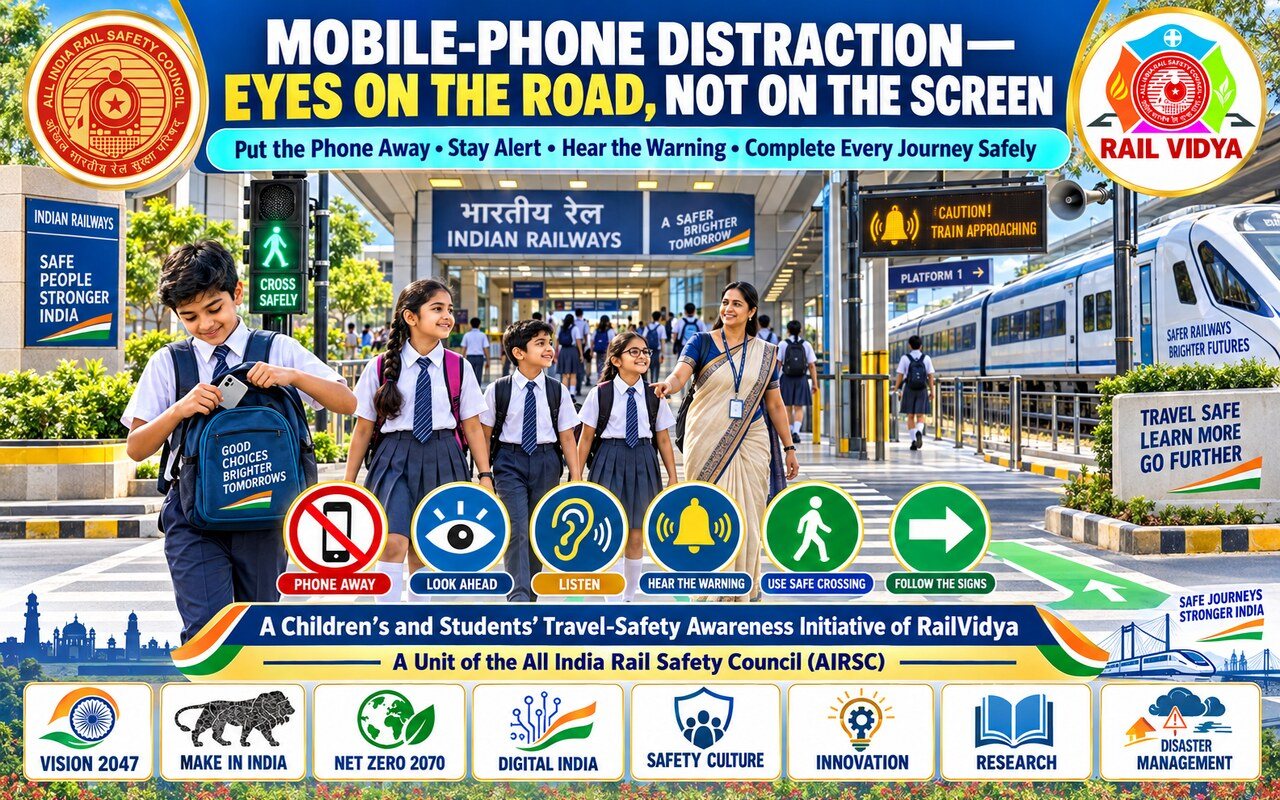
MOBILE-PHONE DISTRACTION—EYES ON THE ROAD- NOT ON THE SCREEN Put the Phone Away • Stay Alert • Hear the Warning • Complete Every Journey Safely A Children’s and Students’ Travel-Safety Awareness Initiative of RailVidya A Unit of the All India Rail Safety Council (AIRSC)
Mobile-Phone Distraction—Eyes on the Road- Not on the Screen
Put the Phone Away • Stay Alert •
Hear the Warning • Complete Every Journey Safely
A Children’s and Students’ Travel-Safety Awareness Initiative of
RailVidya
A Unit of the All India Rail Safety Council (AIRSC)
Mobile phones are valuable tools for education, communication, navigation and emergency assistance. However, using a phone while walking, cycling, crossing a road or moving through a railway or metro station can dangerously reduce attention. A message, video, game or notification may appear harmless, but even a few seconds of distraction can prevent a child from noticing an approaching vehicle, warning signal, platform edge or sudden change in traffic.
Through this awareness initiative, RailVidya encourages children and students to develop a simple but life-protecting habit: stop using the phone whenever the surroundings require full attention. No call, message, photograph or social-media update is more important than personal safety.
Understanding Mobile-Phone Distraction
Mobile-phone distraction occurs when a person’s eyes, ears, hands or thoughts are diverted from the surrounding environment. Looking at a screen is a visual distraction, typing or holding a device is a physical distraction, and concentrating on a conversation is a mental distraction. Headphones and earphones can also reduce the ability to hear horns, bells, announcements, alarms and approaching vehicles.
A child may believe that checking a notification takes only a moment. During that brief moment, however, a vehicle can move a considerable distance, a traffic signal can change or another pedestrian can suddenly enter the path. Safe travel requires continuous awareness rather than occasional glances at the surroundings.
Stop Using the Phone Before Crossing a Road
Before crossing a road, children should stop at a safe location, put the phone away and remove or pause headphones. They should use a zebra crossing, pedestrian signal, foot overbridge or subway wherever available. A child should stop, look carefully in all relevant directions, listen for approaching traffic and cross only when the route is clearly safe.
Children must continue observing traffic while crossing. They should not assume that every driver has seen them or will stop. Vehicles may turn unexpectedly, approach silently or fail to obey a signal. Looking down at a screen while crossing can prevent a student from noticing these dangers.
If a call or message seems urgent, the child should first move to a secure place away from the road and stop walking before using the phone. Safety should be established before communication begins.
Do Not Use Headphones Near Traffic
Loud music, videos and noise-cancelling headphones can block essential warning sounds. Children may fail to hear horns, bicycle bells, emergency sirens, reversing alarms or instructions from traffic personnel.
Headphones should be removed or paused before crossing roads, entering parking areas, walking near construction zones or approaching railway and metro environments. If headphones are used in other public places, the volume should remain low enough for the child to hear surrounding activity.
Safe listening also protects hearing. Prolonged exposure to loud sound can damage the ears and may cause lasting hearing difficulties. Children should use a comfortable volume and take regular listening breaks.
Never Use a Phone While Cycling
Cycling requires both hands, balanced movement and continuous observation of the road. Children must never type messages, watch videos, take photographs, play games or hold a phone while riding. Looking at a screen can cause a cyclist to lose direction, miss a pothole, collide with a pedestrian or move unexpectedly into traffic.
Earphones and headphones should not be used while cycling because they can reduce awareness of approaching vehicles and warning signals. If a child needs to make a call, check a route or read a message, the bicycle should be stopped in a safe place away from moving traffic.
A phone should be stored securely so that it does not fall, interfere with steering or tempt the rider to check notifications. Navigation should be reviewed before starting the journey or used only through a safe, lawful and non-distracting arrangement under appropriate adult guidance.
Railway and Metro Station Safety
Railway and metro stations contain moving trains, platform edges, escalators, stairways, gates and crowded passenger areas. Children must not walk through these environments while looking at a phone. A distracted student may cross the safety line, miss a step, collide with another passenger or become separated from their accompanying adult.
Phones should be put away while boarding or leaving a train, entering ticket gates, using stairways and escalators, or moving through crowded platforms. Children must listen to station announcements and follow the directions of railway, metro and security personnel.
Headphones should not prevent passengers from hearing train-arrival warnings, door-closing signals or emergency announcements. Children should remain close to their parents, guardians or teachers and give full attention to the movement of trains and passengers.
No Mobile Phones Near Railway Tracks
Railway tracks are dangerous and must never be used as walking routes, shortcuts, meeting places or locations for photography. A person distracted by a phone may not notice a fast-approaching train, particularly where visibility is limited or several tracks are present.
Children must never stand, sit, walk, record videos or take selfies on railway tracks. They should cross only through authorised facilities such as foot overbridges, subways or officially controlled crossings. At a level crossing, phones and headphones must be put away so that warning bells, signals, barriers and approaching trains can receive full attention.
A train may approach more quickly and quietly than expected. The safest rule is clear: stay completely away from railway tracks and remain fully alert near railway infrastructure.
Safe Behaviour at Bus Stops and Parking Areas
Bus stops, school entrances and parking areas can contain vehicles moving in several directions. Children should not use phones while stepping onto the road, walking between parked vehicles or approaching a bus. Drivers may have difficulty seeing a small child standing close to a vehicle.
Students should wait at a designated safe point and board only after the bus has stopped completely. When leaving a bus, they should move to a secure location before checking their phones. They must never cross directly in front of or behind a parked bus unless the route has been assessed as safe and appropriate adult guidance is available.
Reversing vehicles are a particular danger in parking areas. Children should listen for alarms, observe vehicle lights and avoid walking while distracted.
Dangerous Selfies and Social-Media Challenges
Children and students must never risk their safety to take a dramatic photograph or video. Railway tracks, platform edges, moving trains, bridges, rooftops, road medians, electrical installations and restricted areas are not suitable locations for social-media content.
Online challenges may encourage participants to cross roads while filming, stand close to moving vehicles or perform other dangerous acts. Children should refuse such challenges and report unsafe content to a parent, teacher or platform administrator. Popularity, likes and online approval can never justify risking injury or death.
Students should also avoid photographing accident scenes or injured people. Recording an emergency can obstruct responders and violate the privacy and dignity of those affected. The responsible action is to move to safety and alert an authorised adult.
Group Walking and School Travel
Students travelling in groups should not allow phones to interfere with instructions from teachers or travel supervisors. While walking in a line, crossing a road or moving through a station, children must remain attentive and follow the group’s safety procedure.
A distracted student can endanger others by stopping suddenly, moving out of line or failing to respond to a warning. Friends should encourage one another to put phones away in traffic and transport areas. Reminding a classmate about safety is an act of care, not criticism.
Teachers should establish clear phone-use rules before school excursions and transport journeys. Designated safe times and locations can be provided for necessary communication or photography.
Using Phones Safely for Navigation
Navigation applications can help students identify routes, but they should not be viewed continuously while walking. The route should be checked before movement begins. If further directions are needed, the child should stop in a well-lit, populated and secure location away from traffic.
Children should not follow an application into an unfamiliar, isolated or restricted area. Digital directions may be incomplete, outdated or unsuitable for pedestrians. Road signs, safety barriers, official instructions and personal observation must always take priority over an application.
Travel plans and live locations should be shared only with trusted family members or responsible adults, not publicly on social media.
Safe Emergency Communication
A mobile phone can be valuable during an emergency, but it must be used from a safe location. A child should first move away from traffic, railway tracks, electrical hazards or crowd pressure before making a call whenever circumstances allow.
When requesting assistance, the child should speak clearly and state their name, location, what happened and whether anyone is injured. They should follow the instructions of the responsible adult or emergency professional and avoid using the phone for unnecessary messages that may reduce battery power.
Children should not stop in an unsafe place to retrieve a dropped phone. A device can be replaced; a life cannot. If a phone falls onto a railway track, roadway or other hazardous area, the child must stay back and inform authorised personnel.
Online Conversations Can Create Physical Distraction
Distraction is not limited to looking at a screen. An emotional telephone conversation, online argument or distressing message can prevent a child from concentrating on the journey. If a message causes anger, fear or sadness, the student should move to a safe place and seek support from a trusted adult before continuing.
Children should never feel pressured to respond immediately. Notifications can wait until the journey reaches a safe stage. Activating a “Do Not Disturb” or focus setting during travel can reduce temptation and help maintain attention.
Protecting Personal Information During Travel
Children should avoid displaying personal details, tickets, identity cards or travel plans while using phones in public. They should not announce that they are travelling alone or share their live location openly.
Photographs of tickets may reveal names, booking references, coach numbers, seat details and journey information. Such images should not be posted publicly. Children should also seek permission before photographing or recording other passengers.
The Role of Parents, Teachers and Schools
Parents and teachers should model the behaviour they expect from children. Adults who use phones while crossing roads or driving may unintentionally teach young people that distraction is acceptable. Consistent adult behaviour strengthens the safety message.
Families can establish simple rules such as “Stop before using the screen,” “No headphones while crossing,” and “Phones away on platforms.” Schools can reinforce these habits through assemblies, road-safety lessons, poster campaigns, role-play activities and supervised travel exercises.
Children should be encouraged to speak up respectfully when they observe a friend or family member using a phone dangerously. A timely reminder can prevent an accident and protect a life.
A Message from RailVidya
Mobile-phone distraction is preventable. Technology should assist children without taking their attention away from roads, vehicles, railway platforms and other environments where hazards can arise quickly. Responsible phone use is therefore an essential part of modern travel safety.
RailVidya encourages every child and student to become a Young Safety Ambassador by putting devices away at critical moments, remaining alert to the surroundings and sharing responsible digital-travel habits with family and friends. Every safe decision contributes to a safer school, community and nation.
RailVidya Safety Messages
“Eyes on the Road—Not on the Screen.”
“Stop Walking Before You Start Using Your Phone.”
“No Headphones While Crossing • No Phones While Cycling • No Selfies Near Railway Tracks.”
“A Message Can Wait—Your Safety Cannot.”