Metro Tracks Are Never Safe • Respect Every Barrier • Report Fallen Objects • Protect Your Life STAND BEHIND THE PLATFORM SAFETY LINE Wait Behind the Marking • Allow Passengers to Exit • Never Block the Doors • Board Calmly NEVER ENTER METRO TRACKS OR RESTRICTED AREAS
Stand Behind the Platform Safety Line
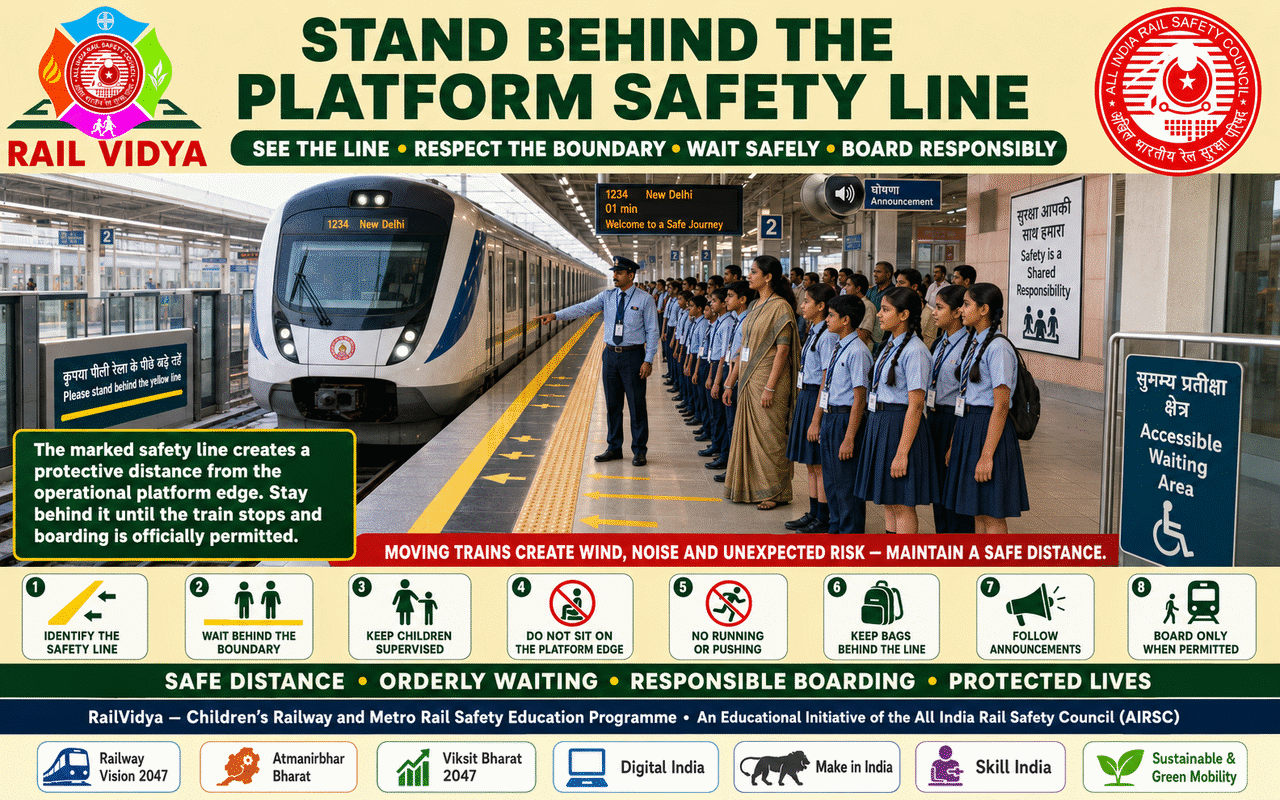
Standing behind the platform safety line is one of the most important rules for protecting children and passengers at railway and metro stations. The marked line creates a protective distance between the passenger-waiting area and the operational edge of the platform. Through RailVidya – Children’s Railway and Metro Rail Safety Education Programme, an educational initiative of the All India Rail Safety Council (AIRSC), children are taught to recognise this boundary, respect it and remain safely behind it until the train has stopped and boarding is officially permitted.
An approaching or passing train can create strong air movement, sudden noise and vibration. A person standing too close to the platform edge may lose balance, become frightened or be affected by the movement of other passengers. The risk can increase when platforms are crowded, surfaces are wet or luggage obstructs movement. Maintaining a safe distance significantly reduces exposure to these dangers.
Children should never stand, sit, kneel or play on the platform edge. They must not extend their hands, heads, toys or belongings beyond the safety line. Running, pushing, chasing and playful behaviour are unacceptable on platforms because even a small collision can cause someone to fall towards the track. Children must remain close to their parent, teacher, guardian or authorised group leader at all times.
The safety line must be respected even when no train is visible. Trains may approach quickly, pass through without stopping or arrive on a different platform from the one expected. Station announcements and information displays may also change. Children should therefore treat the designated boundary as continuously active and never cross it to look for an approaching train.
Tactile paving is often installed near platform edges to assist passengers with visual impairments. It should not be used as a play area, waiting place or location for baggage. Keeping tactile surfaces clear supports accessible movement and protects passengers who depend upon them for guidance. Children should learn that respecting accessibility features is an important part of responsible public behaviour.
While waiting for a train, passengers should form an orderly queue in designated areas and allow sufficient space for alighting passengers. Children should not gather directly in front of train or platform-screen doors. They should wait behind the marked line and move forward only after the train has stopped, the doors have opened and passengers have been permitted to exit.
Mobile phones, headphones, games and photography can distract children from approaching trains, announcements and crowd movement. Digital devices should be put away while walking or waiting near platforms. Children must never step beyond the line to take a photograph or video. No image or online activity is more important than personal safety.
If a toy, mobile phone, bag or another item falls onto the track, children and adults must never cross the safety line or enter the track area to retrieve it. They should remain in the passenger zone and immediately notify authorised railway or metro personnel. Trained staff can manage the situation using approved safety procedures.
Parents, teachers and guardians must demonstrate consistent compliance. Children may imitate an adult who crosses the line to look down the track, takes photographs near the edge or waits in an unsafe position. Responsible adult example is therefore essential to developing reliable safety habits.
As India advances towards faster trains, modern stations and expanded metro networks under Viksit Bharat 2047, disciplined platform behaviour will become increasingly important. Technology can improve operational protection, but the designated safety boundary remains effective only when passengers understand and respect it.
Through RailVidya, AIRSC seeks to make standing behind the platform safety line a permanent national passenger-safety habit. Every child who respects this boundary becomes a safer traveller and a positive influence upon family members and fellow passengers.
Stay Behind the Line • Keep Away from the Edge • Remain Alert • Board Only When Safe
Platform Screen-Door Safety
Platform screen doors are specialised protective barriers installed between metro platforms and train tracks. They open in coordination with train doors when a metro train has stopped in the correct position. These systems help prevent accidental falls, unauthorised track entry and contact with moving trains. Children must understand that platform screen doors are critical safety installations—not objects for touching, climbing, leaning or playing.
Passengers should wait behind the designated markings until the metro train has stopped and the platform screen doors have opened completely. Children should stand close to their accompanying adult and avoid gathering directly in front of the doors. Space must be provided for passengers to exit before boarding begins.
Children must never lean against, strike, climb upon or place their hands on platform screen doors. Even when the doors appear closed, they remain part of an automated operating system and may open according to the train’s arrival sequence. Interfering with them can cause injury, damage the system or disrupt metro services.
Hands, fingers, clothing, shoelaces, toys, umbrellas and bags should be kept away from door edges and closing mechanisms. Children must never attempt to stop the doors by placing a hand, foot or object between them. If the warning sound begins or the doors start closing, passengers should step back and wait for the next train.
Running towards closing screen doors is extremely unsafe. Metro services operate frequently, and missing one train generally causes only a short delay. Rushing can result in falls, entrapment or separation from parents and school groups. Patiently waiting for the next service is always the correct decision.
Children should never hold a platform screen door open for another passenger or attempt to force it after closure. They must also avoid standing between the platform screen doors and train doors during boarding. Passengers should move fully inside the coach and keep doorways clear.
Warning lights, sounds, floor markings, announcements and signs associated with platform screen doors must be observed carefully. Mobile phones and headphones should not be used while boarding or alighting because they can prevent children from noticing door warnings. Full attention should remain on the immediate environment.
If a child’s item becomes trapped or falls into the gap near the doors, the child must not pull dangerously, reach into the mechanism or enter a restricted area. The correct response is to step away and immediately inform authorised metro staff. Trained personnel should manage the situation safely.
Platform screen doors should never be vandalised, marked, kicked or treated as supports for games and photographs. Damaging them can compromise a system designed to protect thousands of passengers. Respecting this infrastructure is part of responsible citizenship and care for national public assets.
Parents and teachers should explain the purpose of screen doors before travelling and supervise children throughout the boarding process. School groups should form orderly queues, complete regular headcounts and ensure that no child becomes separated when the doors close.
If a child is separated from the accompanying adult because the adult boarded and the child remained on the platform—or the reverse—neither person should attempt to block or force the doors. The child should stay calm, remain in a visible public area and approach authorised metro personnel. Families and school groups should establish a simple separation plan before travel.
As platform-screen technology becomes more common within India’s expanding metro systems, public understanding must advance alongside infrastructure. The protection offered by automatic barriers depends upon passengers respecting door warnings, platform markings and authorised procedures.
Through RailVidya, AIRSC seeks to develop children who understand both the benefits and responsibilities associated with modern transport technology. Safe interaction with platform screen doors is an important step towards building disciplined, informed and future-ready metro passengers.
Wait Behind the Marking • Allow Passengers to Exit • Never Block the Doors • Board Calmly
Never Enter Metro Tracks or Restricted Areas
Metro tracks, tunnels, depots, control rooms, technical spaces and maintenance zones are strictly restricted operational areas. They may contain moving trains, high-voltage electrical systems, specialised machinery and other hazards that are not always visible to passengers. Under no circumstances should a child or member of the public enter these locations without official authorisation and trained supervision.
A metro track may appear empty, but this does not mean it is safe. Trains may approach rapidly, silently or from an unexpected direction. Maintenance vehicles and engineering equipment may also operate outside normal passenger-service periods. Children must treat every metro track as active and dangerous at all times.
Many metro systems use electrical equipment positioned beside, beneath or above the track to supply power to trains. These systems may remain energised even when no train is visible. Electricity can cause fatal shock or severe burns, and the danger may not be identifiable by sight or sound. Children must never touch rails, cables, equipment or any object located within the track area.
Children should never enter metro tracks to retrieve a toy, mobile phone, bag, shoe or another possession. If an object falls from the platform, they must stay behind the safety line and notify authorised metro personnel immediately. Trained staff can follow the required procedures, including controlling train movement and isolating electrical systems when necessary. No possession is worth risking a life.
Fences, locked doors, barriers and warning signs protect passengers from operational hazards. Children must never climb over, crawl under, pass around or interfere with them. A door marked “No Entry,” “Restricted Area,” “Danger,” “High Voltage” or “Authorised Personnel Only” must always be obeyed, even if it appears unlocked or another person has entered.
Metro tunnels are particularly dangerous because they provide limited space, reduced visibility and few safe escape options. Train movement can create strong air pressure, while lighting and communication conditions may differ from public areas. Children must never enter tunnels for exploration, photography, shortcuts or online challenges.
Depots, sidings, construction zones, equipment rooms and maintenance areas also remain prohibited. These locations may contain moving vehicles, open pits, tools, electrical systems and automated machinery. Temporary barriers and warning signs must receive the same respect as permanent restrictions.
Curiosity, peer pressure and digital-media challenges must never persuade a child to enter a restricted area. Photographs, videos and social-media attention cannot justify trespassing. Children should reject unsafe challenges and immediately inform a trusted adult when another person suggests dangerous activity near metro infrastructure.
If a child sees someone enter a track or restricted area, the child must not follow or attempt a rescue. The safe response is to remain in the authorised passenger zone and alert metro staff, security personnel or police immediately. An unauthorised rescue attempt can create an additional casualty and make emergency operations more difficult.
During service disruptions or emergencies, passengers must continue to avoid track areas unless authorised personnel provide specific evacuation instructions. If evacuation through a non-public route becomes necessary, children should remain with the responsible adult and follow trained staff closely. They must never begin an independent evacuation based on assumptions or unverified information.
If a child becomes separated from family members or reaches the wrong platform, crossing through the tracks is never an option. The child should stay in a well-lit public area and seek help from uniformed metro personnel, security staff, police officers or an authorised passenger-assistance point.
Parents, teachers and metro authorities share responsibility for reinforcing restricted-area awareness. Educational visits should include clear explanations of public and operational zones. Warning signs, track hazards and appropriate reporting procedures should be introduced through age-appropriate lessons, demonstrations and visual materials.
As India expands its metro systems and integrated urban-mobility infrastructure under Viksit Bharat 2047, public respect for operational boundaries will remain essential. Modern transport systems can function safely only when passengers cooperate with the restrictions designed to protect them.
Through RailVidya, the All India Rail Safety Council seeks to establish a clear national understanding: metro tracks and restricted areas are exclusively for authorised operations. Staying outside these zones, following official instructions and reporting hazards are simple actions that can prevent accidents and save lives.
Metro Tracks Are Never Safe • Respect Every Barrier • Report Fallen Objects • Protect Your Life
Stand Behind the Platform Safety Line
Wait Behind the Marking • Allow Passengers to Exit • Never Block the Doors • Board Calmly
Never Enter Metro Tracks or Restricted Areas
© 2026 Dr.R.Padmanabhan. All Rights Reserved.
Chairman — All India Rail Safety Council (AIRSC)
Promoting Railway Safety, Education and Public Awareness
Email: admin@railsafety.co.in | Website: www.railsafety.co.in/ www.railsafety.in/ www.airsc.in