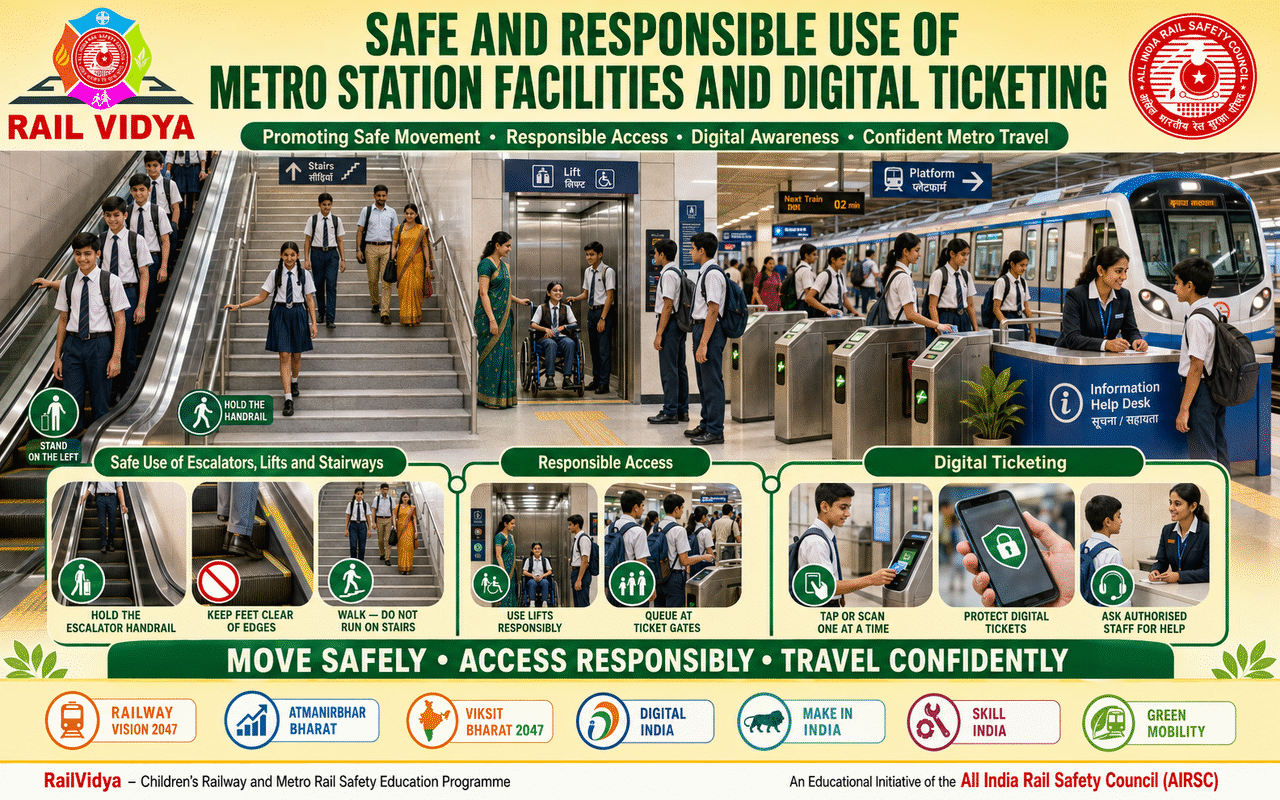
SAFE AND RESPONSIBLE USE OF METRO STATION FACILITIES AND DIGITAL TICKETING PROMOTING SAFE MOVEMENT • RESPONSIBLE ACCESS • DIGITAL AWARENESS • CONFIDENT METRO TRAVEL SAFE USE OF ESCALATORS, LIFTS AND STAIRWAYS USE OFFICIAL SYSTEMS • PROTECT YOUR TICKET • SAFEGUARD PERSONAL INFORMATION • TRAVEL RESPONSIBLY
Safe and Responsible Use of Metro Station
Facilities and Digital Ticketing
Promoting Safe Movement • Responsible Access •
Digital Awareness • Confident Metro Travel
Safe Use of Escalators, Lifts and Stairways
Escalators, lifts and stairways are essential passenger-movement facilities in modern metro and railway stations. They connect entrances, concourses, platforms and interchange levels and help large numbers of passengers move efficiently through complex station environments. Through RailVidya – Children’s Railway and Metro Rail Safety Education Programme, an educational initiative of the All India Rail Safety Council (AIRSC), children are taught to use these facilities calmly, attentively and under appropriate adult supervision.
Before stepping onto an escalator, children should face forward, observe the direction of travel and wait until they are properly positioned. They should step carefully onto the centre of a moving step and immediately hold the handrail. Parents, teachers and guardians should keep young children close and provide assistance without blocking the entry point.
While travelling on an escalator, children should stand securely within the step markings and continue facing the direction of movement. They must never sit, run, jump, play, lean over the side, climb the handrail or travel in the opposite direction. These actions can lead to falls, entrapment and collisions with other passengers.
Shoelaces, scarves, long clothing, bag straps and other loose items should be secured before using an escalator. Such items may become caught near the edges, handrail mechanism or step junction. Children should keep their feet away from the sides, avoid dragging belongings and never place toys or other objects on moving steps.
Prams, wheelchairs, heavy luggage and certain mobility devices should not be taken onto an escalator unless the facility is specifically designed and officially approved for that purpose. Passengers should use an accessible lift or another designated route. Children must never sit on baggage, stand on trolleys or treat luggage as play equipment near escalators.
When reaching the end of an escalator, children should step off promptly and move forward without stopping. Remaining near the exit can cause following passengers to collide or lose balance. If an item falls onto an escalator, children should not reach into the moving mechanism; they should inform a responsible adult or authorised station employee.
Lifts provide safe and accessible movement between station levels, particularly for persons with disabilities, senior citizens, pregnant passengers, families with infants and people carrying appropriate luggage. Children should allow passengers to exit before entering, wait patiently, avoid overcrowding and keep away from closing doors.
Inside a lift, children should stand calmly, keep their hands away from door edges and use controls only when necessary. Jumping, pushing, repeatedly pressing buttons or activating the alarm without genuine cause can create risk and inconvenience. Priority and accessible lifts should be used respectfully, with consideration for passengers who depend upon them.
If a lift stops unexpectedly, children should remain calm, stay inside and use the authorised emergency communication facility or alarm to request assistance. They must never attempt to force the doors, climb through an opening or leave the lift without instructions from trained personnel.
Stairways require equal care. Children should walk—never run—use the handrail and remain on the side indicated by station signs. They must not jump across steps, slide down railings, sit on stairways or block landings. Mobile phones should be put away so that every step and surrounding passenger can be seen clearly.
During emergencies, lifts and escalators may be unavailable or restricted. Children should follow official announcements and use designated evacuation routes under adult or staff supervision. Emergency stairways, landings and exits must never be obstructed by people, baggage or other objects.
As India develops increasingly modern, accessible and high-capacity metro networks under Viksit Bharat 2047, children must learn to use passenger facilities with confidence and responsibility. Safe infrastructure delivers its greatest value when passengers respect its purpose and operating rules.
Through RailVidya, AIRSC seeks to make careful use of escalators, lifts and stairways a lifelong public-transport habit. Calm movement, close supervision and respect for accessibility help create safer and more inclusive stations for everyone.
Stand Securely • Hold the Handrail • Walk on Stairways • Use Lifts Responsibly
Holding Handrails and Watching Every Step
Holding handrails and watching every step are simple but highly effective practices for preventing slips, trips and falls in railway and metro environments. Stations may contain stairways, escalators, ramps, uneven transitions and wet or crowded surfaces. Children must remain attentive and use the safety support provided whenever they move between station levels.
Handrails provide stability during movement and can help a child maintain balance if a train, escalator or crowd moves unexpectedly. Children should use them on stairways and escalators and use designated supports inside metro trains when standing. Handrails should never be treated as seats, slides, climbing equipment or places for play.
When using an escalator, children should face forward, stand firmly within the marked portion of the step and hold the moving handrail. Their hands should remain away from entry and exit mechanisms. They should not attempt to balance without support, turn around repeatedly or reach across to another passenger.
On stairways, children should hold the fixed rail and look at the steps ahead. Running, skipping multiple steps, jumping or looking at a mobile phone can cause a serious fall. Safe walking becomes particularly important when stairways are crowded, wet or being used by passengers carrying luggage.
Children should keep one hand available for balance whenever possible. Carrying excessive baggage, large toys or objects that block their view can make safe movement difficult. Parents and teachers should distribute belongings responsibly and ensure that children carry only items appropriate for their age and strength.
Shoelaces should be tied securely, and long clothing, scarves and bag straps should be kept away from moving equipment. Suitable footwear can improve stability, while loose footwear may increase the risk of slipping. Before beginning a journey, adults should check that children’s clothing and belongings are safe for station movement.
Platform gaps, coach entrances, thresholds and changes in floor level require careful observation. Children should look down before stepping into or out of a train and avoid assuming that every surface is at the same height. The instruction to “Mind the Gap” is an important reminder to watch both foot placement and surrounding movement.
Rainwater, spilled liquids, damaged flooring or discarded objects can create additional hazards. Children should avoid unsafe surfaces and inform a responsible adult or station employee when they notice a condition that may cause someone to fall. Reporting hazards is part of responsible passenger behaviour.
Mobile devices and headphones can reduce awareness. Children should put devices away when using stairs, escalators, lifts, platforms or boarding areas. Watching every step also means noticing warning signs, other passengers and changes in the direction or flow of movement.
Courtesy contributes to safety. Children should avoid pulling, pushing or overtaking others on narrow stairways and escalators. They should provide sufficient space for senior citizens, persons with disabilities and passengers carrying infants or luggage. Patient movement protects both the child and the surrounding public.
Through RailVidya, AIRSC seeks to teach that personal safety is often strengthened through small, consistent actions. Holding a handrail, looking ahead and placing each step carefully can prevent avoidable injury and develop lifelong discipline.
Hold Firmly • Look Carefully • Walk Calmly • Make Every Step Safe
Using Metro Entry and Exit Gates Safely
Metro entry and exit gates are automated systems that verify passenger tickets and regulate access between public areas and paid station zones. They support security, orderly passenger movement and efficient fare management. Children must use these gates carefully and only with a valid token, smart card, digital ticket or other officially accepted travel authority.
Before approaching a gate, passengers should have their ticket or smart card ready. Searching for it while standing in the passage can obstruct others and increase crowding. Children should remain with their parent, teacher or guardian and approach only the gate indicated for the correct direction of travel.
At the gate, the token, smart card or digital ticket should be presented at the designated reader according to the metro operator’s instructions. Children should wait for the authorised visual or audible confirmation before moving forward. They must not push against the gate or attempt to pass before it opens.
Automatic gate flaps or barriers may close after each passenger. Children should move through promptly but calmly and should keep their hands, bags, clothing and toys away from the moving mechanism. They must never sit on, climb over, crawl under or force open a gate.
Children should generally pass through individually unless station guidance provides a specific assisted procedure. Young children who cannot use the gate independently should remain with the responsible adult and follow instructions from authorised metro personnel. Adults must never leave a child uncertain or unsupervised on the opposite side.
Running behind another passenger through the same opening, known as tailgating, is unsafe and may result in contact with closing barriers. It also violates authorised access procedures. Every passenger should use a valid travel entitlement and wait for the gate to reset before proceeding.
Wide or accessible gates are provided for passengers with wheelchairs, mobility aids, prams or appropriate luggage. These facilities must be respected and used according to station rules. Children should not play near accessible gates or obstruct passengers who require additional space and time.
If a valid ticket does not open the gate, children should not repeatedly strike the reader, force the barrier or attempt to follow another passenger. They should step aside with the accompanying adult and seek help from the customer-care counter or authorised station staff.
During group travel, teachers should prepare tickets in advance, assign supervisors and count students before and after passing through the gates. Children should wait in an organised area without blocking other passengers. A clear meeting point should be established in case a student becomes separated.
Entry and exit areas may become crowded during peak periods. Children should remain patient, follow queue markings and avoid rushing. Adults should allow sufficient journey time so that the group can use fare gates safely and without pressure.
In an emergency, gates may be opened or controlled differently to support evacuation. Children should follow staff instructions and move through the designated route without stopping to retrieve non-essential items. They must never operate emergency mechanisms unless instructed or faced with a genuine emergency.
Through RailVidya, AIRSC seeks to develop children who can interact safely and responsibly with automated metro infrastructure. Correct gate use protects passengers, supports orderly operations and reflects respect for public systems.
Prepare Your Ticket • Wait for the Signal • Walk Through Calmly • Never Force the Gate
Safe Use of Tokens, Smart Cards and Digital Tickets
Tokens, smart cards, contactless payment methods and digital tickets provide convenient access to modern metro services. They enable passengers to enter and exit stations, validate journeys and use integrated transport facilities. Children should understand that these travel instruments must be handled responsibly, protected from loss and used only according to the official rules of the relevant metro system.
Before travelling, parents, teachers and guardians should confirm the accepted ticketing method, journey route and applicable passenger requirements. Children should not be expected to manage unfamiliar digital or payment systems without suitable guidance. During school trips, tickets should be organised systematically and linked to accurate student and supervisor counts.
A token should be kept securely until it is required at the exit gate. It should not be treated as a toy, placed in the mouth, thrown, exchanged unnecessarily or left unattended. Younger children may require an adult to retain and manage the token on their behalf.
Smart cards should be presented flat and steadily at the designated reader. Children should wait for the confirmation light, sound or gate movement before proceeding. Repeated tapping, bending, scratching or sharing cards during the same journey may create errors and delay passenger movement.
Digital tickets should be opened before reaching the gate, with the correct screen brightness and authorised code ready for scanning. Children must stand safely while using a phone and should never walk through crowded areas while looking down at the device. If the ticket cannot be displayed, the passenger should step aside and seek authorised assistance.
Personal information, passwords, payment details and one-time verification codes must never be shared with strangers. Children should not photograph or publicly post digital tickets, QR codes, travel cards or real-time journey details. Such information may be misused and can compromise personal or financial security.
Tickets and cards should be purchased, recharged or activated only through official metro counters, vending machines, authorised applications and recognised payment channels. Children should not accept discounted, transferred or unofficial tickets from unknown persons. Parents and teachers should verify the authenticity of digital services before entering payment information.
Children should never use another person’s concession, identity-linked card or restricted travel entitlement. Responsible ticket use teaches honesty, fairness and respect for public systems. Fare rules may vary between metro organisations, and the official regulations of the operating authority must always be followed.
If a token, card or phone is lost, children should remain calm and immediately inform their accompanying adult. The incident should be reported to the authorised customer-care counter or station personnel. Children must not leave the group, cross a barrier or seek help from an unknown person.
Mobile phones used for digital tickets should be adequately charged before travel. However, children must not connect devices to damaged sockets, leave phones unattended at charging points or allow charging cables to obstruct passenger pathways. Digital convenience must never reduce physical safety.
School groups should use a planned ticket-management system. Teachers may assign tickets in an organised manner, retain appropriate journey records and complete headcounts before and after gate passage. Children should receive simple instructions about keeping tickets secure and what to do if a problem occurs.
Digital ticketing supports India’s movement towards connected, efficient and passenger-friendly urban mobility. However, its advantages must be supported by digital awareness, privacy protection and responsible behaviour. Safe travel includes safeguarding both the passenger and their information.
Through RailVidya, AIRSC seeks to prepare children for a future in which transport technology is used confidently, honestly and securely. Learning to handle tokens, smart cards and digital tickets responsibly is an important part of becoming a safety-conscious and digitally aware citizen.
Use Official Systems • Protect Your Ticket • Safeguard Personal Information • Travel Responsibly
© 2026 Dr.R.Padmanabhan. All Rights Reserved.
Chairman — All India Rail Safety Council (AIRSC)
Promoting Railway Safety, Education and Public Awareness
Email: admin@railsafety.co.in | Website: www.railsafety.co.in/ www.railsafety.in/ www.airsc.in
Safe and Responsible Use of Metro Station Facilities and Digital Ticketing
Promoting Safe Movement • Responsible Access • Digital Awareness • Confident Metro Travel
Safe Use of Escalators, Lifts and Stairways
Use Official Systems • Protect Your Ticket • Safeguard Personal Information • Travel Responsibly