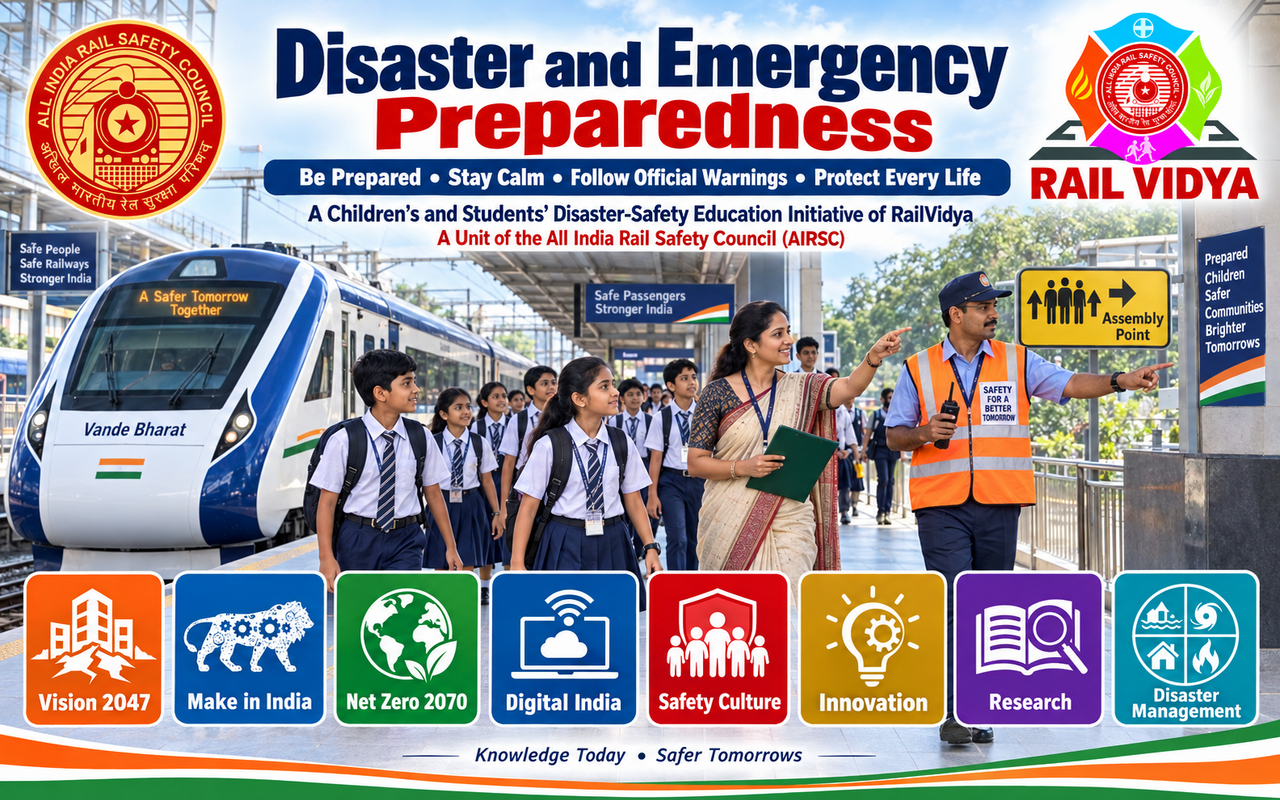
DISASTER AND EMERGENCY PREPAREDNESS Be Prepared • Stay Calm • Follow Official Warnings • Protect Every Life A Children’s and Students’ Disaster-Safety Education Initiative of RailVidya A Unit of the All India Rail Safety Council (AIRSC)
Disaster and Emergency Preparedness
Be Prepared • Stay Calm • Follow
Official Warnings • Protect Every Life
A Children’s and Students’ Disaster-Safety
Education Initiative of RailVidya
A Unit of the All India Rail Safety Council (AIRSC)
Disasters and severe-weather emergencies can occur with little warning and may disrupt homes, schools, transport, electricity, communication and essential services. Children who understand basic protective actions are better prepared to remain calm, follow instructions and avoid preventable danger. Through its Disaster and Emergency Preparedness Programme, RailVidya seeks to build awareness, confidence, discipline and responsible behaviour among children and students.
Preparedness does not mean creating fear. It means understanding local risks, recognising official warnings, knowing safe locations, practising evacuation procedures and remaining connected with trusted adults. Children should never attempt rescue, electrical repair, flood crossing or other hazardous activities by themselves. Their first responsibilities are to protect themselves, alert an adult and follow authorised instructions.
India’s National Disaster Management Authority provides official guidance for hazards including cyclones, floods, earthquakes, lightning and severe weather through its SACHET National Disaster Alert Portal. The National Institute of Disaster Management also provides multilingual disaster-awareness and school-safety resources. NIDM Awareness Materials
Preparedness Begins Before an Emergency
Every family and school should have a simple emergency plan. Children should know the safest exits, assembly points, emergency contacts and the adults responsible for them. Family members should decide where to meet if communication becomes unavailable or they are separated during an emergency.
Emergency contact numbers should be written clearly and stored in an accessible place. Older children may carry a small contact card containing their name, essential medical information and trusted contact details. Personal information should not be publicly displayed or shared with strangers.
Homes and schools should maintain essential supplies suited to local risks and official recommendations. These may include safe drinking water, non-perishable food, prescribed medicines, a first-aid kit, torch, batteries, radio, power bank, hygiene supplies, masks, important documents and child-specific necessities. Adults should inspect these supplies regularly.
Children should participate in age-appropriate safety drills so that they understand what to do without panic. Drills must be organised carefully and should never expose students to real danger.
- 1. Earthquake Safety—Drop, Cover and Hold On
Protect Your Head • Stay Away from Glass • Wait Until Shaking Stops • Evacuate Carefully
An earthquake occurs when energy released within the earth causes the ground to shake. It may begin suddenly and can make furniture move, objects fall, glass break and parts of buildings become unstable. Although earthquakes cannot always be predicted, preparation and correct protective behaviour can reduce the risk of injury.
Children should learn the recognised protective action: Drop, Cover and Hold On. When shaking begins, they should drop to their hands and knees to reduce the chance of being knocked down, cover their head and neck under a strong table or desk when available, and hold on until the shaking stops.
If You Are Inside a Building
Children should remain inside during the shaking unless an immediate danger makes that impossible. Running towards stairs or exits while the ground is moving can expose them to falling glass, ceiling materials, furniture and crowd pressure.
A student should move only a short distance to reach nearby protection. A strong desk or table may provide cover from falling objects. If no suitable shelter is available, the child should crouch beside an interior wall away from windows, cover the head and neck with both arms and remain in position.
Children should stay away from windows, glass doors, display cabinets, shelves, hanging objects, laboratory chemicals and heavy furniture that could fall. They should not stand in doorways unless the building’s specific safety plan identifies a suitable protected location.
Lifts must not be used during or immediately after an earthquake. Electricity may fail, lift systems may malfunction and occupants could become trapped.
Drop, Cover and Hold On
Drop: Get down onto hands and knees before the shaking causes a fall. This position provides greater stability and allows limited movement towards nearby protection.
Cover: Protect the head and neck. If a strong desk or table is nearby, move underneath it. If no cover is available, use the arms, a school bag or another suitable object to protect the head without creating additional danger.
Hold On: Hold the desk or table leg so that the shelter remains over the body if it moves. Stay in position until the shaking stops and an authorised adult provides further instructions.
Students should practise this action during supervised school drills so that it becomes familiar.
If You Are Outdoors
A child outdoors should move away from buildings, walls, balconies, windows, trees, streetlights, signboards, electrical wires and other objects that may fall. The child should proceed to a clear open area when this can be done safely.
Once in a safer location, the child should drop low, protect the head and remain there until the shaking ends. Running through traffic or towards a building may create additional danger.
Children should not stand near damaged structures after the shaking stops because aftershocks may cause loose materials to fall.
If You Are in a Train, Metro, Bus or Vehicle
Children should remain seated or hold a secure handrail and follow the instructions of railway, metro or transport personnel. They should not jump from a moving or unexpectedly stopped vehicle.
Inside a train or metro coach, students should keep away from doors and avoid touching emergency controls unless directed. If evacuation becomes necessary, it must be conducted under the supervision of authorised personnel because railway tracks may contain moving trains, uneven surfaces and live electrical systems.
Children travelling in a road vehicle should remain secured until the responsible adult determines that it is safe to leave.
After the Shaking Stops
Children should expect possible aftershocks. They should remain alert and repeat Drop, Cover and Hold On if shaking begins again.
Evacuation should take place calmly according to the school, building or local emergency plan. Students should use stairs, keep exits clear and leave non-essential belongings behind if carrying them causes delay. Running, pushing and shouting can lead to falls and confusion.
At the assembly point, students must remain with their assigned group while attendance is checked. No one should return to a damaged building until authorised professionals declare it safe.
Recognise Hazards After an Earthquake
Earthquakes may damage electrical wires, gas systems, water pipes, walls, stairways and roads. Children should stay away from fallen cables, broken glass, leaking liquids, damaged buildings and areas where gas or smoke is suspected.
They should never light a match, operate an electrical switch or use a flame where gas leakage may have occurred. Any unusual smell, sound, spark or structural damage should be reported immediately.
Children should not enter damaged houses or schools to retrieve books, phones or other belongings. Property can be replaced; life cannot.
If Trapped
A child who becomes trapped should remain as calm as possible and protect the mouth and nose from dust with available cloth. They should avoid unnecessary shouting that may cause exhaustion or dust inhalation.
The child can call, whistle, tap on a pipe or wall, or use a phone if available to help rescuers identify the location. Matches, lighters and electrical switches should not be used because damaged systems may have released gas or created electrical hazards.
Earthquake Safety Messages
“When the Ground Shakes—Drop, Cover and Hold On.”
“Protect Your Head • Stay Away from Glass • Wait for Instructions.”
“After the Shaking Stops—Evacuate Calmly and Expect Aftershocks.”
- 2. Flood and Heavy-Rain Safety—Stay Away from Moving Water
Move to Higher Ground • Avoid Flooded Roads • Stay Clear of Drains • Beware of Electricity
Floods may result from heavy rain, overflowing rivers, blocked drainage systems, dam-related incidents, coastal conditions or sudden water accumulation in urban areas. Floodwater can move rapidly, conceal deep holes and carry sewage, sharp objects, chemicals, animals and electrical hazards.
Children must never enter floodwater to play, walk, swim, cycle or retrieve belongings. Water that appears shallow or calm may hide strong currents, open drains, damaged roads or uncovered manholes. The safest instruction is clear: stay out of floodwater and move towards an officially identified safe place.
Follow Rain and Flood Warnings
Families and schools should monitor weather reports and warnings issued by authorised government and disaster-management agencies. Children should not depend on rumours, forwarded messages or unverified social-media posts.
When an evacuation warning is issued, preparations should begin immediately. Waiting until water enters the building may make escape more dangerous.
Children should follow parents, teachers and emergency officials. They should not delay evacuation to collect toys, books, electronic devices or other non-essential belongings.
Never Walk or Play in Floodwater
Floodwater is not a playground. Even water that appears manageable can knock a person down or carry them into a deeper channel. Children should never race paper boats, retrieve floating objects or enter water to demonstrate bravery.
Open drains and uncovered manholes may be invisible beneath muddy water. Roads, bridges and pathways may also have been weakened or washed away.
If a ball, bicycle, bag or phone enters floodwater, children must leave it and tell an adult. No possession is worth risking a life.
Do Not Cross Flooded Roads or Bridges
Children should never attempt to cross a flooded road, bridge, underpass, railway subway or low-lying passage. Moving water can be stronger and deeper than it appears.
Barricades and road closures must always be respected. Children should not go around a barrier simply because other people appear to be crossing.
Vehicles can lose control, stall or be carried away in floodwater. Students should never encourage a driver to enter a flooded route. The journey should be delayed or redirected by a responsible adult.
Stay Away from Drains and Water Channels
Storm-water drains, canals, riverbanks and roadside channels become particularly dangerous during heavy rain. Fast-flowing water can pull a person in, and the edge of a drain may collapse.
Children should remain away from drains even when they are covered because lids may be damaged or displaced. They must not attempt to clear blockages or remove waste from flowing water.
Blocked drains, missing covers and overflowing channels should be reported from a safe location to responsible adults or the appropriate authority.
Electrical Safety During Floods
Water and electricity create a potentially fatal combination. Children must stay away from electrical poles, transformers, substations, streetlights, damaged cables and water surrounding electrical equipment.
A fallen wire should always be treated as live. Children should move well away, warn others without approaching and notify emergency or electricity personnel.
Electrical switches, appliances and plugs must not be touched with wet hands or while standing in water. Only a competent adult or authorised technician should disconnect power when it is safe to do so.
Railway and Metro Flood Safety
Flooding can affect railway tracks, bridges, underpasses, platforms, signalling equipment and station access routes. Children must not enter flooded railway property, walk along tracks or attempt to cross waterlogged rail infrastructure.
A stationary train does not mean the track is safe. Other trains may move unexpectedly, and electrical traction systems may remain energised. Students should follow railway announcements and instructions from authorised personnel.
If a station exit or subway is flooded, children should stay in a safe public area and seek help rather than attempting to pass through the water. They must remain with parents, guardians or teachers.
Move to Higher and Safer Ground
When advised, children should move with responsible adults to higher ground or an authorised shelter. The route should follow official directions and avoid riverbanks, steep slopes, damaged bridges and isolated shortcuts.
Students should remain together and cooperate with attendance procedures. Nobody should return to a flooded area until authorities confirm that it is safe.
If trapped on an upper floor, the family should contact emergency services and make their location visible without entering dangerous water or climbing onto unstable structures.
Floodwater May Be Contaminated
Floodwater can contain sewage, chemicals, waste, fuel and disease-causing organisms. Children should not drink, wash utensils in or prepare food with floodwater.
If accidental contact occurs, contaminated clothing should be changed and exposed skin cleaned with safe water and soap as soon as possible. Cuts and wounds exposed to floodwater should be shown to a responsible adult and assessed by a healthcare professional when necessary.
Children should not eat food that has touched floodwater. Damaged food containers and water supplies require adult assessment.
Safe Drinking Water and Food
During flooding, normal water supplies may become unsafe. Families should follow official instructions regarding boiling, treatment or use of packaged water. Children should drink only water confirmed as safe by responsible adults.
Food should be protected from water, insects and contamination. Refrigerated food affected by a prolonged power failure may become unsafe. Children should not taste questionable food to determine whether it is safe.
Medicines, chemicals and cleaning products affected by floodwater should be handled by adults following appropriate guidance.
After the Flood
Floodwater may recede while leaving mud, unstable structures, snakes, insects, exposed wires and contaminated materials behind. Children should not return to homes, schools or playgrounds until responsible authorities declare them safe.
Cleaning should be performed by properly equipped adults. Students must not handle sharp objects, sewage, dead animals, chemicals or damaged electrical equipment.
Mosquito breeding may increase where stagnant water remains. Children can report collected water to adults but should not enter contaminated areas to remove it themselves.
Flood and Heavy-Rain Safety Messages
“Stay Away from Moving Water—Floodwater Can Hide Deadly Hazards.”
“Never Enter Flooded Roads, Drains, Bridges or Railway Subways.”
“Move to Higher Ground • Avoid Electricity • Follow Official Instructions.”
- 3. Cyclone and Severe-Weather Safety—Follow Official Warnings
Prepare Early • Move to Safe Shelter • Stay Away from Windows • Trust Verified Information
Cyclones and severe storms can bring powerful winds, intense rain, coastal flooding, flying debris, lightning, damaged buildings and disruption to electricity, communication and transport. Early preparation and timely evacuation can protect lives.
Children should understand the difference between ordinary weather changes and an official severe-weather warning. They should listen to parents, teachers and authorised agencies and should never treat a cyclone alert as a reason for outdoor exploration or social-media recording.
Monitor Official Warnings
Families and schools should use reliable weather services, government alerts, local authorities, radio and recognised news channels. Unverified voice messages, dramatic videos and old storm images can create confusion.
Children should not forward warnings until a responsible adult has confirmed their source. The location, date and time of the alert should be checked because weather conditions may differ between districts and coastal areas.
Official instructions may include remaining indoors, suspending travel, moving away from the coast or evacuating to a designated shelter. These directions should be followed promptly.
Prepare Before the Cyclone Arrives
Emergency supplies should be assembled before conditions deteriorate. Adults should secure important documents, prescribed medicines, safe water, food, torches, charged communication devices and other essentials.
Children can help with safe, age-appropriate tasks such as checking their contact card, packing clothing and keeping personal necessities together. They should not climb roofs, repair electrical equipment, cut branches or secure heavy outdoor objects.
Loose items around homes and schools may become dangerous in high winds. These should be moved or secured by capable adults before the storm.
Know the Safe Shelter
Families and schools should identify a safe room, sturdy building or official cyclone shelter in advance. Children should know the evacuation route and remain with their responsible adult.
If authorities order an evacuation, families should leave early. Roads may later become blocked by floodwater, fallen trees, debris or traffic.
Children must not hide because they are afraid or do not want to leave their belongings. A trusted adult should explain the plan calmly and reassure them throughout the evacuation.
Stay Indoors and Away from Windows
During powerful winds, children should remain inside a structurally safe building and stay away from windows, glass doors and exterior walls. Flying debris can break glass and cause severe injury.
Doors and windows should not be opened to observe the storm. Children should not stand on balconies, rooftops or near entranceways to record videos.
The safest location may be an interior room or another area identified in the building’s emergency plan. Children should remain there until an official all-clear is communicated.
Do Not Go Outside During a Temporary Calm
Cyclone conditions may sometimes appear to weaken temporarily. This does not necessarily mean the danger has ended; strong winds may return suddenly.
Children must not leave shelter merely because rain or wind has stopped. They should wait for confirmation from authorised officials or responsible adults that conditions are safe.
The desire to examine damage, take photographs or meet friends must never take priority over safety.
Lightning and Thunderstorm Safety
During lightning, children should move into a substantial building or another officially recommended shelter. They should avoid open fields, isolated trees, rooftops, metal fences, water bodies and exposed high ground.
Wired electrical equipment and plumbing may present additional risks during intense lightning activity. Children should follow adult instructions and avoid using equipment that has not been confirmed as safe.
Outdoor games, swimming and sports should stop when severe weather approaches. Activities should resume only after responsible authorities or supervisors determine that conditions are safe.
Strong-Wind Safety
Strong winds can carry sheets of metal, branches, signboards, glass and other dangerous debris. Children should never chase objects blown by the wind or stand close to weak walls, temporary structures and damaged trees.
If caught outside unexpectedly, a child should move with a responsible adult towards a secure building without sheltering beneath trees, billboards, power lines or unstable structures.
Umbrellas may be difficult or dangerous to control during extreme winds. Children should follow local official advice regarding movement and shelter.
Coastal and Storm-Surge Safety
Cyclones may cause seawater to rise and move inland. Beaches, coastal roads, river mouths and low-lying areas can become extremely dangerous.
Children must not visit the coast to watch waves, take photographs or record storm videos. Large waves and storm surges can arrive suddenly and sweep people away.
Evacuation orders for coastal or low-lying communities must be followed immediately. Students should never return until authorities provide an all-clear.
Electrical and Gas Safety
Cyclones may damage power lines, poles, transformers and household systems. Fallen cables must be treated as live. Children should remain far away and report the location.
They should never enter water near electrical equipment or touch metal objects in contact with wires. Only authorised personnel should restore power or repair damaged systems.
If gas leakage is suspected, children should move away with a responsible adult. They should not use flames or operate electrical switches in the affected area.
Railway and Transport Safety During Severe Weather
Heavy rain and high winds may disrupt trains, metros, buses and roads. Children should travel only when parents, schools and relevant authorities consider the journey necessary and safe.
Students should not enter flooded station approaches, damaged bridges or restricted railway areas. Delays and cancellations should be accepted patiently because operational restrictions may be necessary to protect passengers.
Inside a station or train, children should listen to official announcements, keep away from doors and remain with their group. They should never leave the vehicle or station through an unauthorised route.
Power and Communication Failure
Families should keep torches and charged communication devices available. Candles and open flames should be avoided where they could cause fire, especially around children or possible gas leaks.
Mobile-phone batteries should be preserved for essential communication. Children should avoid unnecessary video streaming or gaming during an emergency.
If communication fails, family members should follow the pre-agreed meeting and shelter plan. Children should not leave a safe location to search alone.
After the Cyclone
Even after the storm passes, hazards may remain. Fallen trees, broken glass, damaged buildings, exposed nails, contaminated water and live electrical wires may be present.
Children should stay within the safe area until adults and authorities assess the surroundings. They must not touch debris, enter damaged structures or approach downed power lines.
Photographing or sharing images of injured people should be avoided. Privacy, dignity and emergency access must be respected.
Emotional Safety During Disasters
Loud sounds, darkness, evacuation and uncertainty can be frightening. Children should be encouraged to express their concerns and remain close to supportive adults.
Slow breathing, listening to clear instructions and focusing on one safe action at a time may help reduce panic. Older students can reassure younger children but should not accept responsibilities beyond their ability.
Continued fear, sleep difficulties or distress after a disaster should be discussed with parents, teachers, counsellors or qualified healthcare professionals.
Cyclone and Severe-Weather Safety Messages
“Follow Official Warnings—Prepare Early and Move Before Conditions Become Dangerous.”
“Stay Indoors • Keep Away from Windows • Wait for the Official All-Clear.”
“Never Visit Beaches, Railway Tracks or Flooded Areas During Severe Weather.”
The Role of Schools
Every school should maintain a disaster-management and emergency-response plan suited to its location and risks. The plan should identify evacuation routes, assembly points, responsible staff, communication procedures, first-aid arrangements and support for students with disabilities or medical needs.
Regular, age-appropriate drills can help students respond calmly. Drills should include attendance checks and procedures for safely reuniting children with their families.
Teachers should explain that children must never return to collect belongings during an evacuation. The priority is the protection and accountability of every student.
The Role of Parents and Guardians
Parents should discuss local hazards without creating unnecessary fear. Children should know their family communication plan, safe meeting place and trusted emergency contacts.
Adults should maintain necessary supplies, follow official alerts and model calm behaviour. They should never encourage children to enter disaster-affected areas for photographs, sightseeing or unnecessary travel.
Families with infants, older persons, persons with disabilities, pets or members requiring medication should include those needs in their preparedness plan.
A Message from RailVidya
Disaster awareness gives children practical knowledge that can protect life. Earthquakes require immediate protective action; floods require complete avoidance of moving and contaminated water; cyclones require early preparation, safe shelter and strict attention to official warnings.
RailVidya encourages every child and student to become a Young Disaster-Safety Ambassador by learning emergency procedures, participating seriously in drills and sharing verified safety messages with family and friends.
Preparedness is not fear. Preparedness is knowledge, discipline and readiness to act safely.
RailVidya Disaster-Safety Messages
“Be Prepared—Not Afraid.”
“Stay Calm • Think Clearly • Act Safely • Follow Official Instructions.”
“Earthquake: Drop, Cover and Hold On.”
“Flood: Stay Away from Moving Water.”
“Cyclone: Prepare Early and Follow Official Warnings.”
“One Child • One Family • One Disaster-Safety Plan.”