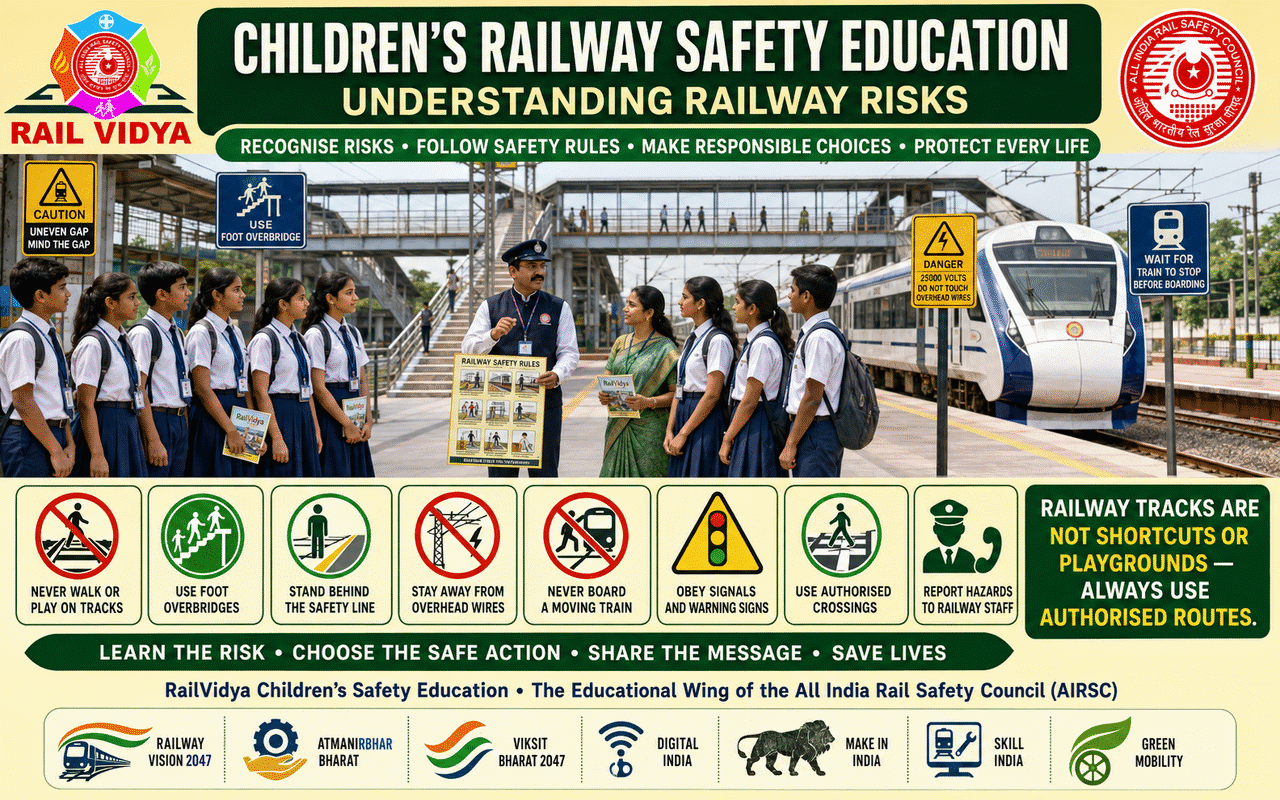
Children’s Railway Safety Education – Understanding Railway Risks, promoted through RailVidya of the All India Rail Safety Council (AIRSC), provides children with practical, age-appropriate knowledge to recognise railway hazards and make responsible decisions. By staying away from tracks and restricted areas, using authorised crossings, following platform and level-crossing rules, avoiding digital distractions and seeking help from authorised personnel, children can become alert passengers, responsible citizens and young safety ambassadors who help prevent accidents and protect lives.
Children’s Railway Safety Education
Understanding
Railway Risks
Understanding railway risks is the first and most important step towards protecting children and developing responsible behaviour in and around railway environments. RailVidya Children’s Safety Education, the educational wing of the All India Rail Safety Council (AIRSC), seeks to provide children with clear, practical and age-appropriate knowledge of railway hazards so that they can recognise unsafe situations, make informed decisions and protect themselves and others.
Railways are one of India’s most important public transportation systems, connecting families, schools, communities and economic centres across the nation. Although railway travel is organised through established operational and safety systems, stations, platforms, tracks, level crossings, moving trains and electrical installations remain specialised environments that require attention, discipline and respect for official instructions. Children must therefore understand that railway areas are not places for playing, exploring, taking shortcuts or engaging in careless behaviour.
A moving train presents risks that may not be immediately understood by a child. Trains are extremely heavy, can travel at considerable speed and cannot stop suddenly. The distance and speed of an approaching train can also be difficult to judge accurately. For this reason, children must never walk, stand, sit, play, cycle, take photographs or use mobile phones on or near railway tracks. A railway track should be crossed only through an authorised foot overbridge, subway or officially designated level crossing.
Platform safety is another essential area of learning. Crowded platforms, moving trains, luggage, uneven surfaces and gaps between trains and platforms can create hazardous situations. Children should remain under responsible adult supervision, stand behind the designated safety line, avoid running or pushing, keep away from platform edges and listen carefully to railway announcements. They must never attempt to touch, chase, board or alight from a moving train.
Children should also understand the dangers associated with railway electrification. Overhead wires, electrical equipment, substations and trackside installations may carry extremely high voltage. Serious injury can occur even without direct contact in some circumstances. Children must never climb railway coaches, signal structures, poles or other railway installations, fly kites close to overhead wires, throw objects at electrical equipment or enter restricted technical areas.
Level crossings require patience and strict obedience to safety controls. Warning lights, bells, barriers, gates and instructions from railway personnel are provided to protect road users and pedestrians. Children must never pass under or around a closed barrier, cross while warning signals are active or follow others who are acting unsafely. They should wait at a safe distance until the crossing is officially opened and it is clearly safe to proceed.
Boarding and travelling by train also require responsible conduct. Children should board only after the train has stopped completely and passengers have been given sufficient space to alight. They should avoid standing near open doors, leaning outside windows, placing hands or objects beyond the coach, climbing between coaches or travelling in unauthorised areas. Safe travel also includes keeping aisles and doorways clear and following the instructions of railway personnel.
Trespassing is a serious railway risk that children must learn to recognise and avoid. Railway tracks, yards, bridges, tunnels, maintenance areas and operational zones are restricted spaces because trains or engineering vehicles may approach unexpectedly. These locations may also contain electrical equipment, moving machinery and uneven ground. An apparently quiet track is never automatically safe, and unauthorised entry must always be avoided.
Distraction can increase risk in every railway environment. Mobile phones, headphones, games, conversations and photography may prevent a child from noticing an approaching train, warning signal, announcement or change in platform conditions. RailVidya encourages children to remain attentive, keep electronic devices away while walking or crossing and focus fully on their surroundings.
Railway risks can also arise from crowding, separation from family members, unattended objects and contact with unknown persons. Children should remain close to parents, guardians, teachers or authorised group leaders during journeys. If separated, they should stay calm and seek assistance from uniformed railway staff, Railway Protection Force personnel, police officers or an authorised help desk. They should never leave a station with an unknown person or touch an unattended or suspicious object.
Understanding risk also means knowing how to respond during an emergency. Children should be taught to remain calm, move away from immediate danger, alert a responsible adult and follow official instructions. They must never attempt a rescue that places their own life at risk. Reporting smoke, fire, damaged equipment, unsafe behaviour or a person in danger to authorised personnel can help prevent a serious incident.
RailVidya communicates these lessons through positive and child-centred education rather than fear. Stories, illustrations, demonstrations, quizzes, role-play, safety walks, activity sheets and digital learning materials help children understand how hazards arise and why safety rules must be followed. The objective is to develop thoughtful judgement, practical preparedness and confidence to choose the safest course of action.
Schools, families, railway professionals and communities share responsibility for helping children understand railway risks. Teachers can reinforce safety lessons through educational activities, while parents and guardians must demonstrate responsible conduct during actual journeys. Children learn not only from instructions but also from the behaviour they observe; adults must therefore consistently model the safety practices they expect children to follow.
As India advances towards Viksit Bharat 2047, railway modernisation must be supported by a well-informed and safety-conscious population. Advanced trains, intelligent signalling, modern stations and digital passenger services can strengthen the transportation system, but public awareness remains indispensable. Educating children to understand railway risks today will prepare responsible passengers, vigilant citizens and safety leaders for tomorrow.
Through this national educational mission, AIRSC seeks to ensure that every child understands a simple but life-protecting principle: railway risks must never be ignored, underestimated or challenged. Awareness creates caution, caution guides responsible behaviour and responsible behaviour protects life.
Recognise the Risk • Respect the Rules • Remain Alert • Protect Every Life
© 2026 Dr.R.Padmanabhan. All Rights Reserved.
Founder Chairman — All India Rail Safety Council (AIRSC)
Promoting Railway Safety, Education and Public Awareness
Email: admin@railsafety.co.in | Website: www.railsafety.co.in / www.railsafety.in
Children’s Railway Safety Education – Understanding Railway Risks, promoted through RailVidya of the All India Rail Safety Council (AIRSC), provides children with practical, age-appropriate knowledge to recognise railway hazards and make responsible decisions. By staying away from tracks and restricted areas, using authorised crossings, following platform and level-crossing rules, avoiding digital distractions and seeking help from authorised personnel, children can become alert passengers, responsible citizens and young safety ambassadors who help prevent accidents and protect lives.