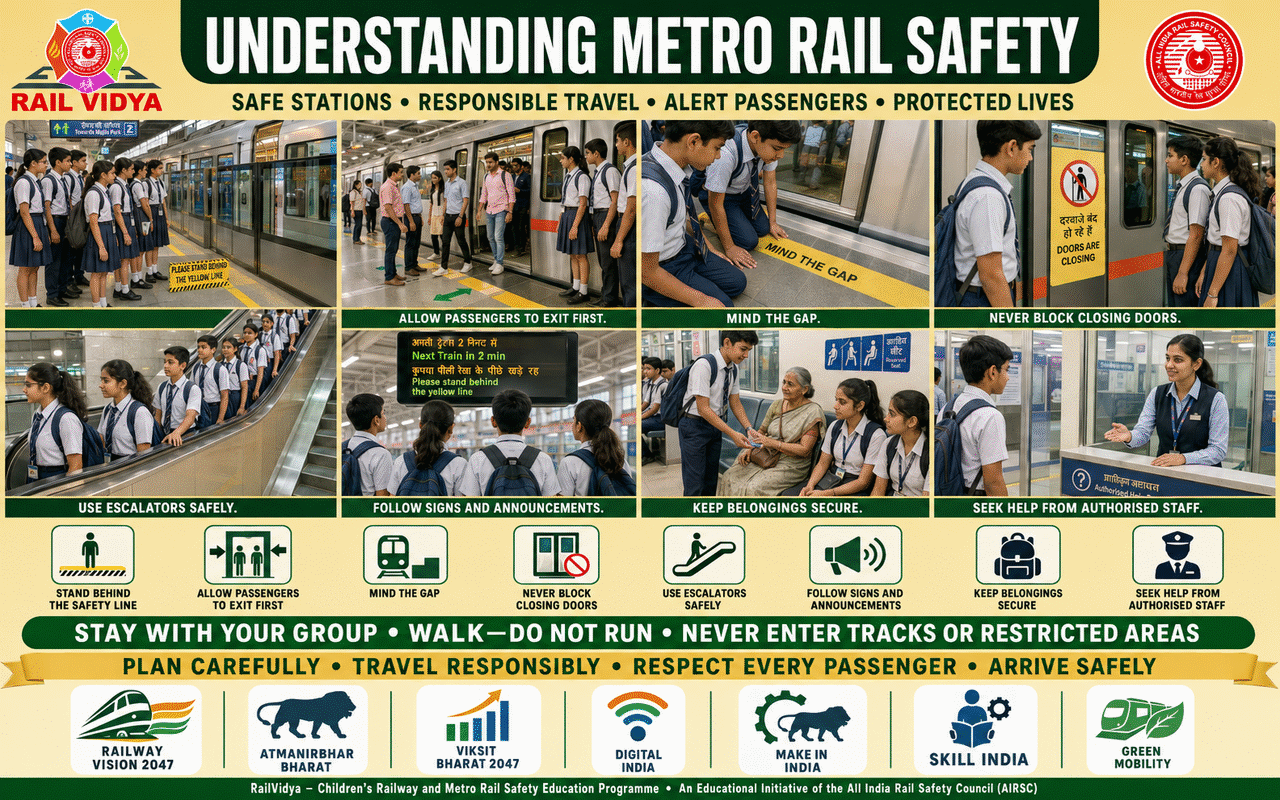
Understanding Metro Rail Safety helps children become alert, disciplined and responsible passengers by teaching them to follow official instructions, remain with accompanying adults, stand behind platform safety lines, use escalators and lifts carefully, allow passengers to exit before boarding and stay away from tracks, tunnels and restricted areas. Through RailVidya, students learn that safe metro travel depends on responsible behaviour, respect for public infrastructure, consideration for fellow passengers and calm cooperation with authorised personnel during every journey.
Understanding Metro Rail Safety
Metro rail systems have become an essential part of India’s modern urban-transport network, providing safe, efficient, accessible and environmentally responsible mobility to millions of passengers. As metro networks continue to expand across major cities and emerging urban centres, children must be equipped with the knowledge and responsible habits required to use these systems safely and confidently. Through RailVidya – Children’s Railway and Metro Rail Safety Education Programme, an educational initiative of the All India Rail Safety Council (AIRSC), metro-safety principles are presented in a practical, engaging and age-appropriate manner.
Metro rail operates within a highly organised environment supported by automatic doors, platform screen doors, signalling systems, electrical installations, surveillance facilities, passenger-information displays and emergency-communication systems. These technologies strengthen safety, but their effectiveness also depends upon disciplined passenger behaviour. Children should understand that signs, announcements, barriers and instructions from authorised metro personnel must always be observed without delay.
A metro station is not a playground. Platforms, escalators, lifts, stairways, entry gates and train doors are busy passenger areas that require continuous attention. Children should remain with a parent, teacher, guardian or authorised group leader and must never run, chase, push, play or wander into restricted locations. Remaining calm and attentive reduces the risk of falls, separation and unsafe contact with station equipment.
Metro tracks and tunnels are strictly prohibited areas. Children must never enter a track area, cross between platforms through the tracks or attempt to retrieve a fallen object. Metro trains may approach rapidly and, in some systems, electrical equipment near the tracks may carry dangerous voltage. If a toy, mobile phone, bag or another item falls onto the track, the child should remain safely on the platform and immediately inform authorised metro personnel.
Platform safety begins by remaining behind the designated line or tactile warning surface until the train has stopped and boarding is permitted. Where platform screen doors are installed, children must not touch, lean against, climb upon or interfere with them. These doors are important protective systems and should be treated with the same respect as all other safety equipment.
Safe boarding requires patience and orderly movement. Passengers inside the train must be allowed to exit before others begin boarding. Children should enter calmly under adult supervision, mind the gap between the platform and train, and keep their hands, clothing, toys and bags clear of the doors. They must never force, hold or block closing train or platform-screen doors.
If the doors begin to close, children should not rush forward or attempt to place a hand, foot or object between them. They should step back and wait for the next train. A missed metro service normally results in only a short delay, while attempting to enter through closing doors can cause injury or separation from accompanying adults.
Inside a metro train, children should occupy a seat safely or use an approved handhold when standing. They should not run between coaches, climb on seats, lean against doors or interfere with emergency equipment. Bags should be kept secure and away from aisles and doorways. During sudden acceleration or braking, holding a stable support helps prevent falls.
Reserved seats and accessible facilities must be respected. Children should learn to show consideration for senior citizens, pregnant passengers, persons with disabilities, passengers carrying infants and anyone who may require additional assistance. Metro-safety education should develop not only personal awareness but also courtesy, inclusion and responsible citizenship.
Mobile phones, headphones, games and photography can create distraction. Children should put devices away when walking, using escalators, boarding, alighting or moving near platforms. They must remain able to hear announcements, alarms and instructions. Photography should never be attempted near platform edges or restricted facilities, and official rules concerning recording must always be followed.
Children should know how to recognise authorised metro personnel, security staff, help desks, emergency intercoms and passenger-assistance points. If separated from a parent or teacher, they should remain calm, stay in a visible public area and seek assistance from uniformed personnel. They must never leave the station with an unknown person or attempt to travel independently in search of their group.
During an emergency or service disruption, children should follow official announcements and remain with their accompanying adult. They should not panic, run with crowds, enter restricted passages or use emergency equipment without genuine need. Calm observation and obedience to authorised instructions are among the most important emergency-safety behaviours.
Metro systems may differ between cities in their station design, ticketing methods, security procedures and emergency arrangements. Therefore, children and accompanying adults should observe the official instructions displayed by the relevant metro operator. Only currently valid information from authorised sources should be included in educational resources and public guidance.
As India advances towards integrated urban mobility and sustainable public transport under Viksit Bharat 2047, metro-safety education will become increasingly important. A world-class metro system requires not only modern technology but also informed passengers who practise discipline, respect public infrastructure and care for the wellbeing of others.
Through RailVidya, AIRSC seeks to prepare children to become responsible metro passengers and Young Safety Ambassadors. A child who understands metro risks, obeys instructions and shares correct safety messages with family and friends contributes to safer urban mobility and a stronger national safety culture.
Understand the System • Follow the Rules • Remain Alert • Travel Safely
Safe Behaviour at Metro Stations
Safe behaviour at metro stations is essential for protecting children and ensuring orderly passenger movement. Metro stations combine trains, automated doors, escalators, lifts, stairways, security systems and large numbers of passengers within a carefully managed environment. Every child must understand that responsible conduct at the station is an important part of a safe journey.
Children should remain close to their parent, guardian, teacher or authorised group leader from the moment they enter the station until they reach their destination. They should never wander away, follow strangers or enter staff-only and restricted areas. Before group travel, adults should explain the route, destination and simple steps the child should follow if separated.
At security-screening and ticketing areas, children should wait patiently and follow instructions from authorised personnel. Tokens, smart cards and digital tickets should be used carefully and only at designated gates. Children should never crawl beneath barriers, climb over gates, push through closing flaps or interfere with ticketing equipment.
Station entrances, corridors and concourses should be used with calm and orderly movement. Running, pushing, chasing or playing can cause collisions and falls, particularly in crowded locations. Children should keep to marked pedestrian routes, avoid blocking passenger flow and ensure that school bags, toys and other belongings do not create tripping hazards.
Escalators require careful use. Children should face forward, hold the handrail, stand securely within the step markings and keep shoelaces, clothing and bags away from moving edges. They must never sit, run, jump, play, travel in the opposite direction or lean over the side. Younger children should use escalators only with close adult supervision.
Lifts should be used responsibly, particularly because they may be prioritised for persons with disabilities, senior citizens, pregnant passengers and families with infants. Children should allow passengers to exit first, avoid jumping or overcrowding and keep away from closing doors. Controls, alarms and emergency buttons must not be treated as toys.
On stairways, children should walk, hold the handrail and remain attentive. Sitting on steps, sliding down rails or blocking landings can endanger other passengers. During peak periods, children should stay close to their responsible adult and move with the flow of passengers without rushing.
At the platform, children must remain behind the designated safety line or tactile warning surface. They should never sit on the platform edge, lean over the track, push others or place belongings near the edge. Tactile surfaces are important accessibility features for passengers with visual impairments and should remain free from luggage and obstruction.
Where platform screen doors are present, children must never lean against, climb, strike or interfere with them. They should wait until both the train and screen doors open fully and boarding is authorised. Hands, fingers, clothing, toys and bags must be kept away from all automatic doors.
Orderly boarding and alighting are essential. Children should stand to the side and allow passengers to exit before entering the train. They should board calmly, mind the platform gap and move away from the doorway after entering. If the train is crowded or the doors begin to close, they should step back and wait for the next service.
Children must never attempt to hold doors open for another passenger. They should also avoid standing directly in front of closing doors or returning hurriedly for a forgotten item. Parents, teachers and guardians should plan sufficient time and prevent last-minute rushing, which can lead to unsafe decisions.
Metro tracks and tunnels must never be entered. If an object falls onto the track, children and adults must not attempt to retrieve it. The incident should be reported immediately through an authorised help point or to metro personnel. Trained staff can follow the required safety procedures.
Children should pay close attention to official signs, platform displays and public announcements. Headphones should be removed and mobile devices put away when walking or waiting near platforms. Station arrangements, train destinations and emergency instructions can change, making continuous attention essential.
Personal security must form part of station-safety education. Children should not accept food, gifts, travel assistance or invitations from unknown persons. If they feel uncomfortable, become separated or observe threatening behaviour, they should approach uniformed metro personnel, security staff, police officers or an authorised help desk.
Unattended or suspicious objects must never be touched, opened or moved. Children should step away and report them immediately. Smoke, sparks, damaged equipment, overcrowding, slippery floors or another unsafe condition should also be brought to the attention of authorised personnel without attempting to manage the danger independently.
Emergency exits, alarms, communication devices, fire-safety equipment and evacuation routes must remain clear. Children should recognise these facilities but never activate or misuse them without genuine cause. During an emergency, they should remain calm, stay with their accompanying adult and follow official announcements and staff instructions.
Cleanliness and respect for public property contribute to station safety. Children should use designated bins, avoid spilling food or water and never damage seats, signs, doors, cameras, ticketing equipment or passenger facilities. A clean, unobstructed and well-maintained station protects everyone.
Responsible metro behaviour also includes courtesy. Children should respect queues, personal space, priority facilities and fellow passengers. Assistance should be offered safely and under adult guidance. Good station conduct demonstrates awareness, empathy and respect for shared public infrastructure.
Parents and teachers must provide continuous supervision and model the correct behaviour. When adults queue patiently, use escalators properly, avoid blocking doors and follow announcements, children learn that safety is a normal public responsibility. Clear instruction supported by a consistent example creates lasting habits.
As metro networks expand across India, safe station behaviour must become an important part of children’s education. Through RailVidya, the All India Rail Safety Council seeks to cultivate a generation capable of using modern urban-transport systems confidently, respectfully and responsibly.
Walk—Do Not Run • Stand Behind the Safety Line • Allow Passengers to Exit • Follow Official Instructions
© 2026 Dr.R.Padmanabhan. All Rights Reserved.
Chairman — All India Rail Safety Council (AIRSC)
Promoting Railway Safety, Education and Public Awareness
Email: admin@railsafety.co.in | Website: www.railsafety.co.in/ www.railsafety.in/ www.airsc.in