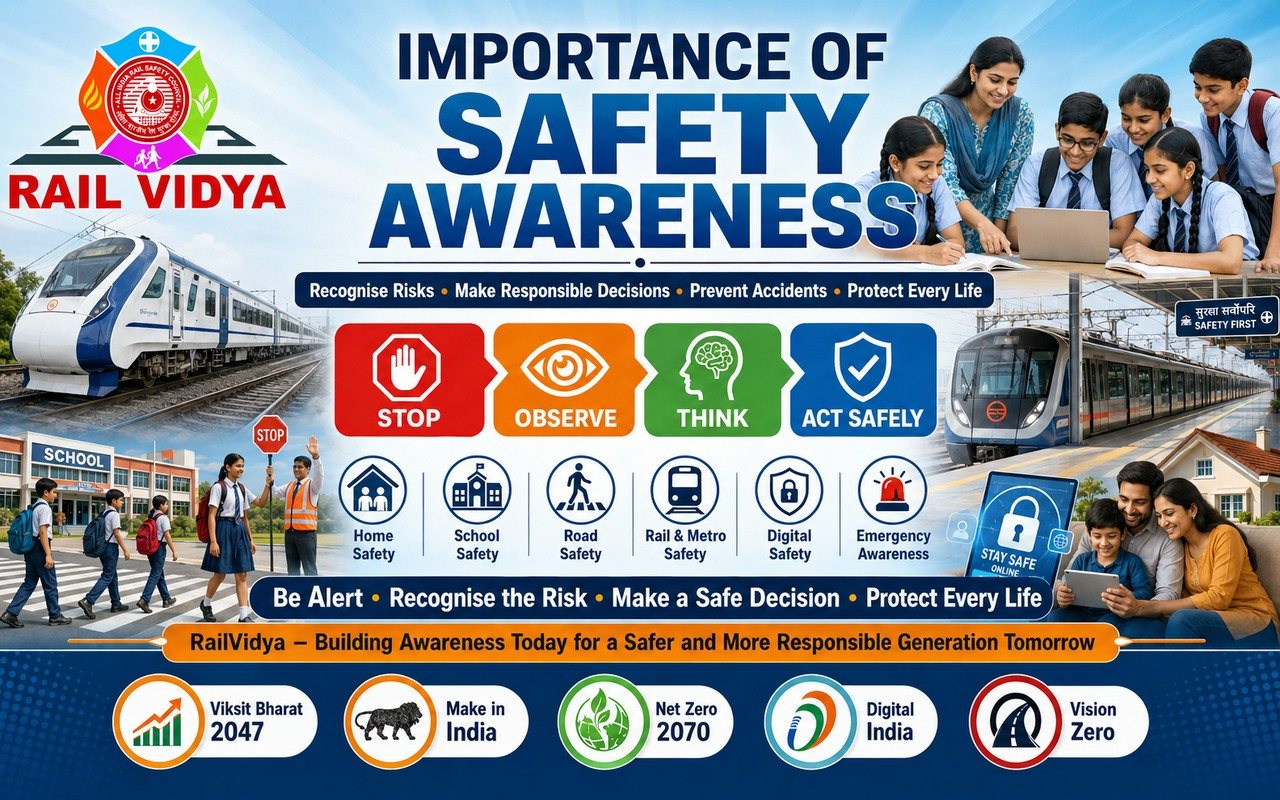
Be Alert • Recognise the Risk • Make a Safe Decision • Protect Every Life RailVidya – Building Awareness Today for a Safer and More Responsible Generation Tomorrow
Importance of Safety Awareness
Safety awareness is the ability to recognise potential dangers, understand warning signs and make responsible decisions before an accident or emergency occurs. For children, it is one of the most important life skills because it helps them move confidently and safely through the different environments they encounter every day—including the home, school, road, playground, railway station, metro premises, public transport and digital world. Safety awareness does not create fear; instead, it develops alertness, confidence, discipline and the ability to respond wisely.
A safety-aware child learns to observe carefully and notice changes in the surrounding environment. An unfamiliar object, damaged electrical wire, unusual smell, wet floor, open gate, approaching vehicle, changing traffic signal, railway warning bell, platform announcement or suspicious online message may indicate a possible risk. Recognising these early signs allows the child to stop, think, move away from danger and seek assistance from a trusted adult or authorised safety professional.
Safety awareness must be understood as a continuous habit—not something practised only during an accident or emergency. It begins before leaving home and continues throughout the day. Checking whether the road is clear before crossing, using designated pedestrian crossings, wearing a seat belt or helmet, remaining behind railway and metro platform safety lines, avoiding overcrowded areas, following school instructions and protecting personal information online are all examples of preventive awareness. These responsible actions may appear simple, but they can prevent serious harm and protect lives.
The principle of “Stop, Observe, Think and Act Safely” should guide every child when facing an unfamiliar or potentially dangerous situation. Children must be encouraged to pause before acting, examine their surroundings, consider the possible consequences and choose the safest available option. They should understand that curiosity, excitement, peer pressure or convenience must never be allowed to override personal safety. If a situation appears unsafe, the correct response is to maintain a safe distance, avoid touching or entering the area and immediately inform a responsible adult.
At home, safety awareness helps children recognise hazards such as exposed electrical wires, overloaded sockets, unattended cooking appliances, leaking gas, unsafe medicines, sharp objects, slippery floors and open balconies. Children should be taught not to handle hazardous materials or attempt repairs on their own. Their responsibility is to identify the danger, avoid contact and promptly alert a parent, guardian or another trusted adult.
Within the school environment, awareness includes following classroom and laboratory rules, using stairs carefully, avoiding running or pushing, participating responsibly in emergency drills and reporting damaged furniture, unsafe equipment, bullying or suspicious activity. Children must know the location of emergency exits and assembly points and understand whom to approach when assistance is required. A safety-aware student contributes not only to personal protection but also to the well-being of classmates, teachers and the entire school community.
Road and travel safety require constant attention. Children should remain alert near moving vehicles, avoid using mobile phones or earphones while crossing roads, walk on designated footpaths and never suddenly enter the roadway. While travelling, they should use seat belts and other protective equipment, remain seated where required, avoid distracting the driver and board or alight only at safe and authorised locations. Awareness enables children to anticipate risks and take preventive action rather than reacting after danger has already developed.
Railway and metro environments demand an especially high level of vigilance. Children must stay away from railway tracks, use foot overbridges, subways and authorised crossings, obey warning signals and never cross under or around a closed level-crossing gate. At stations, they should remain with parents, teachers or guardians; stand behind the platform safety line; avoid running, pushing or playing; allow passengers to exit before boarding; and maintain a safe distance from train doors and platform edges. Any unattended object, unsafe activity or emergency condition should immediately be reported to railway, metro, police or security personnel.
Digital safety awareness is equally important in a child’s modern daily life. Children should understand that online risks may not always be immediately visible. Suspicious links, unknown friend requests, requests for passwords, false offers, cyberbullying and attempts to obtain personal photographs or location details are serious warning signs. A digitally aware child protects personal information, communicates responsibly and reports disturbing or suspicious interactions to a trusted adult without fear or embarrassment.
Safety awareness also strengthens emergency preparedness. Children who understand alarms, evacuation signs, emergency contact procedures and basic first-aid principles are better prepared to remain calm during difficult situations. However, awareness also means recognising personal limitations. Children should never enter a hazardous area or attempt a dangerous rescue. The safest response is to move away from immediate danger, inform the appropriate authority and follow the directions of trained professionals.
Parents, teachers and community leaders have a shared responsibility to develop safety awareness through clear guidance, practical demonstrations, role-play activities, safety walks, emergency drills and regular discussion. Children should be encouraged to ask questions, report concerns and learn from real-life situations without being frightened or blamed. When adults model responsible behaviour consistently, children are more likely to understand that safety is a valuable personal and social responsibility.
Safety awareness ultimately transforms knowledge into prevention. It enables children to observe carefully, recognise warning signs, avoid unsafe actions and respond appropriately whenever circumstances change. A safety-aware child becomes a responsible traveller, disciplined student, careful digital user and compassionate member of the community. By developing this habit from an early age, children can protect themselves, influence their families and contribute to safer schools, safer journeys and a safety-conscious India.
Be Alert • Recognise the Risk • Make a Safe Decision • Protect Every Life
RailVidya – Building Awareness Today for a Safer and More Responsible Generation Tomorrow