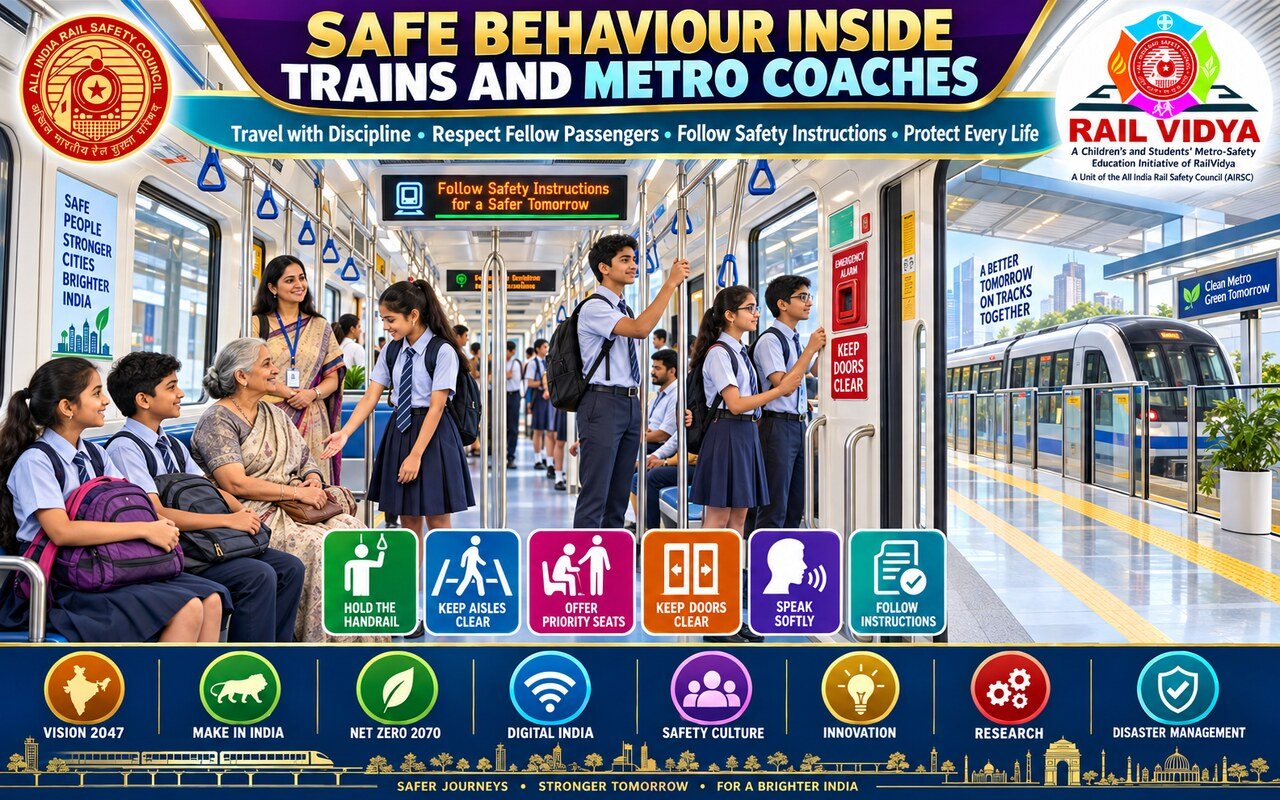
SAFE BEHAVIOUR INSIDE TRAINS AND METRO COACHES Travel with Discipline • Respect Fellow Passengers • Follow Safety Instructions • Protect Every Life
Safe Behaviour Inside Trains and Metro Coaches
Travel with Discipline • Respect
Fellow Passengers • Follow Safety Instructions • Protect Every Life
A Children’s and Students’ Passenger-Safety Awareness Initiative of
RailVidya
A Unit of the All India Rail Safety Council (AIRSC)
Travelling by train or metro is an important part of daily life for millions of students and families. A safe journey depends not only on railway infrastructure and trained personnel but also on the responsible behaviour of every passenger. Through this awareness initiative, RailVidya encourages children and students to develop discipline, alertness, courtesy and respect for safety rules whenever they travel inside trains and metro coaches.
Children should travel under suitable adult supervision according to their age, maturity and the conditions of the journey. Before entering a coach, they should know their destination, remain close to their parents, guardians or teachers and follow all official signs, announcements and instructions. Safe travel begins with patience and continues through responsible behaviour until the journey is completed.
Board Only After the Train Has Stopped
Children must board a train or metro only after it has stopped completely and the doors have opened. They should never run alongside a moving train, jump into or out of a coach, or attempt to board after the departure warning has sounded. Such actions can cause falls, entrapment and life-threatening injuries.
Passengers waiting outside should first allow those inside the coach to exit. Children should stand to the side of the doorway, keep the centre clear and board in an orderly manner after the exit path is free. Pushing, rushing and competing for seats can place children, senior citizens and persons with disabilities at serious risk.
Keep Away from Doors
Train and metro doors are operational safety systems and must never be treated as places for standing, leaning or playing. Children should move away from the doorway after boarding and allow space for other passengers to enter safely. They must not sit on the floor near doors, place their hands between door panels or obstruct the entrance with bags.
Automatic metro doors and platform-screen doors should never be forced open, held back or blocked. Children must not attempt to enter or exit while the doors are closing. If a child misses a train or cannot board with their group, it is safer to remain on the platform and seek authorised assistance than to make a dangerous last-second attempt.
In conventional trains where certain doors may not close automatically, children must remain well away from open doorways. They must never stand, sit, lean or take photographs near an open door. A sudden movement, curve, vibration or loss of balance can result in a fatal fall.
Never Lean Outside a Train
Children must never place their head, hands, arms or any object outside a train window or doorway. Poles, signals, structures, vegetation, passing trains and other trackside objects may be dangerously close to the coach. Even a moment of carelessness can cause severe injury.
Students must also avoid throwing bottles, food wrappers or other objects from windows. Thrown objects can injure railway workers, passengers or people near the tracks. Waste should be placed only in designated bins or retained until a proper disposal facility is available.
Do Not Touch Emergency Controls
Emergency alarms, communication buttons, door-release devices, emergency windows, fire extinguishers and other safety equipment are provided for genuine emergencies. Children must never touch, activate, damage or play with these systems. Misuse can interrupt services, create panic and delay assistance for someone facing a real emergency.
If a child observes smoke, fire, suspicious behaviour, an unattended object, a medical emergency or another serious danger, they should immediately inform their accompanying adult, coach attendant, train crew, metro staff, security personnel or another authorised official. An emergency communication device should be operated only when necessary and in accordance with official instructions.
Students should not attempt to repair equipment or investigate a technical problem. Electrical panels, inter-coach connections, control cabinets and staff-only areas are restricted for a reason and must not be accessed.
Keep Aisles, Doors and Emergency Exits Clear
Bags, luggage and other belongings should not obstruct aisles, coach doors, connecting passages or emergency exits. Obstructed movement can cause falls during normal travel and create serious difficulties during an evacuation.
School bags should be kept close to the body, placed securely under a seat where permitted or stored in the designated luggage area. Bags must not be left where passengers may trip over them. Wheeled luggage should remain stable and controlled so that it does not move when the train accelerates, brakes or turns.
Children should never sit or lie in an aisle. During crowded journeys, they should remain close to their accompanying adult and avoid moving unnecessarily through the coach.
Sit Safely or Hold a Handrail
When a seat is available, children should sit properly without placing their feet on another seat or occupying unnecessary space. They should not stand on seats, climb luggage racks or move between seats while the train is travelling.
If standing is necessary in a metro coach, children should hold a suitable handrail or support and maintain a balanced position. Sudden braking or acceleration can cause passengers to lose their balance. Children should not rely on doors, other passengers or unsecured luggage for support.
Seats reserved for senior citizens, pregnant passengers and persons with disabilities should be respected. Offering appropriate assistance demonstrates courtesy and responsible citizenship, but children should not physically assist someone in a way that could place either person at risk.
Do Not Run, Push or Play
A train or metro coach is a moving public-transport environment, not a playground. Running, chasing, jumping, pushing, wrestling or playing games inside a coach can lead to falls and injuries. Such behaviour may also disturb other passengers and interfere with safe movement.
Children should speak at a reasonable volume and avoid shouting, playing loud music or creating unnecessary disturbance. Good passenger behaviour reflects discipline, consideration and respect for the shared journey.
Remain with Parents, Guardians or Teachers
Young children should remain close to the adult responsible for them throughout the journey. Students travelling as a school group should follow the instructions of their teachers and travel coordinators. They should not change coaches, move to another platform or leave the train at an intermediate station without permission.
Before the journey, groups should agree on what to do if a member becomes separated. A child who becomes separated should not panic or follow an unknown person. The child should approach an authorised railway or metro official, security employee, police officer, coach attendant or staffed help point and contact the responsible adult.
Use Mobile Phones Responsibly
Mobile phones should not distract children from announcements, warning signals or the instructions of their accompanying adults. Children should not walk through moving coaches while looking at screens. Headphone volume should remain low enough to hear safety announcements and surrounding activity.
Children must never attempt dangerous selfies, videos or social-media challenges near train doors, windows, inter-coach connections or railway tracks. They should not record other passengers without permission. Personal details visible on tickets, identity cards and travel documents should not be posted online.
Charging devices should be used carefully and only where charging is officially permitted. Children should not use damaged chargers, overloaded adaptors or exposed electrical sockets. Any sparks, unusual heat, smoke or burning smell should be reported immediately to an adult or authorised staff member.
Protect Personal Belongings and Information
Children should keep tickets, identity cards, mobile phones and bags secure. Valuables should not be displayed unnecessarily, and luggage should never be left unattended. Children must not accept food, drinks, gifts or travel assistance from unknown persons.
Personal information such as a home address, school name, telephone number, travel destination or family details should not be shared with strangers. If someone’s questions or behaviour makes a child uncomfortable, the child should move closer to a trusted adult and report the concern.
Respect Fellow Passengers
Safe travel includes respectful and inclusive behaviour. Children should not block seats, speak offensively, bully other passengers or damage public property. They should show consideration towards younger children, senior citizens, pregnant passengers and persons with disabilities.
Students should respect personal space and avoid touching another person or their belongings without permission. If anyone behaves inappropriately, threatens them or violates their personal boundaries, they should move away and tell a parent, teacher or authorised official immediately.
Maintain Cleanliness and Hygiene
A clean coach supports passenger health, comfort and safety. Children should use designated bins where available and must never leave food, liquid or waste on the floor. Spilled liquids, loose objects and discarded packaging can cause passengers to slip or fall.
Students should follow appropriate hygiene practices and avoid spitting, damaging seats or writing on coach surfaces. Public property belongs to the nation and should be protected with care and responsibility.
Safety Around Inter-Coach Areas
Children must not stand between coaches, sit near inter-coach connections or attempt to move through restricted connecting areas. They should move between permitted coaches only when necessary, when it is safe and under adult guidance.
In trains with vestibule connections, children must avoid touching moving plates, doors or mechanical components. Entering locomotive cabins, guard compartments, technical spaces or staff-only sections is strictly prohibited unless specifically authorised.
Responding to a Medical Emergency
If a passenger becomes ill, falls or loses consciousness, children should immediately alert a responsible adult or authorised staff member. They should not crowd around the person or attempt medical procedures without recognised training and supervision.
The surrounding area should be kept clear for trained responders. Children can assist safely by remaining calm, following instructions and accurately explaining what they observed. Medicines should never be given to an unknown passenger without professional advice.
Responding to Fire, Smoke or an Unusual Smell
Smoke, flames, sparks or a burning smell must be reported immediately. Children should not touch suspicious equipment, open electrical panels or attempt to collect their belongings before leaving an unsafe area.
They should remain calm, listen to official announcements and follow the directions of train crew, metro personnel or emergency responders. Fire extinguishers should be used only by trained persons when conditions allow. Emergency exits should never be opened during normal travel or without an authorised instruction.
Safe Conduct During an Emergency Evacuation
If an evacuation becomes necessary, children should stay with their responsible adult, move in an orderly manner and avoid pushing. They must leave bags and non-essential belongings behind if those items delay safe evacuation.
Children should never jump from a train unless authorised personnel direct them and provide a safe method. Railway tracks may contain moving trains, uneven surfaces and dangerous electrical systems. Evacuation onto or near tracks must occur only under the control of railway or metro authorities.
After leaving the coach, children should proceed to the designated safe area and remain there. They must not return to the train until authorised officials confirm that it is safe.
Follow Official Instructions
Announcements, safety notices and staff directions are provided to protect passengers. Children should listen carefully and encourage their friends to cooperate. Rumours and unverified social-media messages should not be followed during an incident.
If instructions appear unclear, a child should ask a parent, teacher or authorised official for guidance. Staying calm and relying on verified information helps prevent confusion and panic.
The Role of Parents, Teachers and Schools
Parents and teachers should explain train and metro safety rules before every group journey. Younger children should be supervised closely during boarding, travel and alighting. Adults must model safe conduct because children often repeat the behaviour they observe.
Schools can strengthen passenger-safety awareness through classroom lessons, station visits, role-play activities, travel plans and RailVidya Safety Clubs. Students should learn how to recognise authorised personnel, emergency signs, coach numbers, station names and designated meeting points.
A Message from RailVidya
Safe behaviour inside trains and metro coaches is a shared responsibility. Every child who waits patiently, keeps away from doors, respects emergency equipment and follows official instructions contributes to a safer journey for everyone.
RailVidya calls upon children and students to become Young Rail Safety Ambassadors by practising discipline, encouraging responsible passenger behaviour and sharing essential safety messages with their families and communities. Safety is not merely a rule to remember—it is a responsible habit that protects life.
RailVidya Safety Messages
“Inside Every Train, Safety Begins with Discipline.”
“Keep Away from Doors • Keep Aisles Clear • Follow Instructions • Travel Safely.”
“Alert Children • Responsible Students • Safe Coaches • Protected Lives.”