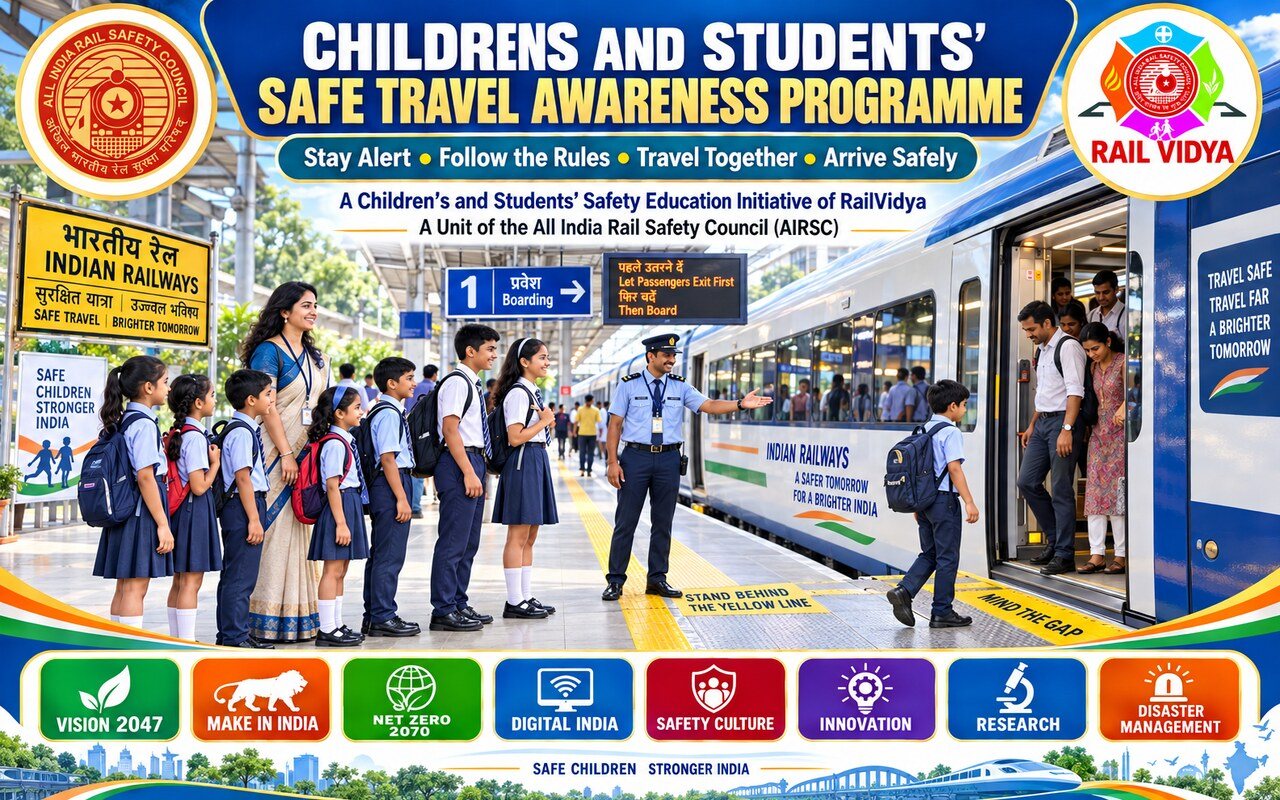
CHILDREN’S AND STUDENTS’ SAFE TRAVEL AWARENESS PROGRAMME Alert Children • Responsible Students • Safe Journeys • Protected Lives An Educational Initiative of the All India Rail Safety Council (AIRSC)
Children’s and Students’ Safe Travel Awareness Programme
Alert
Children • Responsible Students • Safe Journeys • Protected Lives
An Educational Initiative of the All India Rail Safety Council (AIRSC)
Safe travel is an essential life skill for every child and student. Whether travelling by train, metro, school bus, public transport, private vehicle, bicycle or on foot, young travellers must understand how to identify risks, follow safety rules and respond responsibly in unfamiliar or emergency situations. Through its Children’s and Students’ Safe Travel Awareness Programme, RailVidya seeks to develop alertness, discipline, confidence and responsible travel behaviour from an early age.
Children should plan every journey with the knowledge and permission of their parents, guardians or teachers. Younger children must always travel with a trusted adult and remain close to that person in stations, terminals, bus stops and other crowded places. Students should know their destination, travel route and the name and contact number of a responsible adult. They should never leave a station, vehicle or designated meeting point without informing the person accompanying them.
Before beginning a journey, children should carry only necessary belongings and keep their school bags, identity cards, tickets and personal items secure. Bags should be properly closed and carried in a way that does not obstruct doors, aisles, stairways or other passengers. Children should not accept food, drinks, gifts, lifts or travel assistance from strangers. Personal information—including home address, school details, passwords, travel plans and telephone numbers—must not be shared with unknown persons or posted publicly online.
At railway and metro stations, students must use authorised entrances, foot overbridges, subways, escalators and pedestrian pathways. Railway tracks must never be used as shortcuts, playgrounds, walking paths or places for taking photographs and videos. Children should never cross tracks except through an officially authorised crossing. They must obey warning signs, announcements, railway gates, traffic signals and instructions given by authorised railway, metro, security or emergency personnel.
While waiting on a platform, children and students must remain well behind the designated safety line and avoid standing near the platform edge. Running, pushing, playing, leaning over the edge or using mobile phones carelessly can lead to serious accidents. Students should stay together when travelling in groups and immediately inform a teacher, guardian or authorised official if anyone becomes separated. Crowded areas require additional patience, awareness and cooperation.
Boarding should begin only after the train, metro, bus or other vehicle has stopped completely and passengers have been allowed to exit. Children must never rush, push, block doorways or attempt to board a moving vehicle. They should mind the gap between the platform and the train, use handrails where available and allow senior citizens, persons with disabilities, pregnant passengers and travellers with young children sufficient space and time.
Inside a train, metro or bus, students should sit safely or hold an approved handrail when standing. Doors, emergency equipment and control panels must never be touched or misused. Children must not lean out of windows, place their hands outside a vehicle, sit on steps or footboards, climb between coaches or attempt to open doors while the vehicle is moving. Aisles and exits should remain clear so that passengers can move safely, particularly during an emergency.
Road travel also demands constant attention. Children must walk on footpaths wherever available and cross roads only at zebra crossings, pedestrian signals, subways or other designated points. Before crossing, they should stop, look carefully in all directions, listen for approaching vehicles and proceed only when it is safe. Mobile phones, headphones and games should not be used while crossing roads or walking through busy traffic areas because distraction can prevent children from noticing danger.
When travelling in a school bus or another road vehicle, students should wait in a safe place away from moving traffic. They should board and alight in an orderly manner, remain seated, wear seat belts wherever provided and avoid distracting the driver. No child should place their head, hands or belongings outside a moving vehicle. After leaving a bus, students should wait until it has moved away and cross the road only from a location where approaching traffic can be clearly seen.
Children travelling by bicycle must wear a properly fitted helmet, use a roadworthy bicycle and follow applicable traffic rules. Reflective clothing, lights and visible safety accessories are especially important during low-light conditions. Cycling beside fast-moving traffic, holding onto vehicles, performing stunts or using a mobile phone while riding is extremely dangerous. Young cyclists should use safer designated routes and travel under suitable adult guidance whenever required.
Digital responsibility is another important part of travel safety. Mobile phones may be helpful for communication, navigation and emergency assistance, but they should never distract children near roads, tracks, platforms, escalators or vehicle doors. Students must not take selfies or record videos in prohibited or hazardous places. Photographs of tickets, identity cards, live locations or travel documents should not be shared publicly because such information can affect personal security.
In crowded places, children should remain calm, avoid pushing and move with the flow of passengers. If a child becomes separated from a parent, guardian or school group, they should not leave the area with an unknown person. They should approach an authorised station official, police officer, security employee, help desk or another clearly identified responsible authority. Where available, official emergency helplines, alarm points and assistance counters should be used.
During an emergency, students should stay calm, listen carefully to official instructions and move towards the designated safe area without running or creating panic. Emergency exits and equipment must be used only when necessary and under proper guidance. Children should never attempt a dangerous rescue, touch exposed electrical equipment, approach fire or enter a restricted area. The safest response is to move away from danger, alert a responsible adult and call trained emergency services.
Respectful behaviour makes every journey safer. Children should maintain cleanliness, protect public property, speak politely, keep noise at a reasonable level and offer appropriate consideration to passengers who may need assistance. They should never bully, tease, intimidate or endanger fellow travellers. Safety includes not only preventing accidents but also protecting the dignity, comfort and well-being of everyone using public transport.
Parents, teachers and educational institutions have an important responsibility to prepare children for safe travel. Regular discussions, demonstrations, supervised journeys, emergency-contact exercises and age-appropriate safety activities can transform rules into lifelong habits. Adults must also lead by example because children often learn travel behaviour by observing the people around them.
Through RailVidya, the All India Rail Safety Council encourages every child and student to become a responsible Young Safety Ambassador. A safety-aware child can influence classmates, family members and the wider community through informed and disciplined behaviour. By learning safety today and practising it during every journey, children can help prevent avoidable harm and contribute to a safer, more caring and responsible India.
RailVidya Safety Message:
“Plan Your Journey • Stay Alert • Follow Safety Rules • Respect Others •
Reach Safely.”
“Every Safe Journey Begins with Awareness and Ends with Responsibility.”