“Preserving Railway Heritage • Promoting Safety Knowledge • Inspiring Future Generations • Strengthening the Nation”
Importance of
Indian Rail Museums
Preserving the Nation’s Railway Heritage,
Inspiring Future Generations
A
Perspective by the All India Rail Safety Council
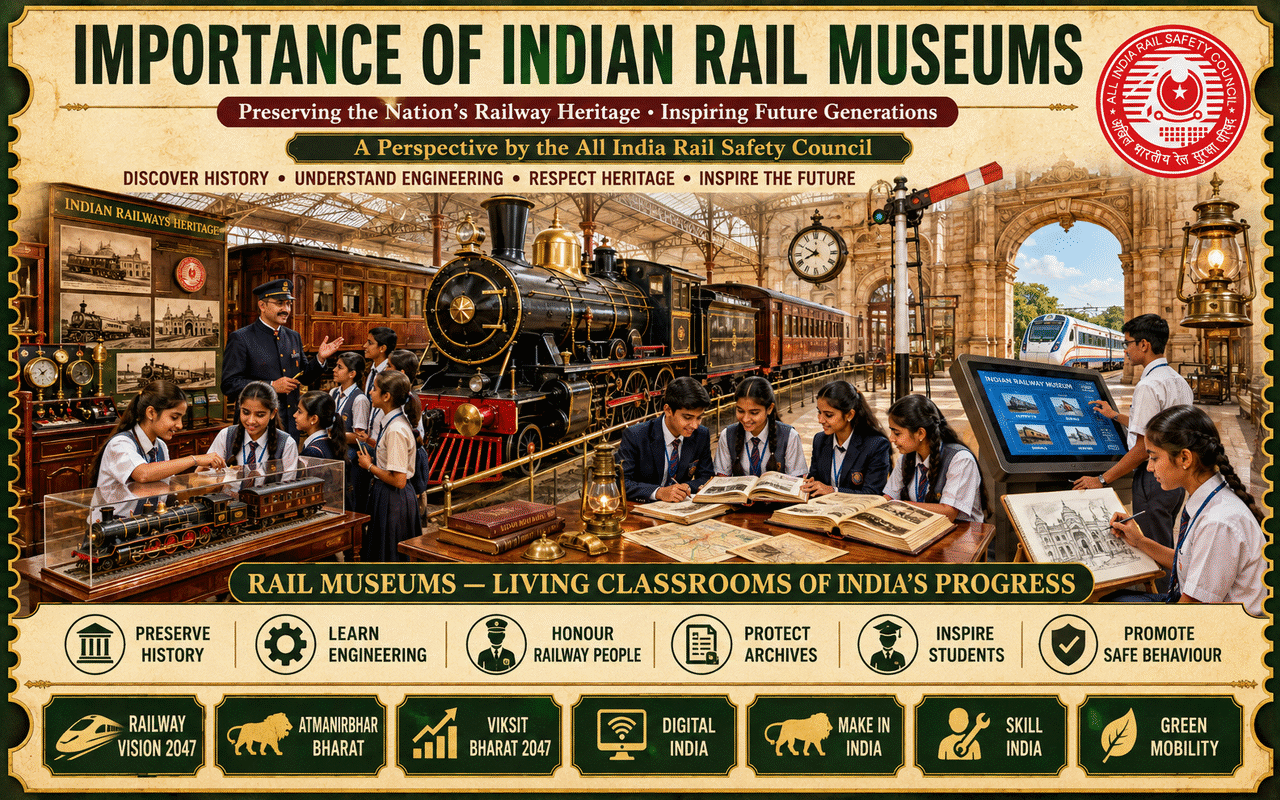
India’s railway heritage represents far more than the history of trains, tracks and stations. It reflects the extraordinary story of national integration, industrial development, engineering achievement, public service and social transformation. For generations, the railways have connected distant regions, enabled trade and commerce, supported national security, created employment and brought people of different languages, cultures and communities closer together. Indian rail museums therefore serve as vital national institutions that preserve, interpret and communicate this remarkable journey.
A railway museum is not simply a collection of old locomotives, coaches, signalling instruments and historical documents. It is a living centre of knowledge where engineering, technology, human endeavour and national memory come together. Every preserved steam locomotive, heritage carriage, station clock, railway badge, route map, communication instrument and archival photograph carries an important story about the people and technologies that built India’s railway system. Protecting these objects ensures that the achievements and experiences of earlier generations are not lost with the passage of time.
India possesses one of the world’s richest and most diverse railway legacies. Its railway history includes pioneering engineering works, mountain railways, monumental bridges, tunnels, workshops, station architecture, steam technology, signalling systems and the development of an extensive national transportation network. Indian rail museums provide an organised platform for presenting this heritage in an educational, meaningful and publicly accessible form. They help visitors understand how the railway system evolved from early mechanical operations to electrification, advanced signalling, modern high-speed mobility, digital systems and increasingly sustainable transportation.
Rail museums also make an important contribution to national identity. Indian Railways has played a decisive role in connecting villages, towns, cities, ports, industrial centres, agricultural markets, pilgrimage destinations and border regions. It has supported the movement of people and essential commodities during major national events, emergencies and periods of economic transformation. A railway museum records these contributions and reminds citizens that the railway is not merely a mode of transport—it is an institution deeply connected with the nation’s development and collective experience.
The educational importance of rail museums is especially significant. For schoolchildren and college students, a museum visit can transform history and science into a memorable learning experience. Locomotives, wheels, braking mechanisms, track systems, signalling equipment and communication technologies offer practical opportunities to understand engineering, physics, mechanics, electricity, electronics and transportation management. Well-designed exhibitions can encourage curiosity, technical thinking, creativity and interest in railway-related professions.
For students of engineering, architecture, archaeology, industrial design, transportation, management and public policy, rail museums can function as valuable academic resources. They provide tangible evidence of how infrastructure was designed, constructed, operated and maintained under different technological conditions. Historical railway systems also demonstrate how engineering decisions are shaped by geography, climate, available materials, operational requirements and human factors. Museums can therefore support project work, technical studies, research publications, internships and professional training.
From the perspective of the All India Rail Safety Council, railway museums have a special responsibility to promote safety education. Historical accidents, technological failures and operational challenges have led to improvements in braking, signalling, track inspection, communication, fire protection, rolling-stock design and emergency management. Carefully curated exhibits can explain how the railway safety system has evolved and why compliance with safety procedures remains essential. Such exhibitions must be factual, respectful and focused on institutional learning, prevention and continuous improvement.
Interactive safety galleries can educate passengers and communities about safe behaviour at railway stations, platforms, level crossings and areas near railway tracks. Visitors can be informed about the dangers of trespassing, unauthorised track crossing, roof travel, leaning out of trains, unsafe photography, boarding or alighting from moving trains and approaching overhead electrical equipment. Demonstrations on emergency communication, evacuation, fire safety and responsible passenger conduct can make rail museums powerful centres of public safety awareness.
Railway museums are equally important for preserving the contributions of railway employees. The growth of Indian Railways has depended upon generations of engineers, technicians, drivers, guards, station masters, track maintainers, signalling personnel, workshop employees, safety professionals, medical teams, security personnel and administrative officers. Their dedication, discipline and specialised knowledge form an essential part of India’s railway story. Museums should document their experiences through photographs, uniforms, tools, diaries, oral histories, recorded interviews and personal collections.
The human dimension of railway heritage must receive the same attention as locomotives and infrastructure. Railway colonies, institutes, hospitals, schools, workshops, sports organisations and cultural associations created distinctive communities across India. Documenting these institutions can help future generations understand the social life that developed around the railway system. Special galleries may also recognise the contributions of women railway employees, indigenous workers, artisans, technicians and communities whose efforts have not always received adequate historical visibility.
Rail museums can make an important contribution to the conservation of heritage railway stations, bridges, workshops, signalling cabins and operational structures. Preservation should not be limited to movable objects displayed inside a building. Historic railway environments should be documented and, wherever feasible, conserved as integrated heritage sites. Restored station rooms, platforms, ticket counters, control equipment and workshop spaces can provide visitors with a deeper understanding of how railway operations functioned during different periods.
Digital technology offers new opportunities to make railway museums more accessible and engaging. Three-dimensional models, virtual-reality journeys, augmented-reality exhibits, interactive route maps, digital archives and simulated locomotive cabins can help visitors experience railway history in dynamic ways. Artificial intelligence may support multilingual interpretation, personalised learning and easier access to large archival collections. Digitisation is also essential for protecting fragile documents, drawings, photographs, films and operational records against deterioration or accidental loss.
However, digital presentation should complement rather than replace the authenticity of original heritage objects. The physical presence of a historic locomotive, handmade instrument, engineering drawing or railway employee’s personal record creates an emotional and educational connection that cannot be reproduced entirely through a screen. The most effective museums combine authentic collections with modern interpretation, enabling visitors to appreciate both the material heritage and the wider historical meaning of each exhibit.
Indian rail museums can also become important centres for specialised research and knowledge exchange. Partnerships with railway organisations, universities, engineering institutions, archives, professional bodies and conservation experts can support the documentation of railway history and technology. Museums can organise seminars, exhibitions, heritage lectures, student competitions, technical workshops and oral-history projects. Such collaboration would help establish railway heritage as a serious field of interdisciplinary research rather than treating it only as a recreational subject.
The economic and tourism potential of rail museums is equally substantial. Well-managed museums can attract families, students, domestic tourists, international visitors, historians, railway enthusiasts and engineering professionals. Heritage train rides, restored coaches, model railway displays, guided tours, railway-themed cultural programmes and regional exhibitions can strengthen local tourism. Museums located near historic stations and railway settlements can also become anchors for broader heritage-tourism circuits, generating employment and supporting local businesses.
Accessibility and inclusion must remain central to museum development. Exhibitions should be designed for children, senior citizens and persons with disabilities. Information should be made available in English, Hindi and relevant regional languages. Audio guides, tactile models, ramps, clear signage, accessible washrooms, seating areas and appropriately trained guides can ensure that railway heritage is open to every section of society. A national institution becomes meaningful only when citizens can engage with it comfortably and with dignity.
Environmental sustainability should also guide the future of Indian rail museums. Heritage conservation programmes can demonstrate how repair, restoration and adaptive reuse reduce waste and extend the life of valuable assets. Museums can highlight the transition from steam and diesel traction to electrification, renewable energy, energy-efficient systems and low-carbon transportation. Exhibitions on green stations, water conservation, solar power, regenerative braking and climate-resilient infrastructure can connect railway history with India’s sustainable-mobility goals.
India requires a coordinated national approach to railway heritage conservation. Historically significant locomotives, coaches, documents and equipment must be scientifically assessed, catalogued and preserved before they deteriorate or disappear. Clear acquisition policies, professional conservation laboratories, disaster-management plans, fire-protection systems, climate-controlled archives and trained heritage personnel are essential. Digital inventories should be created so that collections across different museums and railway zones can be studied and managed systematically.
Public participation can greatly strengthen this mission. Retired railway employees, their families, collectors, historians and local communities often possess rare photographs, documents, uniforms, badges, tickets, manuals and personal memories. Structured donation, documentation and oral-history programmes can help preserve these materials with proper acknowledgement and care. Citizen participation can transform railway museums into genuinely shared institutions built around the memories and contributions of the people.
The All India Rail Safety Council believes that Indian rail museums should be developed as integrated centres of heritage conservation, safety education, technical learning, research, tourism and national inspiration. They should connect the achievements of the past with the responsibilities of the present and the possibilities of the future. By presenting both historical progress and the lessons learned through experience, these museums can promote stronger safety culture, professional excellence and public respect for railway infrastructure.
As India advances towards Viksit Bharat 2047, modernisation must move forward together with heritage conservation. New trains, advanced signalling, artificial intelligence, indigenous manufacturing and sustainable technologies represent the future of Indian mobility; historic locomotives, stations, documents and employee experiences explain the foundations upon which that future is being built. Preserving railway heritage is therefore not an act of looking backward—it is an investment in education, institutional memory and responsible national development.
Indian rail museums ultimately belong to the people of India. They celebrate the workers who built the railway, the professionals who operate it, the passengers whose journeys shaped the nation and the innovations that continue to transform mobility. By protecting this legacy with vision and professional commitment, India can ensure that future generations understand not only how its railways developed, but also why safety, discipline, innovation and public service must remain at the heart of every railway journey.
AIRSC’s Commitment
The All India Rail Safety Council remains committed to encouraging railway-heritage preservation, safety-based museum education, professional research, student engagement and institutional collaboration. AIRSC advocates the development of Indian rail museums as nationally significant knowledge centres capable of preserving history, strengthening safety awareness, inspiring future professionals and contributing to a safer, smarter, sustainable and culturally enriched railway ecosystem.
“Preserving Railway Heritage • Promoting Safety Knowledge • Inspiring Future Generations • Strengthening the Nation”
All India
Rail Safety Council
Railways—The Lifeline of Our Nation
www.railsafety.co.in