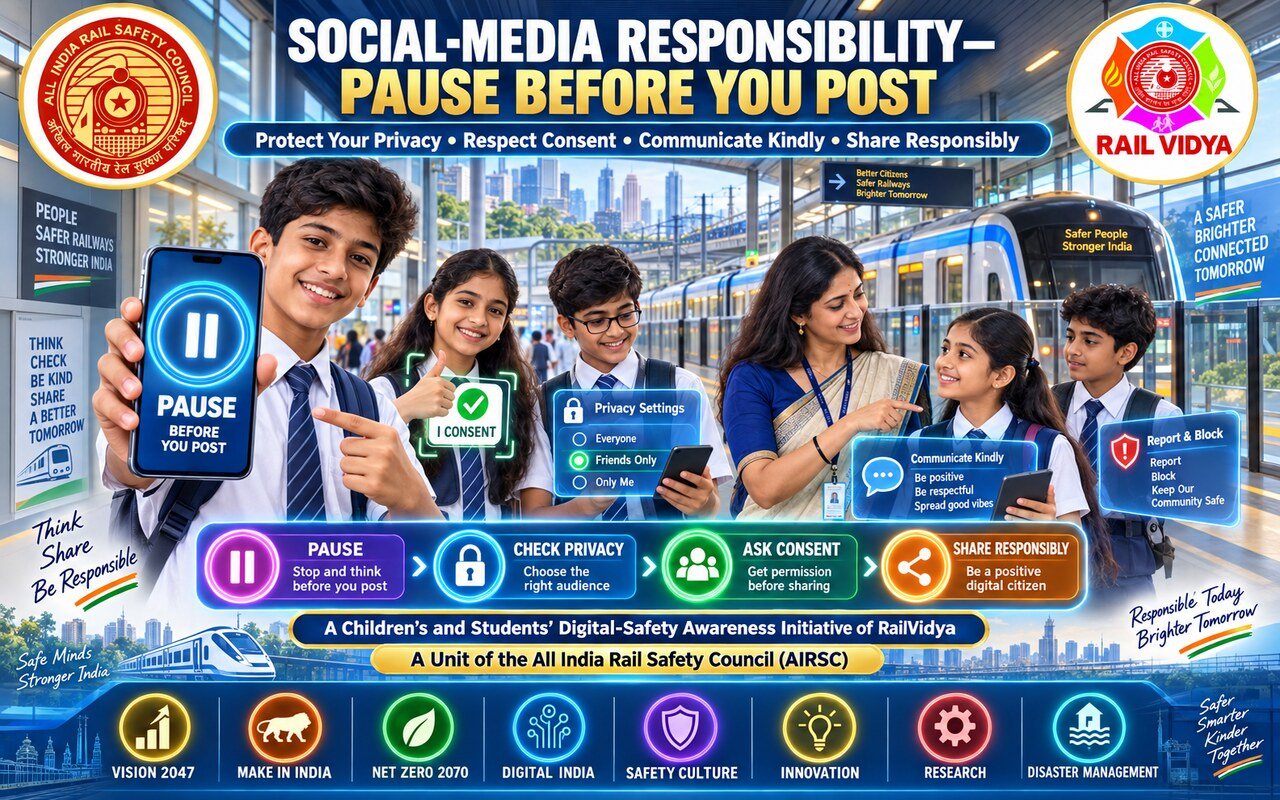
SOCIAL-MEDIA RESPONSIBILITY—PAUSE BEFORE YOU POST Protect Your Privacy • Respect Consent • Communicate Kindly • Share Responsibly
Social-Media Responsibility—Pause Before You Post
Protect Your
Privacy • Respect Consent • Communicate Kindly • Share Responsibly
A Children’s and
Students’ Digital-Safety Awareness Initiative of RailVidya
A Unit of the All India Rail Safety Council (AIRSC)
Social media allows children and students to learn, communicate, express creativity and participate in positive communities. However, every post, photograph, video, comment and message can affect personal safety, privacy, reputation and the well-being of others. Through this awareness initiative, RailVidya encourages young people to become thoughtful and responsible digital citizens who pause, examine and make safe decisions before sharing anything online.
The internet can spread information quickly and widely. Content intended for a small group may be copied, forwarded, recorded or displayed to people beyond the original audience. Even deleted material may remain available through screenshots, downloads or archived copies. Children should therefore remember a simple principle: if something is unsafe, private, hurtful or inappropriate, do not post it.
Pause and Think Before Posting
Before posting any content, students should ask themselves: Is it true? Is it kind? Is it necessary? Is it safe? Do I have permission to share it? Could it embarrass, harm or reveal private information about anyone? Would I be comfortable if my parents, teachers or future educational institutions saw it?
A short pause can prevent a long-lasting mistake. Children should not post when they are angry, frightened, upset or under pressure from friends. Emotional messages may be misunderstood and can damage relationships. It is safer to save the content, step away from the screen and speak to a trusted adult before deciding whether to share it.
Protect Personal Information
Children must not publicly share their home address, telephone number, school name, classroom details, passwords, identification numbers, daily routine or travel plans. Photographs of school identity cards, certificates, tickets and official documents may reveal sensitive information and should remain private.
Live-location sharing should be used only with the knowledge and approval of a parent or guardian. Publicly announcing that a child is alone, away from home or travelling without an adult can create a serious personal-safety risk.
Students should examine the background of photographs and videos before uploading them. A school badge, house number, vehicle registration plate, station sign, name board or personal document may reveal more than intended.
Use Privacy Settings Carefully
Privacy settings can help limit who sees an account, sends messages, comments on posts or views a location. Children should review these settings with a parent or guardian and keep personal accounts private where appropriate.
Privacy controls reduce risk but do not guarantee complete privacy. Approved followers can still take screenshots, download content or forward it to others. Children should share only material they are prepared to have seen beyond the intended audience.
Unknown follower requests should not be accepted merely because the account has mutual contacts, attractive photographs or a familiar name. Online profiles can be false, copied or deliberately misleading.
Respect Consent Before Sharing
Children should obtain permission before posting a photograph, video, voice recording or personal story involving another person. Consent should be clear and freely given. If someone says no, appears uncomfortable or later asks for the content to be removed, that decision should be respected.
Permission to take a photograph is not automatically permission to publish it. Similarly, information shared privately should not be made public without approval. Screenshots of private chats, video calls or personal messages should never be circulated to embarrass or expose another person.
Extra care is required when content includes younger children, persons experiencing distress or individuals receiving medical assistance. Their dignity and privacy must always take priority over online attention.
Communicate with Respect
Responsible communication requires kindness, honesty and self-control. Students should avoid insults, threats, abusive language, rumours and comments about another person’s appearance, background, disability, religion, culture or family circumstances.
Words posted online can cause real emotional harm. A message that appears humorous to one person may feel humiliating or frightening to another. Children should communicate online with the same respect they would show during a face-to-face conversation.
Disagreement is not a reason for abuse. Students can express a different opinion politely, withdraw from an unhealthy discussion or ask a trusted adult for guidance. They should never encourage others to target or isolate someone.
Prevent Cyberbullying
Cyberbullying may include repeated insults, rumours, threats, impersonation, exclusion, unauthorised sharing of photographs or the creation of harmful content about another person. It can occur through social-media platforms, messaging services, online games, group chats and educational applications.
A child experiencing cyberbullying should not retaliate or continue an abusive argument. Where safe, relevant evidence such as usernames, messages, dates and screenshots should be preserved. The account should be blocked and reported, and the child should immediately speak to a parent, teacher, school counsellor or another trusted adult.
Students who witness cyberbullying should not like, forward or add comments to harmful content. They should support the affected person privately, report the material and inform a responsible adult. Remaining silent while harmful content spreads can allow the bullying to continue.
Be Cautious with Online Friendships
An online contact should not automatically be trusted, even if the person appears friendly or claims to be the same age. Names, photographs, schools and personal stories can be invented. Children should not move conversations into secret chats or share private photographs with someone whose identity has not been verified by a trusted adult.
Students must never agree to meet an online contact without the knowledge, permission and presence of a parent or guardian. Anyone who asks a child to keep a relationship secret, delete messages or hide conversations from family members is demonstrating unsafe behaviour.
If a person becomes threatening, controlling, sexual, manipulative or overly interested in personal information, the child should stop communicating, block and report the account, and tell a trusted adult immediately.
Never Share Intimate or Inappropriate Content
Children should never create, request, save or share intimate images of themselves or another young person. Such material can be copied, misused, circulated without consent and used for threats or exploitation.
If someone pressures a child to send an inappropriate photograph or video, the child should refuse, stop contact and tell a trusted adult. If material has already been shared, the child should seek help immediately rather than attempting to manage the situation alone. The child deserves protection and should not be blamed for asking for assistance.
Threats to publish private material must be treated seriously. Children should not pay money, provide further content or continue negotiating with the person making the threat. Evidence should be preserved where safe and the matter should be reported to responsible adults and the appropriate platform or authority.
Verify Information Before Sharing
Not everything online is accurate. False news, edited images, misleading videos, impersonated accounts and artificially generated content can appear convincing. Students should verify information through reliable sources before believing or sharing it.
A dramatic headline, urgent warning or popular post should not be treated as fact simply because many people have shared it. Children should check the source, date, context and supporting evidence. If they are uncertain, they should ask a teacher, parent or knowledgeable adult.
Forwarding false information can create fear, damage reputations and place people at risk. Responsible digital citizens help stop misinformation rather than spreading it.
Avoid Dangerous Online Challenges
Some social-media challenges encourage risky behaviour near roads, railway tracks, platforms, rooftops, water bodies, electrical installations or moving vehicles. Children must refuse any challenge that could harm themselves or others.
No number of views, likes, followers or online rewards is worth risking a life. Students should report dangerous challenges and encourage friends not to participate. Photographs and videos must never be recorded in restricted railway or metro areas.
Children should remember that online popularity is temporary, but the consequences of a serious accident can be permanent.
Responsible Photography During Travel
Railway tracks, platform edges, train doors, level crossings and electrical installations are unsafe places for selfies and videos. Children should follow all photography restrictions and remain behind designated safety lines.
Students must not lean outside a train, block a coach door, stand on a track or enter a restricted area to create social-media content. If a device falls onto a railway track or roadway, they should never attempt to retrieve it themselves. Authorised personnel must be informed.
Travel tickets, boarding details and live journey information should not be posted publicly because they may reveal a child’s identity, location and movements.
Think Before Tagging a Location
Location tags can show where a child lives, studies, travels or spends time regularly. Posting a live location may allow unknown people to identify a child’s routine. Children should disable unnecessary location permissions and avoid publicly tagging their home or school.
Photographs from holidays, excursions or family events can be shared after leaving the location rather than in real time. Parents or guardians should approve any post that reveals travel details or the child’s current whereabouts.
Protect Accounts and Passwords
Every social-media account should have a strong and unique password. Passwords, verification codes and account-recovery details must not be shared with friends or unknown persons. Multi-factor authentication should be enabled where available.
Children should be suspicious of messages claiming that they have won a prize, must urgently verify an account or need to click a link to avoid being blocked. These messages may be designed to steal login details.
If an account behaves unusually, sends messages without permission or becomes inaccessible, the child should immediately inform a trusted adult. Passwords should be changed through the platform’s official website or application.
Recognise Advertising, Influencers and Hidden Promotion
Social-media posts may be designed to sell products, influence opinions or collect personal data. Influencers and advertisements may present highly edited or unrealistic images. Children should not assume that a product is safe or necessary simply because a popular person promotes it.
Purchases, subscriptions and donations should not be made without parental permission. “Free” offers may request personal information or include hidden costs. Students should learn to distinguish genuine educational content from paid promotion and misleading claims.
Maintain Healthy Screen Habits
Social media should not interfere with sleep, education, physical activity, family relationships or emotional well-being. Children should take regular breaks and avoid continuous scrolling, particularly before bedtime.
Comparing oneself with carefully selected or edited online images can negatively affect confidence. Students should remember that social media rarely shows the complete reality of another person’s life.
If online activity causes anxiety, sadness, anger, sleep problems or pressure to remain constantly connected, the child should speak to a trusted adult. Taking a break, muting notifications or leaving an unhealthy platform can be a positive safety decision.
Do Not Post Emergency Scenes Irresponsibly
During an accident, fire, medical emergency or disaster, children should move to safety and alert authorised personnel. They should not gather around the incident to take photographs or videos. Recording can obstruct emergency responders and violate the dignity of injured or distressed people.
Names, images and personal details of victims should not be shared. Only verified information from authorised sources should be followed during an emergency. Rumours can create panic and interfere with rescue operations.
Understand the Digital Footprint
A digital footprint is the record created by online activity. Posts, comments, photographs, search history and account interactions may remain accessible for years. This record can influence relationships, education and future opportunities.
Children should build a positive digital footprint by sharing respectful, accurate, creative and constructive content. If an old post is inappropriate, it should be removed where possible, and any harm caused should be addressed honestly.
Responsible posting does not mean avoiding social media entirely. It means making choices that protect personal dignity, safety and the rights of others.
Reporting Unsafe Content
Children should report accounts or content involving threats, bullying, impersonation, exploitation, dangerous challenges, hate, violence or inappropriate contact. Platform reporting tools should be used, and a trusted adult should be informed.
If there is an immediate risk to a child’s safety, responsible adults and the appropriate authorities should be contacted without delay. Children should not investigate the matter, confront a dangerous person or attempt to resolve serious threats alone.
Speaking up is a sign of strength. A child who reports harmful content may also protect other young users from experiencing the same danger.
The Role of Parents, Teachers and Schools
Parents and teachers should create an environment where children can discuss online experiences without fear of immediate blame or punishment. Calm and respectful listening helps children report problems early.
Families should regularly review privacy settings, account permissions and age requirements. Schools can promote responsible digital citizenship through classroom lessons, cyber-safety programmes, student discussions and clearly communicated reporting procedures.
Adults should model responsible behaviour by obtaining consent before posting children’s photographs, protecting family information and avoiding harmful online arguments. Children learn digital responsibility by observing the choices made by adults around them.
A Message from RailVidya
Social media should be used to educate, inspire, communicate and build positive relationships—not to harm, humiliate or endanger anyone. Every student has the power to create a safer digital environment through thoughtful posting, respectful communication and responsible reporting.
RailVidya encourages children and students to become Young Digital Safety Ambassadors. Before posting, commenting or forwarding, pause and consider the possible impact. A responsible digital choice protects not only the user but also friends, families, schools and communities.
RailVidya Safety Messages
“Pause Before You Post—Your Digital Choices Have Real-World Consequences.”
“Protect Privacy • Respect Consent • Reject Bullying • Share Responsibly.”
“Think Before You Click • Verify Before You Share • Speak Up When Something Is Unsafe.”
“Use Social Media to Inform, Inspire and Protect—Never to Harm.”