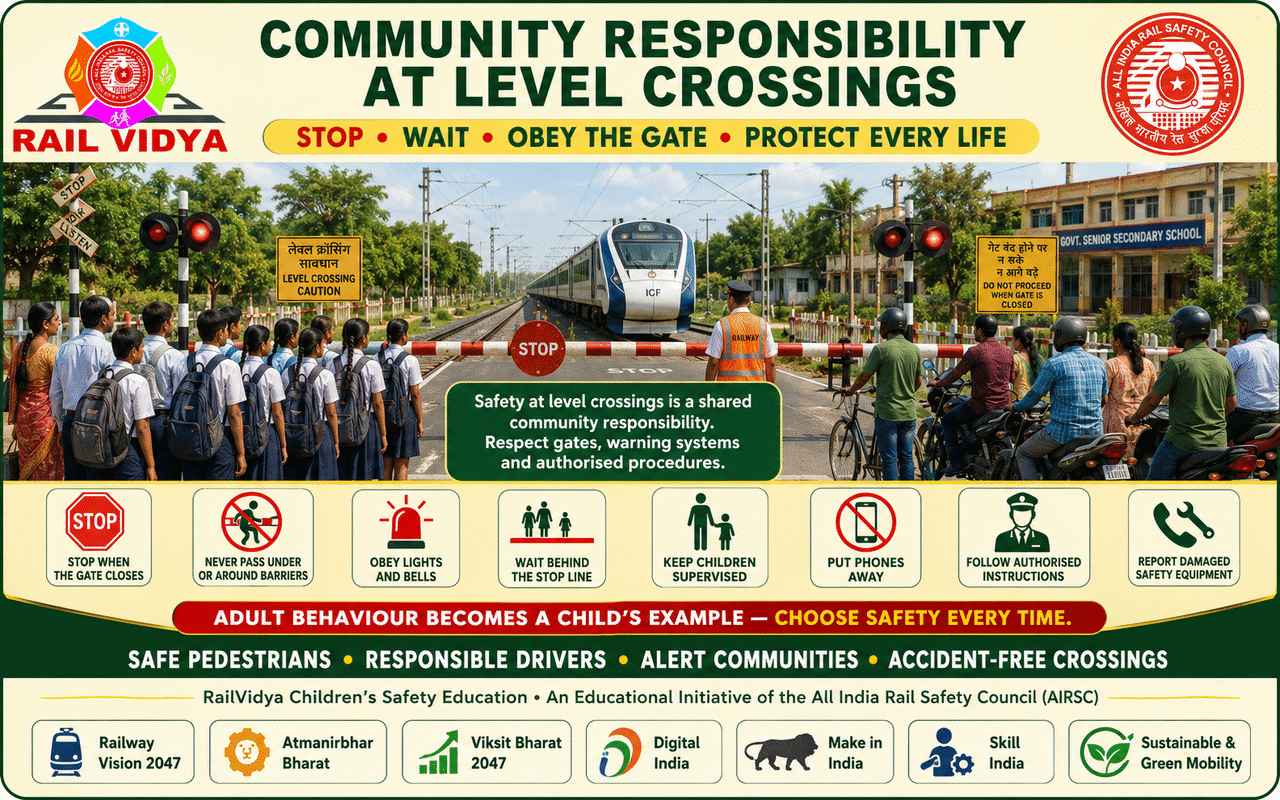
Level-crossing safety depends on responsible behaviour from every member of the community. Through RailVidya, the All India Rail Safety Council (AIRSC) encourages pedestrians, cyclists, drivers, parents, schools and local residents to obey closed gates, warning signals and authorised instructions without exception. By avoiding unsafe shortcuts, keeping crossing approaches clear, setting a positive example for children and promptly reporting hazards through official channels, communities can help prevent accidents and protect every life.
Community Responsibility at Level Crossings
Safety at level crossings is a shared community responsibility. Railway authorities provide operational controls and infrastructure, but the conduct of pedestrians, cyclists, drivers, parents, schools and local residents directly influences whether crossings remain safe. A strong community safety culture begins when every person respects gates, warning systems and authorised procedures.
No community member should pass under, around or through a closed railway gate. Warning lights, bells, barriers and instructions from authorised personnel must be obeyed without exception. Adults must recognise that their behaviour is observed and often copied by children. Bypassing a gate can normalise a dangerous practice across an entire community.
Drivers should approach level crossings at a safe speed, remain in the correct lane and stop behind designated road markings. They should not overtake waiting vehicles, block the tracks or enter a crossing unless there is sufficient space to clear it completely. Motorists must avoid creating pressure on pedestrians and cyclists waiting near the gate.
Pedestrians and cyclists should wait in a safe position away from the barrier mechanism and road traffic. They must not gather on the track side of a closed gate or cross immediately after the first train passes. Movement should begin only when active warnings have ended and the crossing is officially reopened.
Parents, teachers and community leaders should regularly remind children that railway tracks are not shortcuts or play areas. Local awareness campaigns, school assemblies, posters and public meetings can reinforce the message that level-crossing safety protects families and communities.
Residents should never damage, obstruct or interfere with gates, fencing, warning signs, lights or bells. Any apparent defect, damaged barrier, restricted visibility or unsafe condition should be reported promptly through the appropriate official channel. Community members should not attempt unauthorised repairs or direct traffic in ways that conflict with railway controls.
Vendors, parked vehicles and stored materials should not obstruct sightlines, pedestrian routes, gates or warning equipment. Keeping crossing approaches clear supports safer movement and helps road users identify warnings in time.
Community organisations can work with schools to identify safe student routes and discourage the use of informal track crossings. Transport operators, school-vehicle drivers and local groups should participate in periodic safety-awareness programmes suited to the conditions of the area.
If an emergency occurs, members of the public should alert authorised personnel and keep children and bystanders away from danger. No person should enter an operational track area or attempt an unsafe rescue. Clear reporting and professional intervention provide the safest response.
Public awareness should be inclusive and available in locally understood languages and accessible formats. Messages should address pedestrians, cyclists, vehicle drivers, senior citizens, persons with disabilities and children without creating confusion or fear.
The long-term goal is to replace risky habits with shared accountability. When a community refuses to tolerate gate violations, trespassing, distraction and unsafe shortcuts, it creates a protective environment for every resident.
Through RailVidya, the All India Rail Safety Council seeks to mobilise schools, families and communities as partners in accident prevention. Under the national aspirations of Vision Zero and Viksit Bharat 2047, safe railway crossings must represent both modern infrastructure and responsible public behaviour.
Respect the Gate • Set a Safe Example • Report Hazards • Protect the Community
© 2026 Dr.R.Padmanabhan. All Rights Reserved.
Chairman — All India Rail Safety Council (AIRSC)
Promoting Railway Safety, Education and Public Awareness
Email: admin@railsafety.co.in | Website: www.railsafety.co.in/ www.railsafety.in/ www.airsc.in