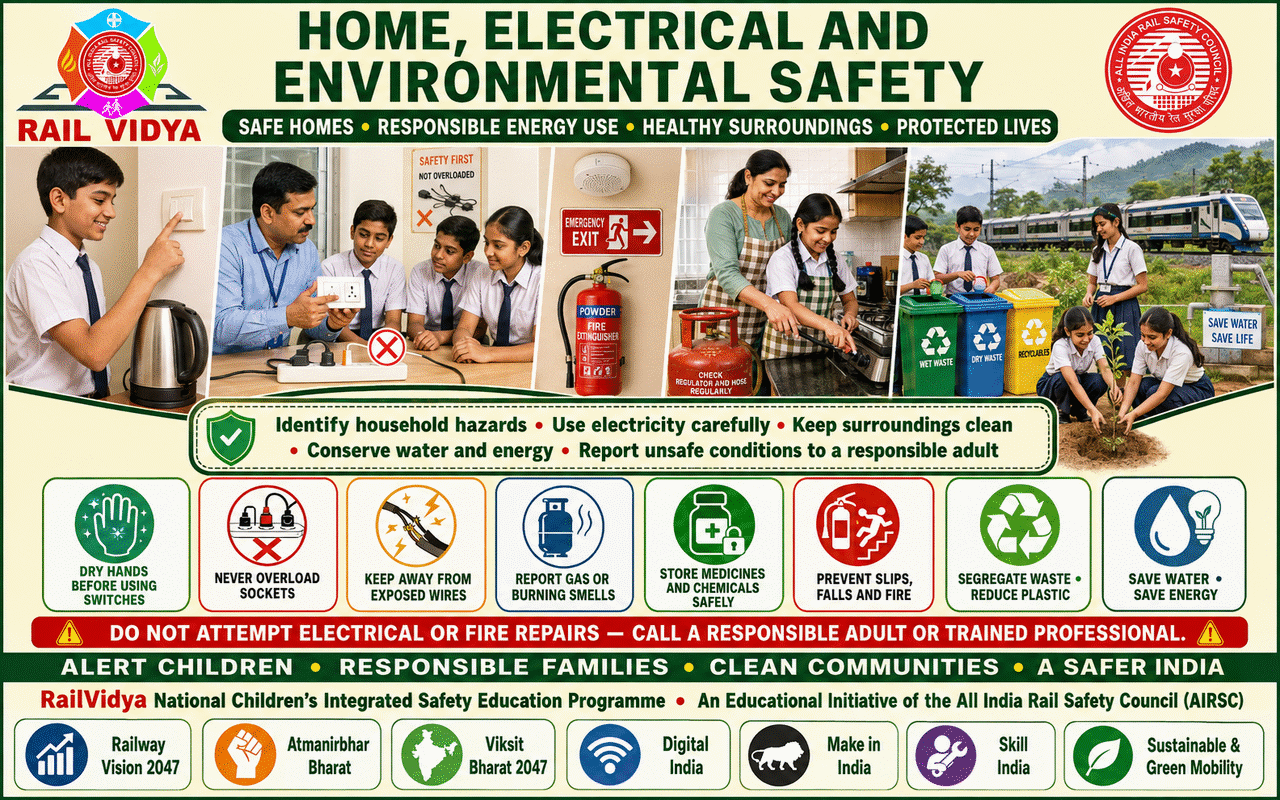
Home, Electrical and Environmental Safety education helps children recognise household hazards, prevent accidents and develop responsible habits for protecting their families and surroundings. Through RailVidya, students learn safe practices related to kitchens, electricity, fire emergencies, chemicals, medicines, waste disposal, hygiene, water and energy conservation. By reporting dangers to responsible adults, avoiding unsafe intervention and participating in family safety planning, children can help create safer homes, healthier communities and a cleaner, more sustainable India.
Home, Electrical and Environmental Safety
Safe Homes • Responsible Energy Use •
Healthy Surroundings • Protected Lives
The home should be a place of comfort, security and well-being; however, everyday household activities can involve risks such as fire, electrical shock, burns, falls, poisoning, gas leakage, unsafe storage, poor waste disposal and environmental pollution. Many of these incidents are preventable when children and families understand hazards, practise safe behaviour and respond correctly to emergencies. Home, electrical and environmental safety education is therefore essential for developing responsible habits that protect individuals, families, communities and natural resources.
The RailVidya National Children’s Integrated Safety Education Programme, an educational initiative of the All India Rail Safety Council (AIRSC), recognises safety as a continuous responsibility extending beyond schools, roads, railway stations and public transport. The programme equips students with practical knowledge to identify household hazards, use electrical appliances carefully, maintain healthy surroundings, conserve essential resources and report unsafe conditions to a responsible adult.
Home Safety and Accident Prevention
A safe home begins with good organisation, cleanliness and awareness. Floors, stairways, balconies, doorways and passages should remain dry, adequately illuminated and free from obstacles. Water, oil and other spills must be cleaned immediately to prevent slips and falls. Toys, footwear, electrical cables and household objects should not be left in walking areas. Staircases should have secure handrails, and children must avoid running, pushing or playing near steps, balconies, windows and rooftops.
Medicines, cleaning chemicals, pesticides, fuels, sharp instruments, matches and lighters must be clearly labelled and stored securely beyond the reach of younger children. Chemicals should never be transferred into food or beverage containers because they may be mistaken for something safe to consume. Students must not taste, smell closely, mix or experiment with unknown substances. If accidental exposure or poisoning is suspected, they should immediately alert an adult and obtain professional medical assistance.
Kitchens require particular care because they contain heat, flames, sharp utensils, hot liquids, gas connections and electrical appliances. Children should use kitchen equipment only with appropriate adult guidance. Pan handles should be turned away from edges, inflammable materials should be kept away from cooking areas and hot vessels must be handled using suitable protection. Loose clothing should not be worn near open flames. If a gas smell is detected, flames and electrical switches should not be operated; doors and windows should be opened where safe, the gas supply should be closed by a responsible adult and authorised emergency assistance should be contacted.
Electrical Safety
Electricity is essential to modern life, but unsafe handling can cause serious burns, electric shock, fire or death. Students must never touch switches, plugs, wires or appliances with wet hands or while standing on a wet surface. Fingers and objects must never be inserted into electrical sockets. Damaged plugs, exposed wiring, loose connections, overheating appliances, sparks or burning smells should be reported immediately to an adult and examined by a qualified electrician.
Electrical sockets should not be overloaded with multiple high-power appliances. Chargers and devices must be used according to the manufacturer’s instructions and disconnected safely by holding the plug rather than pulling the cable. Unapproved, damaged or duplicate chargers can create risks of overheating, battery failure and fire. Mobile phones, tablets, power banks and other rechargeable devices should not be charged beneath pillows, blankets or other materials that restrict ventilation.
Students should never attempt to repair electrical wiring, appliances, fuse boxes, meters or distribution boards. They must maintain a safe distance from transformers, substations, fallen power lines and damaged electrical poles. A fallen wire should always be treated as live. No person should touch the wire, any nearby object or someone receiving an electric shock until the power supply has been safely isolated by authorised personnel.
If a person is in contact with an electrical source, students must not touch the individual directly. They should immediately call an adult and contact emergency services. The power supply should be disconnected only when this can be done safely. Water must never be thrown on an electrical fire. Suitable fire-safety equipment should be used only by someone trained to do so, while children move to a safe location and alert others.
Fire Safety and Emergency Preparedness
Every household should have a simple emergency plan, clearly identified exits and accessible emergency-contact information. Children should know how to raise an alarm, leave the building quickly and proceed to the agreed family assembly point. Doors, corridors and emergency exits must never be blocked. During a fire, students should remain low beneath smoke, avoid using lifts and never return to collect belongings.
If clothing catches fire, the correct response is to stop, drop and roll while protecting the face. Burns should be cooled promptly with clean, cool running water, and medical assistance should be obtained. Oils, creams, powders, ice or unapproved household remedies should not be applied to serious burns.
Environmental Safety and Responsibility
Environmental safety involves protecting people from unhealthy surroundings while safeguarding air, water, soil, plants and animals. Students should learn that littering, burning waste, excessive plastic use, unsafe chemical disposal and contamination of water sources can harm both human health and the environment. Waste should be separated appropriately, placed in designated containers and managed according to local regulations. Batteries, electronic waste, medicines, chemicals and sharp objects require specialised disposal and must not be mixed carelessly with ordinary household waste.
Clean water, sanitation and hygiene are fundamental to a healthy home. Drinking water should be obtained from a safe source and stored in clean, covered containers. Stagnant water should be removed to reduce mosquito breeding. Food and waste must be handled hygienically to prevent insects, rodents and disease. Students should participate in maintaining clean surroundings without touching hazardous or biomedical waste.
Energy and water conservation are also important safety and environmental responsibilities. Lights, fans and appliances should be switched off when not required, leaking taps should be reported and water should not be wasted. Natural ventilation, daylight and energy-efficient equipment should be used whenever practical. Responsible consumption reduces household costs, conserves national resources and supports a cleaner and more sustainable future.
Children should also recognise environmental warning signs such as smoke, unusual chemical odours, polluted water, damaged trees, exposed waste, waterlogging and unsafe construction debris. These hazards should be reported to parents, teachers, local authorities or other responsible persons. Students must never enter contaminated, flooded, unstable or restricted areas to investigate on their own.
Building a Family Culture of Safety
Home safety becomes most effective when every family member participates. Parents and children should regularly check emergency contacts, first-aid supplies, smoke alarms where installed, gas connections, electrical cords, exits and household storage arrangements. Age-appropriate safety discussions and simple family drills can prepare children to respond calmly during fires, electrical failures, severe weather and other emergencies.
Through practical education and family participation, RailVidya aims to develop students who recognise hazards before they cause harm, make responsible decisions and encourage safer behaviour in their homes and communities. A safety-conscious child can become a powerful messenger—protecting the family, conserving the environment and contributing to a healthier nation.
Identify the Hazard • Prevent the Accident • Protect the Family • Preserve the Environment
Safe Home • Safe Electricity • Clean Environment • Healthy Family • Safer India
© 2026 Dr.R.Padmanabhan. All Rights Reserved.
Chairman — All India Rail Safety Council (AIRSC)
Promoting Railway Safety, Education and Public Awareness
Email: admin@railsafety.co.in | Website: www.railsafety.co.in/ www.railsafety.in/ www.airsc.in