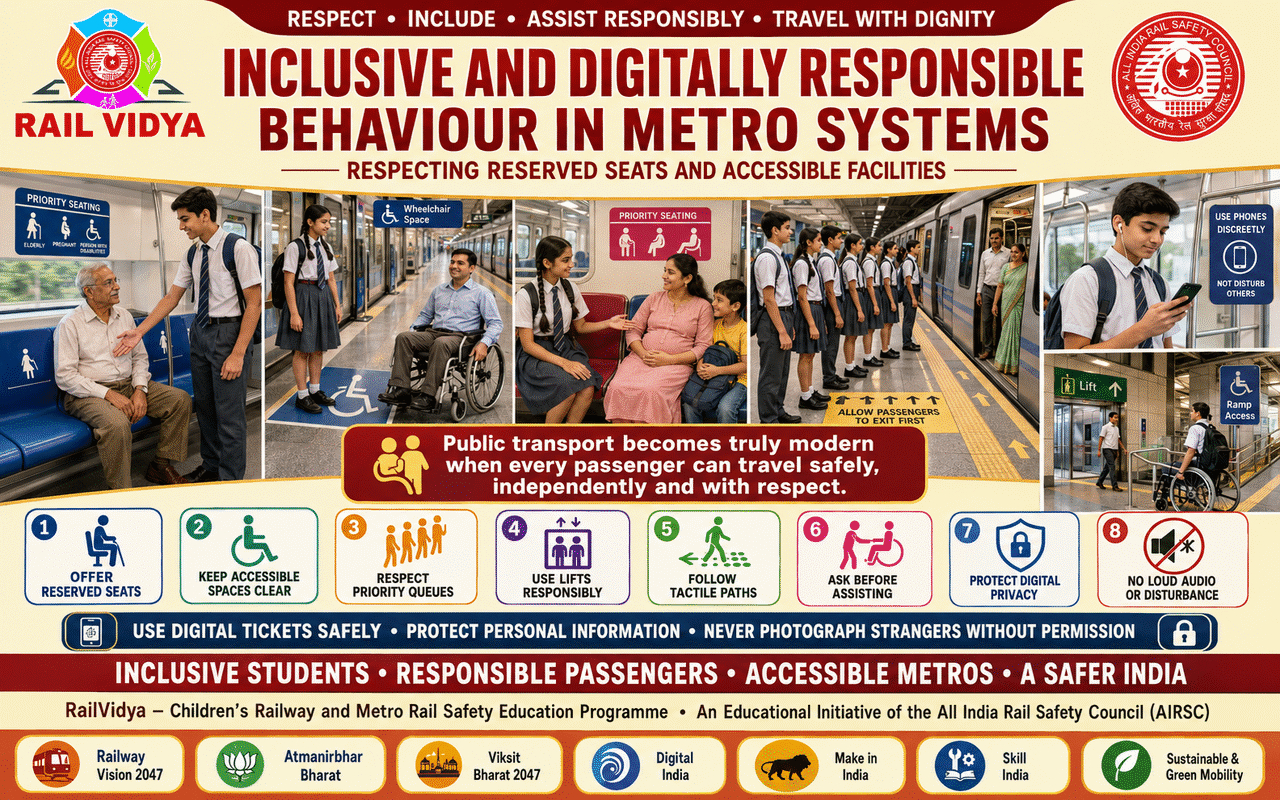
Give Priority • Keep Access Clear • Offer Help Respectfully • Include Every Passenger These responsible habits promote safer, more inclusive and respectful metro journeys for every passenger.
Inclusive and Digitally Responsible Behaviour in
Metro Systems
Respecting Reserved Seats and Accessible Facilities
Respecting reserved seats and accessible facilities is an important expression of safety, dignity, inclusion and responsible citizenship. Metro systems are designed to serve passengers of different ages, abilities and mobility needs. Through RailVidya – Children’s Railway and Metro Rail Safety Education Programme, an educational initiative of the All India Rail Safety Council (AIRSC), children are encouraged to understand that public transport becomes truly modern only when every passenger can travel safely, independently and with respect.
Reserved or priority seats are provided for passengers who may require additional support, including persons with disabilities, senior citizens, pregnant passengers and adults travelling with infants. Specific eligibility and markings may vary across metro systems. Children should observe official signs and give priority to passengers for whom these seats are designated.
A reserved seat should never be treated as a permanent entitlement simply because it is temporarily unoccupied. If an eligible passenger enters the coach, a child occupying that seat should offer it promptly and politely under adult guidance. This small action can reduce the risk of falls and make the journey safer and more comfortable for someone with limited mobility.
Children should avoid placing school bags, toys or personal belongings on passenger seats, especially reserved seats. Belongings should be held securely or stored according to the metro operator’s rules. Keeping seats and aisles clear ensures that passengers can access facilities without unnecessary obstruction.
Accessible facilities may include lifts, ramps, wide ticket gates, tactile pathways, handrails, wheelchair spaces, accessible toilets, lowered counters and audio or visual passenger-information systems. These features are not play equipment. Children must never block, damage or misuse them, as they may be essential to another passenger’s independence and safety.
Tactile paving provides directional and hazard information to passengers with visual impairments. Children should not sit, stand unnecessarily, play or leave luggage on tactile paths. Keeping these surfaces clear allows passengers who depend upon them to navigate more safely.
Accessible lifts should be used with consideration for people who cannot use stairs or escalators easily. Children should allow priority passengers to enter and exit first, avoid overcrowding and never jump, play or repeatedly press lift controls. When another suitable route is available, families and school groups should avoid unnecessarily occupying limited accessible capacity during busy periods.
Wheelchair spaces and priority standing areas inside trains must remain available for their intended users. Children should not sit on the floor, play or store baggage in these locations. They should also avoid holding or moving another person’s wheelchair, walking aid or mobility device unless assistance has been requested and an adult is supervising.
Assistance should be offered respectfully rather than imposed. Children should not assume that every person with a disability needs help. A polite question allows the passenger to decide whether assistance is wanted. Children should follow the person’s directions and avoid touching mobility aids, guide dogs or personal equipment without permission.
Invisible disabilities and temporary health conditions may not be immediately apparent. A passenger using a priority facility may have a genuine need that others cannot see. Children should therefore avoid questioning, staring at or judging anyone. Respectful behaviour protects privacy and dignity.
Audio announcements, visual displays, induction systems and other accessibility technologies support passengers with different communication needs. Children must never interfere with, cover or damage these facilities. They should remain attentive to official information while allowing others to see and hear it clearly.
Parents, teachers and guardians should demonstrate inclusive behaviour by respecting priority markings, keeping accessible routes clear and speaking about disability with dignity. School activities can introduce accessibility through age-appropriate discussions, guided observation and inclusive travel planning.
As India develops modern and integrated urban mobility under Viksit Bharat 2047, accessibility must remain central to public-transport development. World-class infrastructure is measured not only by speed and technology but also by how safely and respectfully it serves every member of society.
Through RailVidya, AIRSC seeks to nurture children who recognise inclusion as a national value. Respecting reserved seats and accessible facilities helps build a metro culture founded on compassion, equality and shared responsibility.
Give Priority • Keep Access Clear • Offer Help Respectfully • Include Every Passenger
© 2026 Dr.R.Padmanabhan. All Rights Reserved.
Chairman — All India Rail Safety Council (AIRSC)
Promoting Railway Safety, Education and Public Awareness
Email: admin@railsafety.co.in | Website: www.railsafety.co.in/ www.railsafety.in/ www.airsc.in