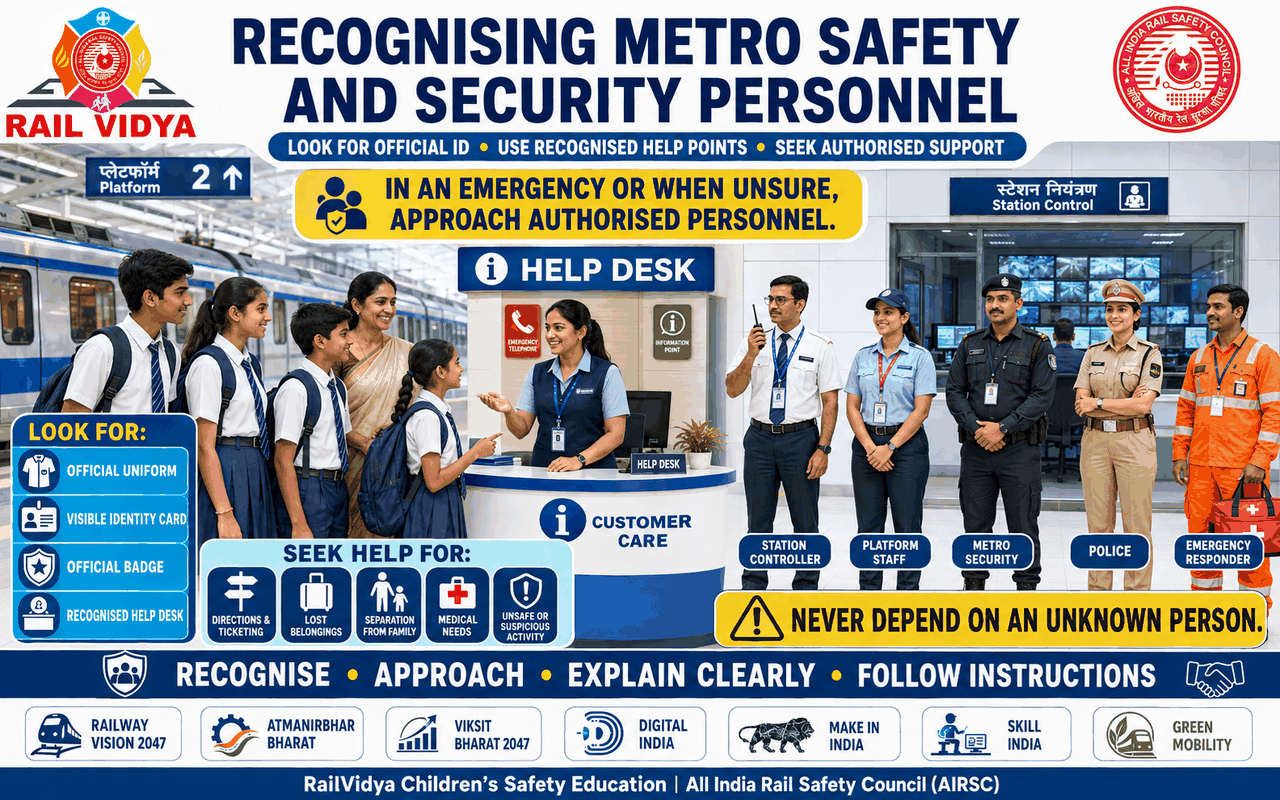
RECOGNISE AUTHORISED PERSONNEL • SEEK SAFE ASSISTANCE Children should seek help from clearly identified metro staff, security personnel, police officers or authorised help counters whenever they are lost, separated, threatened or require assistance. They must check official identification, remain in visible public areas and never follow an unknown person to an isolated place. Recognising the right personnel enables children to request reliable support with confidence and stay safe throughout their journey.
Recognising Metro Safety and Security Personnel
Recognising authorised metro safety and security personnel is an essential part of children’s passenger-safety education. During a journey, children may need assistance with directions, ticketing, lost belongings, separation from family members, medical concerns or an emergency. Knowing whom to approach helps a child obtain reliable support without depending on an unknown person.
Authorised personnel may include metro station controllers, customer-care employees, platform staff, train operators, security personnel, police officers, emergency responders and other officially designated employees. Their uniforms, identity cards, badges and responsibilities may differ among metro systems and cities. Children should therefore be taught to look for visible official identification and seek help at recognised service locations.
Customer-care counters, station-control rooms, security posts and passenger-assistance points are generally appropriate places to request support. Help points and emergency intercoms may also be available on platforms, in concourses or inside trains. Children should learn to identify these facilities during supervised travel without touching or misusing them.
A uniform alone should not be the only basis for trust. Where possible, children should approach personnel positioned at an official counter, security point or marked metro facility. They should observe the individual’s identification badge and remain in a visible public area. If uncertain, the child may seek confirmation from another authorised employee.
If separated from a parent, teacher or guardian, the child should clearly state: “I am separated from my family or group and need help.” The child may provide their name, the name of the responsible adult and an agreed contact number. They should avoid sharing unnecessary personal details with other passengers.
Children should never leave a station, enter a private vehicle or move to an isolated location with an unknown person offering assistance. Genuine help should be provided through established metro, police or child-protection procedures. If a person’s behaviour causes discomfort, the child should move towards a staffed, well-lit and public area and seek a second authorised official.
Metro security personnel help protect passengers, monitor stations, manage access, respond to incidents and support emergency procedures. Children should follow their lawful safety instructions, particularly during crowd control, evacuation, service disruption or security screening. Barriers and restricted zones established by security staff must never be crossed.
Station personnel can assist with platform directions, train information, ticketing difficulties, accessibility requirements and lost-property reporting. Children should not attempt to solve these problems by crossing tracks, forcing gates or following strangers. Asking the right person is always safer than taking an unauthorised action.
Police officers and authorised security personnel should be approached when a child feels threatened, observes harassment, notices suspicious conduct or requires urgent protection. Children should report what they witnessed accurately and avoid exaggerating, inventing details or sharing unverified information.
Emergency responders such as firefighters and medical personnel may enter stations during serious incidents. Children should stay clear of response areas, follow instructions and avoid filming or obstructing their work. Allowing trained professionals to act quickly is itself an important form of responsible behaviour.
Parents and teachers should point out authorised personnel, official help counters and passenger-assistance facilities during supervised journeys. Role-play activities can help children practise asking for assistance, reporting a hazard and explaining separation calmly. This preparation can increase confidence without creating unnecessary fear.
Schools should ensure that educational materials do not present one universal uniform as applicable to every metro system. Uniforms, badges, agencies and procedures may vary across India. RailVidya resources should use locally verified information whenever programmes are delivered in a particular city.
Children must also learn that emergency communication facilities and security services are not for jokes or false complaints. Accurate reporting helps authorities respond efficiently and maintains trust in essential public-safety systems.
As India builds safer, smarter and more inclusive metro networks, child-friendly assistance and public understanding of authorised safety roles will remain vital. Technology can connect passengers with help, but children must know how to identify reliable sources and communicate their needs clearly.
Through RailVidya, the All India Rail Safety Council seeks to prepare every child to recognise authorised support, reject unsafe assistance and seek help with confidence. This knowledge strengthens personal security and contributes to a safer public-transport culture.
Look for Official Identification • Use Authorised Help Points • Stay in Public Areas • Ask for Verified Assistance
© 2026 Dr.R.Padmanabhan. All Rights Reserved.
Chairman — All India Rail Safety Council (AIRSC)
Promoting Railway Safety, Education and Public Awareness
Email: admin@railsafety.co.in | Website: www.railsafety.co.in/ www.railsafety.in/ www.airsc.in