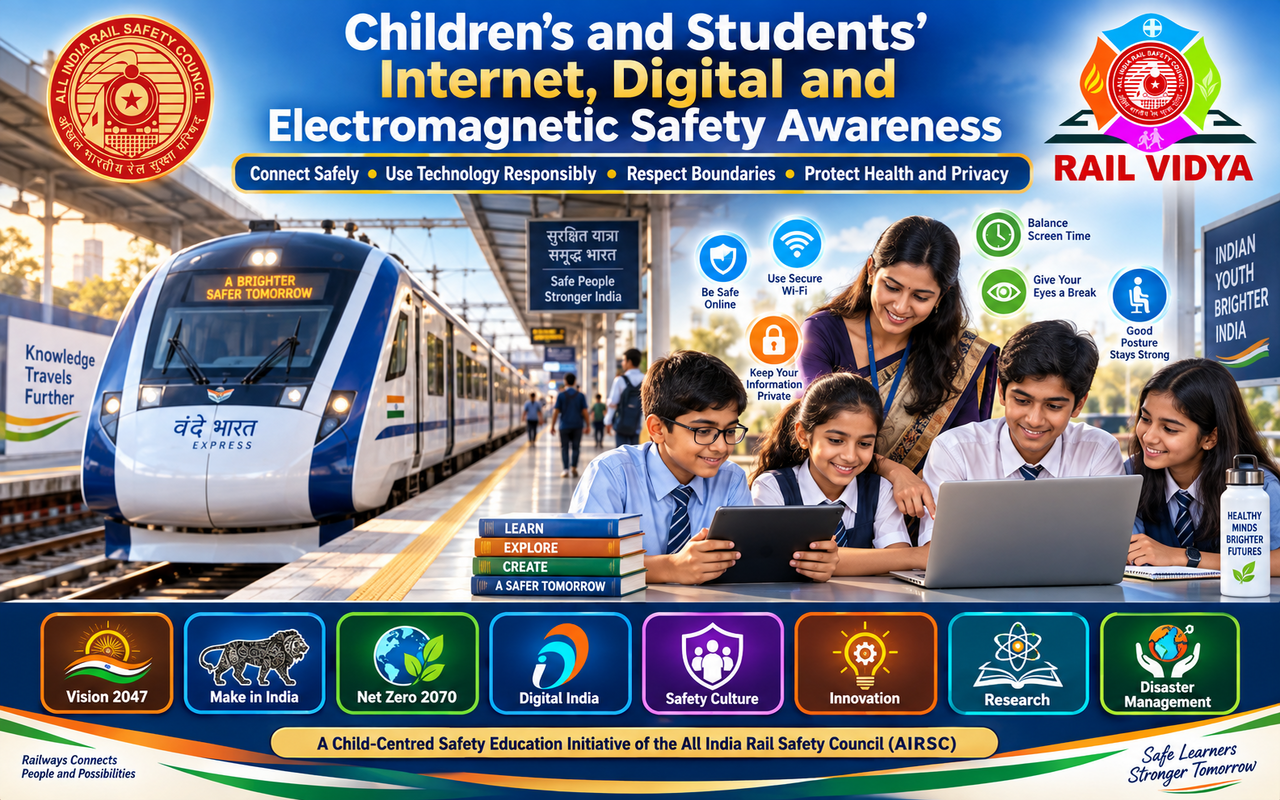
CHILDREN’S AND STUDENTS’ INTERNET, DIGITAL AND ELECTROMAGNETIC SAFETY AWARENESS Connect Safely • Use Technology Responsibly • Respect Boundaries • Protect Health and Privacy A Child-Centred Safety Education Initiative of the All India Rail Safety Council (AIRSC)
Children’s and Students’ Internet, Digital and Electromagnetic Safety
Awareness
Connect
Safely • Use Technology Responsibly • Respect Boundaries • Protect Health and
Privacy
A Child-Centred Safety Education Initiative of the All India Rail Safety
Council (AIRSC)
Digital technology has become an important part of children’s education, communication, creativity and everyday life. Computers, smartphones, tablets, online learning platforms, wireless networks and other electronic systems provide valuable opportunities, but their use must be guided by awareness, responsibility and appropriate adult supervision. Through its Internet, Digital and Electromagnetic Safety Awareness Programme, RailVidya seeks to help children and students protect their privacy, recognise online risks, use electronic devices responsibly and remain safe around electrical and electromagnetic equipment.
Understanding Internet Safety
Internet safety means using websites, applications, social media, online games and communication platforms in ways that protect personal information, emotional well-being, financial security and physical safety. Children should understand that not every person, message, picture, advertisement or claim found online is trustworthy. Content can be misleading, manipulated, harmful or deliberately designed to obtain private information.
Students should use age-appropriate platforms and follow the guidance of parents, guardians and teachers. Privacy settings, contact permissions, location sharing and account-security options should be reviewed regularly with a responsible adult. Children should never attempt to bypass parental controls, school security systems or age restrictions because these safeguards are intended to reduce exposure to unsuitable content and unsafe interactions.
Protecting Personal Information
Children must avoid publicly sharing their full name, home address, telephone number, school name, daily routine, passwords, live location or travel plans. Photographs of school identity cards, examination documents, railway or airline tickets, certificates and other records may contain sensitive information and should not be posted online.
Before uploading a photograph or video, students should carefully examine what is visible in the background. House numbers, vehicle registration plates, school uniforms, location signs and personal documents can reveal more information than intended. Location tagging should remain disabled unless a parent or guardian has approved its use for a specific and safe purpose.
Children should also respect the privacy of others. They must ask permission before photographing, recording or posting information about friends, classmates, teachers or family members. Content that humiliates, embarrasses or exposes another person should never be created or shared.
Creating Strong and Secure Accounts
Every online account should have a strong and unique password. A secure password should be difficult to guess and should not include easily known information such as a child’s name, birthday, school or telephone number. Passwords must never be shared with friends or unknown persons. Parents or guardians may help younger children manage passwords safely.
Where available, accounts should use multi-factor authentication. This provides an additional layer of protection when someone tries to access an account. Children should log out of accounts used on shared or public computers and must never allow a browser on an unfamiliar device to save their login details.
Security questions and one-time passwords must also remain private. Banks, government services and reputable organisations do not normally ask users to disclose confidential passwords or verification codes through unsolicited messages. Any such request should be treated cautiously and shown to a trusted adult.
Recognising Online Strangers and Unsafe Contact
A person met online is still a stranger unless their identity has been verified by a trusted adult. Profile photographs, names, ages and personal stories can be false. Children should not accept unknown friend requests, participate in secret conversations or agree to private video calls with unfamiliar people.
Students must never meet an online contact in person without the knowledge, permission and presence of a parent or guardian. Anyone who asks a child to keep a relationship secret, share personal photographs, move a conversation to a private platform or hide messages from family members is demonstrating unsafe behaviour.
If an online person becomes threatening, controlling or inappropriate, the child should stop responding, block the account and inform a trusted adult immediately. Reporting unsafe contact is an act of courage and should never result in blame or punishment for the child.
Cyberbullying and Respectful Online Behaviour
Cyberbullying includes threatening messages, repeated insults, rumours, impersonation, exclusion, humiliation or the unauthorised sharing of photographs and videos. Its effects can be serious because harmful material may spread quickly and remain accessible for a long time.
A child experiencing cyberbullying should avoid retaliating or joining an abusive argument. Where safe, relevant messages, usernames, dates and screenshots should be preserved as evidence. The child should block and report the account and speak to a parent, teacher, school counsellor or another trusted adult.
Students must never create fake accounts, spread rumours, alter photographs to humiliate someone or forward cruel content. Responsible digital citizenship requires kindness, honesty, consent and respect. Words typed online can affect real people and may have lasting educational, emotional or legal consequences.
Identifying Scams, False Information and Harmful Content
Children may encounter fake prizes, gaming rewards, scholarship offers, urgent money requests, suspicious links and messages claiming that an account has been blocked. These may be attempts to steal passwords, personal data or money. Students should not click unknown links, open unexpected attachments, scan unfamiliar QR codes or download software without adult approval.
A message that creates fear, promises an unrealistic reward or demands immediate action should be checked carefully. Children should verify information through parents, teachers and reliable official sources before believing or sharing it. Headlines, images and videos can be edited, taken out of context or generated artificially.
If disturbing or age-inappropriate content appears, the child should close the page, avoid forwarding it and tell a trusted adult. Reporting harmful content helps protect other users and allows appropriate action to be taken.
Online Gaming Safety
Online games may involve communication with unknown players, purchases, rewards and competitive pressure. Children should use age-appropriate games, restrict chat features where necessary and avoid sharing personal information. An online teammate should not automatically be considered a trusted friend.
In-game purchases should be made only with parental permission. Children should never use a parent’s card, banking details or digital wallet without approval. Offers of free coins, skins, prizes or game upgrades may direct players to fraudulent websites designed to steal accounts or financial information.
Gaming should not interfere with sleep, studies, physical activity, family relationships or emotional well-being. Parents and children should agree upon reasonable time limits and take regular breaks.
Safe and Balanced Use of Digital Devices
Extended screen use can contribute to eye discomfort, headaches, poor posture, fatigue and sleep disruption. Children should take regular breaks, blink frequently, maintain a comfortable viewing distance and use devices with suitable brightness and text size. Screens should be positioned to reduce glare, while chairs and tables should support healthy posture.
Mobile phones, tablets and laptops should not be used continuously before bedtime. A regular sleep routine and device-free periods can support better rest, concentration and emotional health. Children should balance digital learning with outdoor activity, reading, creative work and face-to-face interaction.
Headphones and earphones should be used at a comfortable volume. Excessively loud sound or prolonged listening can harm hearing. Noise-cancelling headphones should not prevent a child from noticing traffic, platform announcements, alarms or other important warnings.
Digital Safety During Travel
Children must not use mobile phones while crossing roads, walking near railway tracks, standing close to platform edges or using stairways and escalators. Headphones can reduce awareness of approaching vehicles, warning signals and public announcements. Devices should be put away whenever full attention is necessary for personal safety.
Selfies and videos must never be taken on railway tracks, near moving trains, beside platform edges, from train doors or in other restricted areas. No photograph, social-media post or online challenge is worth risking a life. Photography and recording should also respect official restrictions, passenger privacy and security requirements.
Tickets containing QR codes, booking references, seat numbers or personal details should not be displayed online. Sharing live travel information may expose a child’s identity, location and journey plans.
Understanding Electromagnetic Safety
Electromagnetic fields are produced by many natural and human-made sources. Everyday electrical equipment, mobile phones, wireless networks, power lines, broadcasting systems, railway electrification and medical devices can generate different forms of electromagnetic energy. Exposure depends on factors such as the strength of the source, distance from it and duration of contact.
Everyday consumer devices that comply with applicable safety standards are designed to operate within prescribed limits. Children should not be frightened by normal technology use, but they should follow manufacturers’ instructions, school rules and guidance from responsible adults. Sensible habits—including using approved equipment, avoiding damaged devices and maintaining a reasonable distance from powerful or restricted installations—support safe use.
Electromagnetic safety should be communicated using reliable scientific guidance. Unverified claims and alarming social-media messages can create unnecessary fear. Questions about health effects should be discussed with qualified healthcare professionals and supported by recognised public-health or regulatory information.
Safety Around Railway and Metro Electrical Systems
Railway and metro environments contain powerful electrical and signalling equipment. Overhead traction wires, third rails, substations, electrical cabinets, antennas, cables and restricted technical areas must be treated as dangerous. Children should never touch, climb, enter or approach such installations.
Overhead railway wires may carry extremely high voltage. Direct contact is not always necessary for serious injury because electricity may arc across a gap under certain conditions. Children must never climb train coaches, poles, gantries, signal structures or parked railway vehicles. Objects such as sticks, balloons, wires, umbrellas, kites and metal rods must be kept far away from overhead electrical equipment.
If a cable is hanging, damaged or lying on the ground, children should stay well away, warn others and inform railway, metro, police or emergency personnel. They must never touch the cable or any nearby object that may have become electrically energised.
Safe Use of Mobile Phones and Wireless Devices
Children should use mobile phones and wireless devices according to the manufacturer’s safety instructions. Devices should not be placed under pillows or bedding while charging because trapped heat can increase the risk of overheating. Phones, power banks and chargers should be kept on a stable, ventilated surface.
A mobile phone should not be used when its battery is swollen, leaking, unusually hot or physically damaged. Such a device must be switched off when it is safe to do so, kept away from heat and reported to a responsible adult. Batteries should never be punctured, crushed, burned or placed in household fire.
When a strong signal is unnecessary, practical choices such as using a wired connection, speaker mode or an approved headset may reduce direct contact with the device. These are precautionary options and should not be presented as substitutes for compliance with recognised safety standards.
Charging and Electrical Safety
Children should use only compatible, good-quality chargers and cables approved for the device. Damaged plugs, exposed wires, loose sockets and counterfeit charging accessories can cause electric shock, fire or equipment failure. Charging should take place away from water, sinks, wet floors and flammable materials.
Children must not handle plugs, switches or charging devices with wet hands. They should not overload electrical sockets, force plugs into outlets or attempt to repair damaged equipment. If sparks, smoke, a burning smell or unusual heat is noticed, the power should be disconnected by a responsible adult when safe, and trained assistance should be requested.
Devices should not be charged unattended for unnecessarily long periods. Schools and homes should maintain safe charging areas with suitable ventilation and responsible supervision.
Medical Devices and Special Safety Needs
Some electronic and electromagnetic equipment can affect particular medical implants or health-support devices. Children who use pacemakers, hearing devices, insulin pumps or other medical equipment should follow the advice of their healthcare professional and the manufacturer’s instructions.
Parents should inform schools and responsible travel supervisors about any relevant medical precautions. Children must not be encouraged to experiment with strong magnets, electromagnetic devices or unfamiliar electronic equipment near medical implants.
School Laboratory and Technical Equipment Safety
Students should use laboratory equipment, electrical models, wireless transmitters, magnets and technical-training systems only under qualified supervision. Safety guards must not be removed, electrical circuits must not be altered without permission and restricted experiments must not be attempted at home.
Magnets and magnetic objects should be kept away from certain medical devices, electronic storage media and sensitive equipment. Batteries and electronic components must not be placed in the mouth or treated as toys. Small button batteries require particular care because swallowing them can cause a life-threatening emergency and requires immediate professional attention.
Reporting Online and Technical Safety Concerns
Children should report suspicious messages, hacked accounts, online threats, damaged electrical equipment, unsafe charging points and unauthorised access to technical areas. They should speak to a parent, guardian, teacher, school administrator or authorised professional without delay.
Children should never feel ashamed to report an online mistake. Quick action can prevent further harm, protect an account and help adults provide appropriate support. Parents and teachers should listen calmly, avoid blaming the child and respond in a way that protects the child’s dignity and well-being.
The Role of Parents, Teachers and Schools
Digital and electromagnetic safety education is most effective when families and schools work together. Adults should set clear rules, demonstrate responsible behaviour, review privacy settings and encourage open conversations about online experiences. Monitoring should be age-appropriate, respectful and focused on protection rather than fear.
Schools can strengthen awareness through cyber-safety sessions, digital citizenship lessons, supervised technology use, electrical-safety demonstrations and clear reporting systems. Technical or health-related instruction should be delivered by suitably qualified professionals and based on recognised safety guidance.
A Message from RailVidya
Technology should empower children without compromising their safety, dignity or well-being. An informed student knows how to enjoy the benefits of the digital world while protecting personal information, respecting others and remaining alert to online and physical hazards.
RailVidya encourages every child to become a responsible digital citizen and safety ambassador. By combining secure online behaviour, balanced device use and respect for electrical and electromagnetic systems, young people can help build a safer, smarter and more responsible India.
RailVidya Safety Messages
“Think Before You Click • Protect Before You Share • Report What Feels Unsafe.”
“Technology Is Powerful—Use It Safely, Wisely and Responsibly.”
“Stay Away from Railway Electrical Installations—High Voltage Can Kill.”