Through RailVidya, AIRSC seeks to prepare children as confident, considerate and safety-conscious passengers. Every responsible action inside a metro train strengthens public trust, protects lives and contributes to a more disciplined India. Hold On Safely • Keep Doorways Clear • Respect Fellow Passengers • Protect Public Property
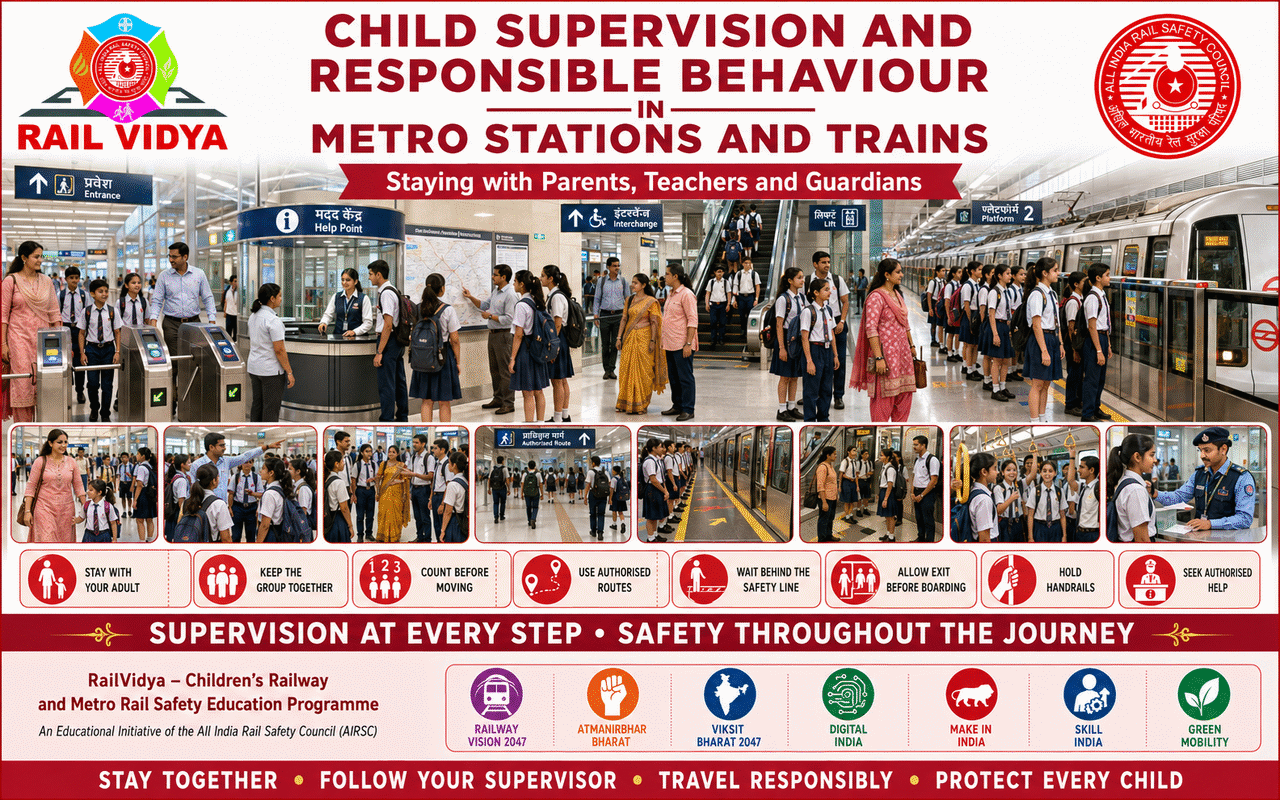
Child Supervision and Responsible Behaviour in Metro Stations and Trains
Staying with
Parents, Teachers and Guardians
Remaining with parents, teachers, guardians or authorised group leaders is one of the most important protections for children travelling through metro systems. Metro stations can be large, busy and unfamiliar environments containing multiple entrances, platforms, interchange corridors, escalators, lifts and trains operating in different directions. Through RailVidya – Children’s Railway and Metro Rail Safety Education Programme, an educational initiative of the All India Rail Safety Council (AIRSC), children are taught that staying close to a responsible adult is essential throughout every stage of a metro journey.
Before entering a metro station, parents and teachers should explain the journey in simple and age-appropriate language. Children should know the destination, interchange stations where relevant, the name of the responsible adult and what to do if the group becomes separated. A clearly identified meeting point and simple communication plan can provide reassurance and help prevent panic.
Children should never wander away to explore station areas, visit shops, use facilities or observe trains without permission and supervision. They must not follow unknown persons or accept travel assistance, food, gifts or invitations from strangers. When help is needed, children should approach uniformed metro personnel, authorised security staff, police officers, customer-care counters or clearly identified passenger-assistance points.
At entry and exit gates, escalators, lifts, stairways and platforms, children should remain within the direct sight and supervision of the accompanying adult. Younger children may require hand-holding, particularly in crowded areas or near automated equipment. Adults should avoid becoming distracted by mobile phones, ticketing tasks or luggage and should maintain continuous awareness of the child’s location.
School groups require organised supervision. Each group should have an adequate number of responsible adults, an updated student list and a clearly assigned group leader. Children may be placed in small, identifiable groups with designated supervisors. Headcounts should be completed before entering the station, after passing through ticket gates, before and after boarding, when changing trains and after leaving the destination station.
Children should be instructed not to rush into a train if their accompanying adult or group has not boarded. Similarly, if an adult boards while a child remains on the platform, neither should attempt to force or obstruct the closing doors. The child should remain calm, stay in a visible public location and immediately seek assistance from authorised metro personnel.
Where appropriate, children may carry a secure identification card containing essential contact information. Personal details should not be displayed or shared unnecessarily with unknown persons. Parents and schools should follow suitable child-protection and privacy practices when preparing identification materials.
If a child becomes separated, the child should avoid running between platforms, boarding another train independently or leaving the station. The safest action is to remain in an authorised, well-lit public area and approach official personnel. Children should clearly explain that they have become separated and provide the name and contact details of the responsible adult when requested through a verified process.
Adults must also model the safety behaviour they expect children to follow. Parents and teachers should use authorised routes, respect platform lines, avoid rushing and listen to official announcements. Calm, attentive adult conduct helps children feel secure and demonstrates that supervision is a shared responsibility rather than a restriction.
As metro networks expand under Viksit Bharat 2047, millions of children will increasingly experience urban public transport. Strong supervision practices, clear separation procedures and child-friendly station support will remain essential to creating safe and inclusive mobility.
Through RailVidya, AIRSC seeks to strengthen cooperation among children, families, schools and metro organisations. Staying together protects young passengers, supports confident travel and ensures that every metro journey begins and ends with responsible care.
Stay Together • Follow Your Group Leader • Never Follow Strangers • Seek Authorised Help
Avoiding Running, Pushing and Playing at Metro Stations
Metro stations are carefully managed transport environments—not playgrounds. Trains, automated doors, escalators, lifts, stairways and large passenger crowds create conditions in which running, pushing or careless play can quickly lead to falls, collisions, separation or serious injury. Children must move calmly, remain attentive and respect the safety of everyone around them.
Running through station entrances, concourses, corridors or platforms can cause a child to slip on smooth or wet surfaces, collide with passengers or fall near stairs and platform edges. Sudden movement can also make it difficult for parents and teachers to maintain supervision. Even when a train is about to depart, children and adults should never run; waiting for the next service is always safer.
Pushing can be particularly dangerous in queues, on platforms and near automatic doors. A minor push may cause another passenger to lose balance, fall towards the track, collide with station equipment or become trapped in a crowd. Children should respect personal space, wait patiently and move only when the area ahead is clear.
Games involving chasing, hiding, jumping, throwing objects or playful physical contact are unsuitable for stations. Children should never use escalators, handrails, seating, ticket gates, luggage trolleys or platform barriers as play equipment. Toys, balls and other objects should remain securely stored so they cannot fall onto tracks or obstruct passenger movement.
Platforms require the highest level of discipline. Children must stand behind the designated safety line, remain close to the accompanying adult and never sit or play near the edge. They should avoid gathering directly in front of train doors and must allow passengers to exit before boarding.
Escalators and stairways must be used only for safe movement between station levels. Children should hold the handrail, face forward and watch every step. Sliding on rails, running up or down stairs, jumping over steps or travelling in the wrong direction on an escalator can cause injury to both the child and surrounding passengers.
Mobile phones, headphones and digital games can reduce awareness and may encourage children to continue playing while walking. Devices should be put away during movement, boarding and alighting. Children should be able to hear announcements, warnings and instructions from responsible adults.
Parents and teachers should plan journeys with sufficient time so that children are not encouraged to hurry. Adults must also avoid pushing, rushing or forcing their way through doors, because children frequently imitate observed behaviour. Calm adult example is one of the strongest forms of safety education.
Schools can reinforce responsible station behaviour through role-play, illustrated lessons, safety pledges and guided travel preparation. Children should understand that avoiding rough behaviour demonstrates maturity, courtesy and concern for other passengers—not merely obedience to a rule.
Through RailVidya, AIRSC seeks to make calm and orderly station conduct a lifelong habit. When children walk carefully, queue patiently and avoid unsafe play, they help create safer, more welcoming and more efficient metro stations.
Walk—Never Run • Wait—Never Push • Travel—Never Play • Keep Every Station Safe
Responsible Behaviour Inside Metro Trains
Responsible behaviour inside metro trains protects children, supports fellow passengers and contributes to efficient public-transport operations. A metro coach is a shared travel environment used by people of different ages, abilities and needs. Children should travel with awareness, courtesy and respect for the safety systems and public facilities provided.
After boarding, children should move away from the doorway and occupy an available seat or stand in a safe location with their accompanying adult. When standing, they should hold an authorised handrail, grab handle or support because metro trains may accelerate, brake or change speed unexpectedly. Running through coaches, climbing on seats or playing in aisles can result in falls and collisions.
Train doors must remain completely unobstructed. Children should never lean against them, place their fingers near door edges or attempt to hold them open. Bags, clothing, toys and other belongings should be kept away from the closing path. When the door warning sounds, children should stand clear and allow the automatic system to operate.
Seats should be used responsibly. Children must not stand or jump on them, place dirty footwear on them or occupy more space than necessary. Priority seats and designated areas should be respected for senior citizens, pregnant passengers, persons with disabilities and passengers carrying infants. Offering space when appropriate is an important lesson in compassion and inclusive citizenship.
Children should speak quietly and avoid shouting, singing loudly or playing music and videos in a way that disturbs others. Headphones may be used at a safe volume where permitted, but children must remain able to hear important announcements. Personal space and the comfort of fellow passengers should always be respected.
Aisles, inter-coach passages and emergency routes must be kept clear. School bags, luggage, toys and other belongings should be held securely or placed in an appropriate location. Children should never move between coaches unnecessarily or enter areas marked for authorised personnel.
Metro property must be treated with care. Children should not scratch, write on, damage or interfere with seats, windows, route maps, displays, cameras, communication equipment, alarms or emergency devices. Protecting public property demonstrates civic responsibility and helps maintain safe services for everyone.
Emergency alarms, intercoms and door-release devices must never be activated as a joke or experiment. They are provided for genuine emergencies and misuse can interrupt services or delay assistance to someone in real danger. Children should learn how to recognise emergency equipment while understanding that it should be used only according to official instructions.
Food, drinks and waste should be managed according to the rules of the relevant metro operator. Children should never litter, spill liquids or leave objects on the floor, where they may cause passengers to slip. Cleanliness supports safety, hygiene and the dignity of shared public spaces.
Children must not accept food, gifts or personal assistance from unknown passengers. If they experience harassment, feel unsafe or notice suspicious behaviour, they should immediately inform their parent, teacher or authorised metro personnel. Personal details and real-time travel information should not be shared unnecessarily.
Unattended or suspicious objects should never be touched, opened or moved. Children should keep a safe distance and report the item promptly. Smoke, sparks, damaged equipment or unsafe passenger conduct should also be brought to the attention of responsible adults or metro staff.
During service interruptions or emergencies, children should remain calm and follow official announcements. They should stay with their accompanying adult, avoid spreading rumours and never attempt to open doors, leave the train or enter a tunnel without specific instructions from authorised personnel.
Parents and teachers should demonstrate respectful behaviour inside the coach and correct unsafe actions calmly. School journeys can be used to teach children how personal conduct affects the safety, accessibility and comfort of the wider travelling public.
As India’s metro systems become an increasingly important part of national urban mobility, responsible passenger behaviour must develop alongside modern infrastructure. A world-class metro system is supported by citizens who practise discipline, protect public property and treat fellow passengers with dignity.
Through RailVidya, AIRSC seeks to prepare children as confident, considerate and safety-conscious passengers. Every responsible action inside a metro train strengthens public trust, protects lives and contributes to a more disciplined India.
Hold On Safely • Keep Doorways Clear • Respect Fellow Passengers • Protect Public Property
© 2026 Dr.R.Padmanabhan. All Rights Reserved.
Chairman — All India Rail Safety Council (AIRSC)
Promoting Railway Safety, Education and Public Awareness
Email: admin@railsafety.co.in | Website: www.railsafety.co.in/ www.railsafety.in/ www.airsc.in