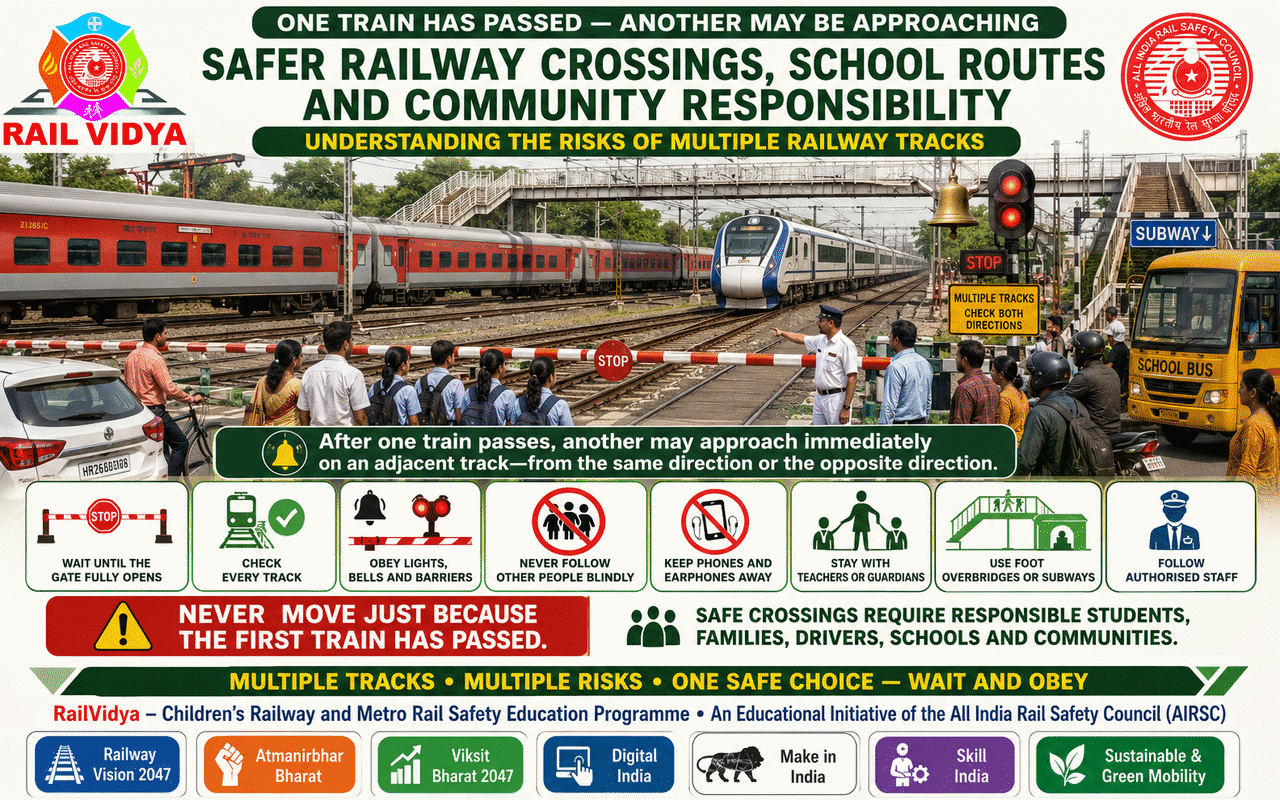
Safer Railway Crossings, School Routes and Community Responsibility teaches children that multiple railway tracks can conceal approaching trains and must be crossed only through authorised facilities. Through RailVidya, students and families are encouraged to use road overbridges, footbridges, subways and underpasses, obey every gate and warning, remain alert and avoid unsafe shortcuts. Choosing approved routes, reporting damaged facilities and waiting for full clearance are essential responsibilities that protect children and strengthen community railway safety
Safer Railway Crossings, School Routes and
Community Responsibility
Understanding the Risks of Multiple Railway Tracks
Locations with two or more railway tracks present serious and complex risks for pedestrians and road users. After one train passes, another train may approach immediately on an adjacent line, from the same direction or from the opposite direction. Through RailVidya – Children’s Railway and Metro Rail Safety Education Programme, an educational initiative of the All India Rail Safety Council (AIRSC), children are taught never to assume that all tracks are safe merely because one train has passed.
A train on one line can hide another approaching train from view and reduce the ability to hear its horn. The sound and air movement created by the first train may also mask warnings from a second train. Curves, stationary coaches, buildings, vegetation and weather conditions can further limit visibility. Personal observation alone cannot establish that multiple tracks are safe to cross.
Children should cross railway lines only through an authorised foot overbridge, subway, road overbridge, underpass or officially controlled level crossing. At a level crossing, they must remain behind the barrier while it is closed or while lights, bells and other warnings remain active. The crossing must not be entered until all warnings have ended, the gate is fully open and passage is officially permitted.
A barrier may remain closed after one train has passed because another train or railway vehicle is approaching. Children must never follow pedestrians, cyclists or drivers who begin moving before the crossing is officially reopened. The unsafe actions of others do not provide permission to cross.
Children should never stop between railway tracks. Areas between lines do not provide reliable protection because trains may pass simultaneously, overhang beyond the rails and create strong air pressure. Track points, cables, loose stones and uneven surfaces can also cause a person to trip, become trapped or lose balance.
Mobile phones, headphones, games and photography significantly increase the risk. Children must put away all devices, remove headphones and maintain full attention at authorised crossings. Railway tracks must never be used for selfies, videos, shortcuts or social-media activities.
If an item falls onto any track, children must not attempt to retrieve it. They should remain in a safe public area and notify authorised railway personnel. Similarly, if a person appears to be in danger, children should never enter the tracks to attempt an untrained rescue; they must raise the alarm and seek professional assistance.
Parents and teachers should explain multiple-track risks through illustrations, demonstrations and age-appropriate activities. Children must learn that a second train can arrive before they have sufficient time to react, making patience and authorised crossing facilities essential.
As India develops busier routes, higher-capacity corridors and faster services under Viksit Bharat 2047, understanding multiple-track hazards will become increasingly important. Infrastructure and technology must be supported by passengers and communities who obey every crossing control.
Through RailVidya, AIRSC seeks to establish a permanent safety principle: after one train passes, remain stopped and continue waiting until the entire crossing is officially reopened.
One Train Has Passed—Another May Be Coming • Stay Behind the Gate • Wait for Full Clearance
Using Road Overbridges and Underpasses
Road overbridges and underpasses provide safer, grade-separated routes for vehicles, cyclists and pedestrians to cross railway lines without entering the operational track area. They reduce direct conflict between road users and trains and are important components of modern railway and community-safety infrastructure.
Where a road overbridge, pedestrian bridge, subway or underpass is available, children and families should use it instead of crossing tracks directly or using an unauthorised path. The approved route may require additional distance, but convenience must never take priority over safety.
Children using a road overbridge or underpass should remain on the designated pedestrian pathway and, where provided, behind protective barriers. They must not walk in vehicle lanes, climb parapets, lean over railings or throw objects towards trains and electrical equipment.
Railway overhead wires beneath bridges may carry extremely high voltage. Children should never lower ropes, kite strings, poles, selfie sticks or other objects towards the lines. Direct contact may not be necessary for an electrical injury to occur, as electricity can arc across a gap when an object comes too close.
Underpasses may include vehicle lanes, pedestrian walkways, drainage channels and areas with restricted visibility. Children should use the marked path, remain with a responsible adult and avoid playing, cycling unpredictably or stopping in the traffic lane. Reflective clothing or visibility measures may be useful where formally recommended for local school routes.
Floodwater in an underpass must never be entered merely because it appears shallow. Water may conceal open drains, uneven surfaces, electrical hazards or strong currents. Children should return to a safe location and use an authorised alternative route under adult guidance.
Damaged lighting, broken barriers, water accumulation, blocked pathways or unsafe traffic conditions should be reported through appropriate official channels. Such defects do not justify crossing railway tracks as an alternative. Community members should use another approved facility until the condition is addressed.
Parents and schools should familiarise children with the safest overbridge or underpass route before independent travel is considered. Route maps, supervised walks and school-safety sessions can help young people distinguish between an authorised facility and an unsafe shortcut.
Road users should follow lane markings, speed restrictions and signage on bridges and underpasses. School vehicles must stop only in designated safe locations and should never allow children to board or alight in moving traffic or near bridge approaches.
Road overbridges and underpasses support the national objective of separating road and railway movement. Their effectiveness, however, depends upon disciplined use, maintenance and community cooperation.
Through RailVidya, AIRSC encourages children and families to choose grade-separated crossings whenever available. The safe route is the responsible route, even when it takes a little longer.
Use the Bridge • Use the Underpass • Avoid the Tracks • Choose Life Over Shortcuts
© 2026 Dr.R.Padmanabhan. All Rights Reserved.
Chairman — All India Rail Safety Council (AIRSC)
Promoting Railway Safety, Education and Public Awareness
Email: admin@railsafety.co.in | Website: www.railsafety.co.in/ www.railsafety.in/ www.airsc.in