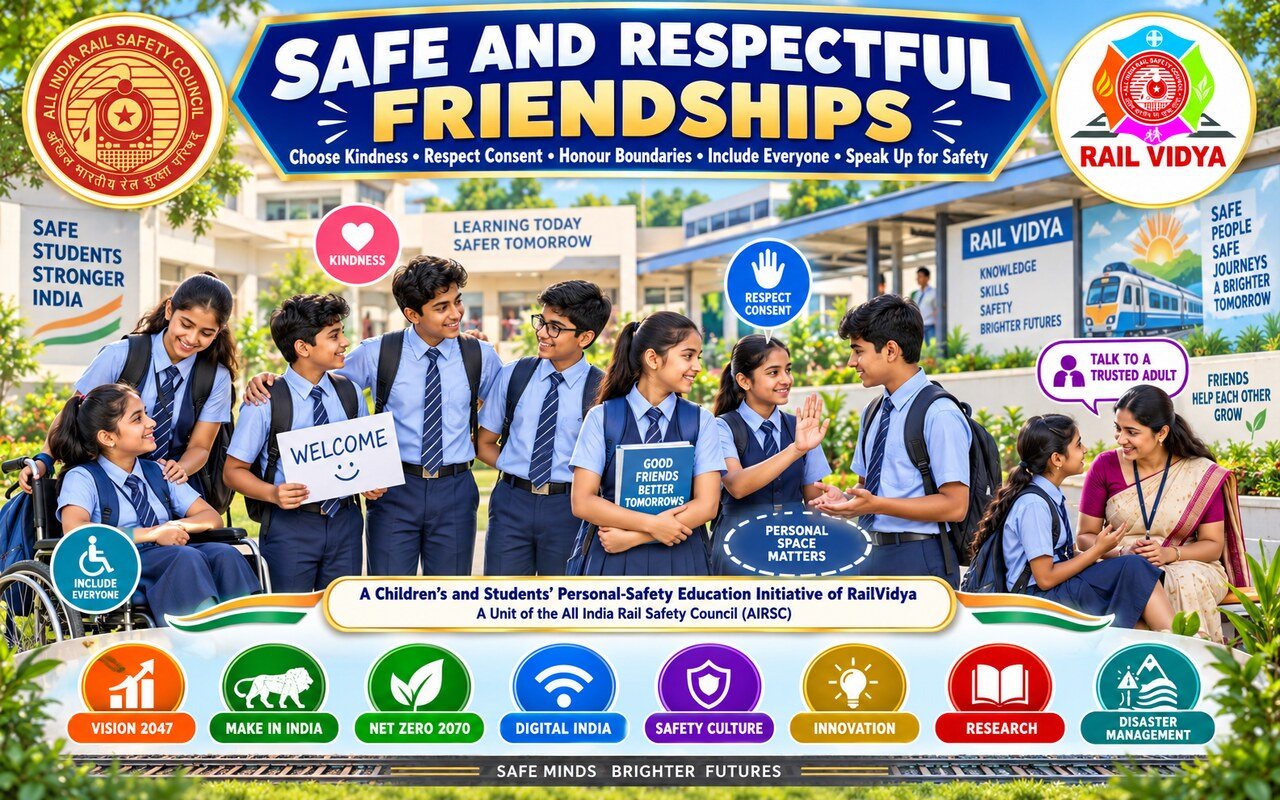
SAFE AND RESPECTFUL FRIENDSHIPS Choose Kindness • Respect Consent • Honour Boundaries • Include Everyone • Speak Up for Safety
Safe and Respectful Friendships
Choose Kindness •
Respect Consent • Honour Boundaries • Include Everyone • Speak Up for Safety
A Children’s and Students’
Personal-Safety and Well-Being Initiative of RailVidya
A Unit of the All India Rail Safety Council (AIRSC)
Friendship is an important part of childhood and student life. Good friends can help one another learn, build confidence, overcome difficulties and feel included. However, every friendship must be based on kindness, equality, trust, consent and respect for personal boundaries. Through this awareness initiative, RailVidya helps children and students understand the qualities of a healthy friendship, recognise controlling or harmful behaviour and seek trusted assistance when they feel unsafe.
A true friend does not frighten, threaten, humiliate or pressure another person. Friendship never gives anyone the right to control another child’s body, belongings, choices, personal information or other relationships. Every student has the right to feel safe, respected and free to say “No,” “Stop,” “I do not like that,” or “I need help.”
Understanding a Healthy Friendship
A healthy friendship is one in which both people feel respected, supported and able to express themselves honestly. Friends may have different interests, abilities, opinions, cultures and backgrounds, but those differences should be treated with dignity.
Good friends listen to each other, share fairly, apologise when they make mistakes and accept that nobody must agree with them all the time. They celebrate each other’s achievements without jealousy and provide encouragement during difficult moments.
A friendship should not require a child to change their personality, abandon other friends or repeatedly do things that make them uncomfortable. Healthy friendship allows space for individuality, family relationships, studies, rest and other activities.
Kindness Is the Foundation of Friendship
Kindness means speaking respectfully, offering help when appropriate and considering how words or actions may affect another person. It includes inviting others to participate, listening without interruption and avoiding jokes that cause embarrassment or pain.
Kindness should be genuine and should not be offered only in exchange for favours. A child should not use gifts, popularity or social influence to control another student. Helping someone does not create a right to demand obedience later.
Children should remember that kindness also includes being honest. A respectful friend can disagree, identify unsafe behaviour or refuse to participate in wrongdoing without insulting the other person.
Understanding Consent
Consent means receiving clear and willing permission before doing something that affects another person. Children should ask before hugging, holding hands, borrowing belongings, taking photographs, sharing personal information or including someone in an online post.
Consent must be voluntary. Permission obtained through pressure, threats, guilt, repeated asking or fear is not genuine consent. A person who remains silent, looks uncomfortable or moves away has not necessarily agreed.
Consent can be withdrawn. A child who first agrees to a photograph, game or activity can later change their mind. A respectful friend stops when asked and does not argue, tease or punish the person for setting a boundary.
Respect Personal Boundaries
Personal boundaries are the limits people establish to protect their body, feelings, belongings, time, privacy and comfort. Boundaries may differ from one child to another. One student may enjoy physical affection, while another may prefer more personal space. Both choices deserve respect.
Children should communicate boundaries clearly and calmly when possible. Useful statements include:
- “Please do not touch my belongings.”
- “I do not want to be photographed.”
- “Please stop making that joke.”
- “I need some space.”
- “I am not comfortable with this.”
- “No, I am not going with you.”
A friend who repeatedly ignores boundaries is not behaving respectfully. The affected child should move away and seek help from a trusted adult.
Respect the Right to Say No
Children have the right to refuse an activity that feels unsafe, uncomfortable, dishonest or inappropriate. They do not have to participate merely because a friend says, “Everyone is doing it,” “Prove you are my friend,” or “Do not be afraid.”
A genuine friend accepts a reasonable refusal. Friendship should never depend on breaking school rules, hiding dangerous behaviour, entering restricted areas, sharing passwords or participating in risky online challenges.
Children should also respect another person’s refusal. Asking repeatedly after someone has said no can become pressure. The responsible response is to stop and accept the decision.
Safe Secrets and Unsafe Secrets
Some temporary secrets may be harmless, such as planning a supervised birthday surprise. However, a secret involving fear, threats, inappropriate touching, bullying, unsafe photographs, weapons, self-harm or dangerous behaviour must be told to a trusted adult.
A person who says, “If you tell anyone, I will hurt you,” “Nobody will believe you,” or “You will get into trouble” is attempting to use fear and secrecy as control. Children should not manage such situations alone.
Speaking up about an unsafe secret is not betrayal. It is a protective action that may help both the child experiencing harm and others who could be at risk.
Inclusion and Respect for Differences
Every child deserves dignity and the opportunity to participate. Students should not exclude someone because of disability, language, appearance, academic performance, economic circumstances, religion, culture, gender or family background.
Inclusion may involve inviting a student to join an activity, explaining rules patiently, providing accessible communication or preventing others from mocking differences. It does not mean forcing friendship, but it does require respectful and fair treatment.
Children should avoid forming groups that gain popularity by insulting or excluding others. Leadership should be used to build confidence and belonging, not to create fear or social isolation.
Recognising Unhealthy Friendship Behaviour
A friendship may be unhealthy when one person repeatedly controls, threatens, humiliates or frightens another. Warning signs may include:
- Demanding passwords or access to private messages
- Deciding whom the child may speak to
- Taking belongings without permission
- Pressuring the child to lie or break rules
- Threatening to end the friendship to obtain compliance
- Spreading rumours or revealing private information
- Constantly criticising or insulting the child
- Hitting, pushing, pinching or deliberately causing pain
- Requesting inappropriate photographs
- Forcing secrecy about unsafe conduct
- Encouraging dangerous travel or social-media challenges
- Threatening harm or retaliation
A single disagreement does not necessarily make a friendship unsafe. However, repeated patterns of fear, pressure, control and disrespect require adult attention.
Friendship Is Not Ownership
No friend owns another person’s time, attention or loyalty. Children are allowed to have more than one friend, spend time with family and participate in different activities.
Statements such as “You cannot speak to anyone else,” “If you were my real friend, you would obey me,” or “I will punish you if you leave” are signs of controlling behaviour. Healthy friendships are chosen freely and maintained through mutual respect.
Children also have the right to step back from or end a friendship that repeatedly makes them feel unsafe or unhappy. They should seek adult help if they are worried about the other person’s reaction.
Handling Disagreements Respectfully
Disagreements are normal, even between close friends. Children can manage conflict by remaining calm, listening to each other and discussing the specific problem without insults or threats.
A respectful apology acknowledges the action and its effect: “I am sorry I shared your photograph without permission. I understand why that hurt you, and I will remove it.” An apology should be supported by changed behaviour.
If a disagreement becomes aggressive, children should move away and allow time to calm down. A teacher, parent or counsellor can help both students communicate safely. Physical fighting, online retaliation and public humiliation are never acceptable ways to resolve conflict.
Peer Pressure and Unsafe Challenges
Peer pressure occurs when friends or groups influence someone to do something they would not otherwise choose. It can involve skipping classes, stealing, bullying, experimenting with harmful substances, entering railway tracks or participating in dangerous social-media challenges.
Students should pause and ask:
- Is this safe?
- Is it lawful and allowed?
- Could anyone be hurt?
- Would I do this without pressure?
- Would I feel comfortable telling my family or teacher?
If the answer creates doubt, the child should refuse, leave the situation and inform a trusted adult. True friends protect one another from danger; they do not demand proof of friendship through risky behaviour.
Bullying Is Not Friendship
Bullying is repeated behaviour intended to cause physical or emotional harm, often involving an imbalance of power. It may include hitting, threats, insults, rumours, exclusion, property damage or online harassment.
A person cannot excuse bullying by saying, “We are friends,” “It was only a joke,” or “Everyone does it.” A joke stops being harmless when someone is frightened, humiliated or repeatedly asked to stop.
Children experiencing bullying should speak to a parent, teacher, counsellor or another trusted adult. UNICEF advises adults to listen calmly, reassure children that the bullying is not their fault and work with the school or appropriate support system. UNICEF: Understanding and Preventing Bullying
Be an Active and Safe Bystander
A bystander is someone who witnesses bullying or unsafe behaviour. Students should not laugh, encourage the aggressor, forward harmful content or remain part of a crowd gathered around the incident.
When it is safe, a student can support the affected child, invite them to leave, call an adult or report the incident. Children should not physically confront someone if doing so could place them in danger.
Afterward, they can check whether the affected student is safe and encourage them to seek help. Quiet support can make a significant difference to a child who feels isolated.
Safe Digital Friendships
Friendship rules also apply online. Children should communicate respectfully, protect personal information and ask permission before posting photographs, screenshots or private messages.
Friends should never demand passwords, verification codes or unrestricted access to each other’s accounts. Sharing a password as proof of trust is unsafe. Every child is entitled to digital privacy.
Private messages can be copied or forwarded. Students should therefore avoid sending material that could expose or harm themselves or another person. If someone sends threatening, sexual or inappropriate content, the child should stop communicating, preserve relevant evidence where safe and tell a trusted adult.
Online Contacts Are Not Automatically Friends
A person encountered through social media, gaming or messaging remains an online contact until their identity has been safely verified. Profile photographs, ages and personal stories can be false.
Children should never meet an online contact without the knowledge, permission and presence of a parent or guardian. They must not send private photographs, share live locations or reveal school and travel details.
Anyone who asks a child to hide conversations, move to a secret platform or keep the relationship unknown to family members is demonstrating unsafe behaviour. The child should block and report the account and seek trusted support.
Respect Privacy and Personal Information
Friends may share feelings, experiences and personal information in confidence. Such information should not be turned into gossip or posted online. Children should ask permission before discussing another person’s private matter.
However, privacy must never be used to conceal danger. If a friend says they are being abused, threatened, harmed or feel unable to stay safe, the child should tell a trusted adult—even if asked to keep it secret.
A child is not responsible for solving another friend’s serious personal crisis alone. Obtaining adult or professional help is the caring and responsible action.
Safe Behaviour During Travel
Friends travelling together should support safe behaviour. They should remain behind platform safety lines, use authorised crossings, follow traffic rules and avoid mobile-phone distraction.
A friend should never pressure another child to stand near a train door, take photographs on railway tracks, run across a road or enter a restricted area. Students should actively discourage such conduct and alert an adult or authorised official.
Looking after one another means preventing danger, not joining an unsafe activity.
Protect Personal Belongings
Friends should ask before borrowing books, stationery, devices or money. Borrowed property should be used carefully and returned promptly.
Taking, hiding or damaging another student’s belongings is not a harmless joke when it causes distress. Similarly, repeatedly demanding food, money or gifts can become coercive behaviour.
Students should not share bank details, payment passwords or verification codes. Any request involving significant money or online purchases should be discussed with a parent or guardian.
Support Friends Without Carrying Every Problem
Children can listen, show kindness and encourage a friend to seek help. However, they should not feel responsible for managing another person’s serious health, safety or emotional difficulties by themselves.
If a friend talks about running away, self-harm, abuse, violence or another serious danger, the child should tell a trusted adult immediately. Promising complete secrecy in such circumstances can prevent essential assistance.
Seeking help is not abandoning a friend. It is bringing the situation to someone with the knowledge and authority to protect them.
Friendship and Emotional Well-Being
Healthy friendships should generally help children feel accepted, supported and safe. Every friendship may experience occasional disagreement, but it should not create continuous fear, shame or emotional exhaustion.
A child should speak to a trusted adult if a friendship causes significant anxiety, loss of sleep, reduced concentration or fear of attending school. Professional counselling may be helpful when distress continues.
Children should also spend time on studies, family relationships, rest, hobbies and physical activity. A balanced life reduces unhealthy dependence on one person or group.
How to Leave an Unsafe Friendship
A child may choose to reduce contact or end a friendship that repeatedly violates boundaries. Where safe, the child may say calmly, “This friendship no longer feels respectful, and I need some distance.”
If the other person threatens, follows, harasses or pressures the child, the situation should be reported immediately. The child should avoid meeting the person alone and may require a safety plan developed with parents and school authorities.
Online accounts may need to be blocked, privacy settings updated and harmful messages preserved as evidence. Serious threats should be referred to appropriate authorities by responsible adults.
Recognising a Trusted Adult
A trusted adult may be a parent, guardian, teacher, school counsellor, close relative or another responsible person known to protect the child’s well-being. Children should identify more than one trusted adult in case the first person is unavailable.
If one adult does not listen or provide appropriate support, the child should continue speaking to other trusted adults until someone takes the concern seriously. Children have the right to be heard and protected.
Immediate danger should be reported to authorised emergency or child-protection services through a responsible adult whenever possible.
The Role of Parents and Teachers
Adults should create environments where children can discuss friendships without fear of ridicule or immediate punishment. Open conversations help identify bullying, pressure and unsafe online contact before problems become more serious.
Parents and teachers should avoid dismissing concerns as “ordinary friendship problems” without listening carefully. Changes in behaviour, fear of school, unexplained injuries, loss of belongings or distress after using a phone may require sensitive attention.
Adults should model consent, respectful disagreement and inclusive behaviour. Children learn friendship values from how adults speak, apologise and respond to boundaries.
Building an Inclusive School Culture
Schools should maintain clear expectations concerning respect, bullying, discrimination, privacy and digital behaviour. Students should know how to report concerns confidentially and whom to approach.
Peer-support programmes and RailVidya Safety Clubs can promote kindness, safe travel, inclusion and responsible digital citizenship. However, students supporting peers should receive guidance and should never be expected to replace trained counsellors or child-protection professionals.
Every student should feel that school is a place where dignity is protected, differences are respected and help is available.
A Message from RailVidya
Safe and respectful friendships help children grow into compassionate, confident and responsible citizens. Friendship is strongest when both people feel free to express themselves, establish boundaries and make safe decisions.
RailVidya encourages every child and student to become a Young Friendship and Safety Ambassador by practising kindness, respecting consent, including others and speaking up when someone is being harmed. A good friend does not encourage danger, demand secrecy or use fear—a good friend respects, supports and protects.
RailVidya Safety Messages
“A True Friend Respects Your Voice, Your Choices and Your Boundaries.”
“Kindness Builds Friendship—Control and Fear Destroy It.”
“Consent Must Be Clear, Free and Respected.”
“Include Others • Reject Bullying • Speak Up for Safety.”
“A Good Friend Never Asks You to Hide Something Unsafe.”
“Safe Friendships • Confident Children • Respectful Schools • Stronger Communities.”