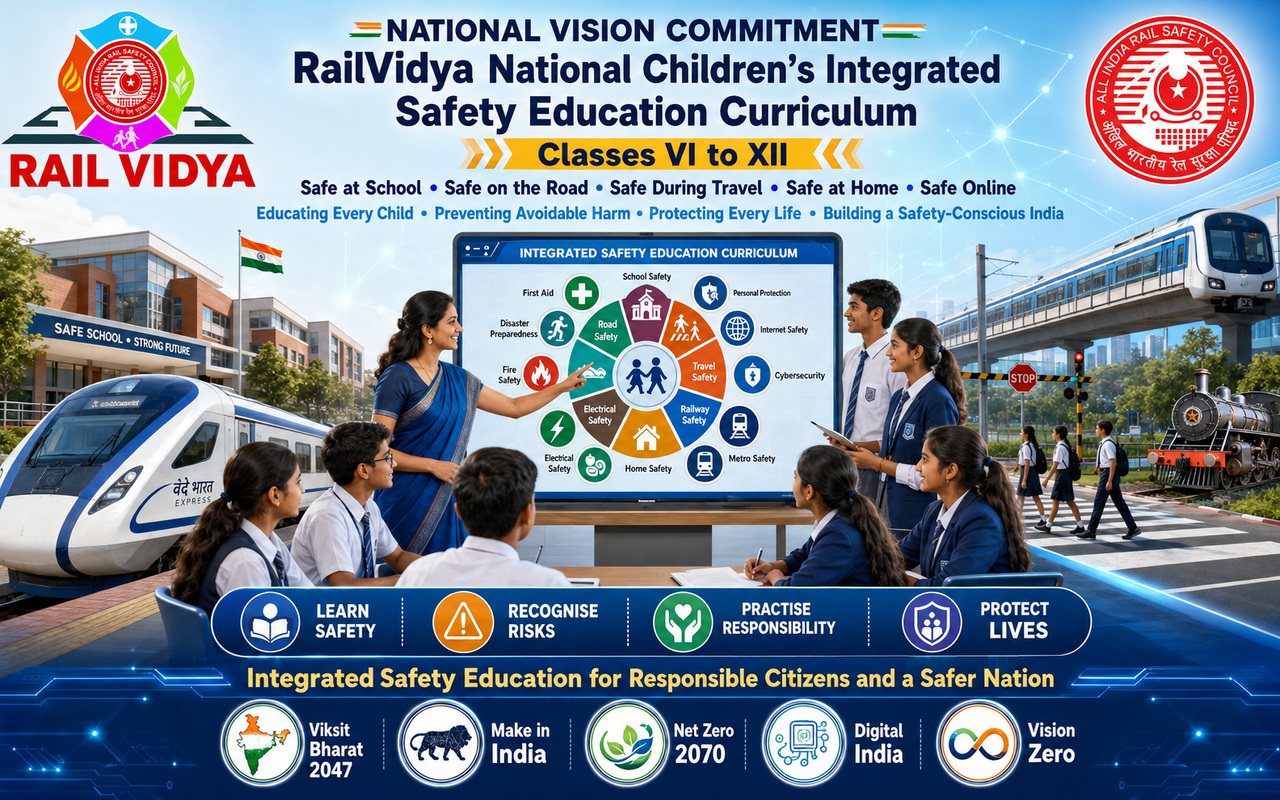
The National Vision Commitment of RailVidya is clear: every child must have access to practical, age-appropriate and empowering safety education; every school must be encouraged to develop a culture of prevention; every family must be supported in practising responsible behaviour; and every community must recognise the protection of life as a shared national duty.
National Vision Commitment
The reconstructed RailVidya National Children’s Integrated Safety Education Curriculum presents safety as a fundamental educational priority and an essential component of responsible national development. It brings together school safety, road safety, travel safety, railway and metro safety, home safety, food safety, electrical safety, fire safety, disaster preparedness, first-aid awareness, personal protection, internet safety and cybersecurity within a unified, child-centred learning framework. Instead of treating these subjects as separate or occasional awareness activities, the curriculum establishes safety as a continuous learning journey that develops progressively from Classes VI to XII.
RailVidya is founded on the belief that safety education must begin before children encounter serious risks without preparation. Children regularly travel between their homes and schools, use roads and public transport, visit railway and metro stations, participate in school activities and engage extensively with digital platforms. They may also face electrical hazards, extreme weather, public emergencies, online manipulation, unsafe food practices and unfamiliar situations when travelling or remaining alone. A comprehensive curriculum equips them to recognise these risks early, understand the possible consequences and select the safest available course of action.
The programme adopts a positive, preventive and age-appropriate approach. Its objective is not to create fear or limit children’s independence, but to develop awareness, confidence, discipline and responsible decision-making. Students are taught to observe carefully, identify warning signs, respect safety rules, avoid unnecessary risk and seek help through authorised channels. They learn that a safe decision is not a sign of weakness or hesitation; it is evidence of maturity, intelligence and respect for life.
Through a structured progression from foundational awareness to applied leadership, RailVidya can address the changing safety needs of adolescents. Students in the earlier classes may begin by understanding hazards, safe behaviour and emergency contacts. As they advance, they can study risk assessment, public-transport responsibility, digital security, first-aid awareness, disaster preparedness, peer education and community participation. Senior students can undertake supervised safety projects, support school campaigns and serve as Young Safety Ambassadors without being placed in enforcement or emergency-response roles.
The integrated curriculum recognises that a child does not experience safety in isolated categories. A journey to school may involve personal safety, road awareness, public-transport discipline, railway or metro rules, digital communication and emergency preparedness at the same time. By connecting these areas, RailVidya helps students understand safety as a complete system of responsible choices rather than a collection of unrelated instructions.
School safety forms an important foundation of this national vision. Students learn to use classrooms, laboratories, stairways, playgrounds and transport facilities responsibly. They are encouraged to identify and report hazards such as damaged electrical wiring, blocked exits, slippery floors, unsafe equipment, bullying and overcrowding. Emergency drills, evacuation awareness and inclusive support for younger children and persons with disabilities help create a school culture in which protection, dignity and cooperation are shared responsibilities.
Road and travel safety education prepares students to become careful pedestrians, passengers and future road users. It promotes the use of footpaths, pedestrian crossings, helmets, seat belts and authorised boarding points while addressing distraction, speeding, unsafe shortcuts and careless behaviour. Children learn that responsible mobility protects not only their own lives but also those of fellow passengers, drivers, pedestrians and the wider public.
Railway and metro safety occupy a central place within RailVidya’s educational mission. Students are taught never to trespass on railway tracks, cross under or around closed level-crossing gates, enter restricted operational areas or engage in unsafe behaviour near moving trains. They learn to use foot overbridges, subways and authorised crossings; remain behind platform safety lines; board and alight carefully; respect warning signals; protect public property; and cooperate with railway, metro and security personnel. Such education can help children become disciplined passengers and influential safety messengers within their families.
Home safety extends the programme beyond the classroom. Students learn to recognise fire, gas, electrical, chemical, structural and household hazards. They understand that medicines, sharp objects, cooking appliances and damaged electrical systems require responsible adult management. The curriculum also encourages families to maintain emergency contacts, inspect basic safety arrangements and discuss evacuation or communication plans. In this way, every student can carry practical safety knowledge from school into the home.
Food and health safety promote hygiene, safe drinking water, responsible food handling, careful reading of labels and awareness of contamination and allergies. These lessons help children understand that safety includes the protection of health and well-being, not merely the prevention of visible accidents. Healthy habits established during childhood can contribute to stronger families and more resilient communities.
First-aid awareness and disaster management build preparedness while clearly defining the limits of student intervention. Children learn how to recognise an emergency, protect themselves from immediate danger, call for assistance, communicate accurate information and provide appropriate support within their level of training. They are taught never to attempt hazardous rescues or medical procedures for which they have not received recognised practical instruction. The emphasis remains on calm observation, prompt reporting and cooperation with trained professionals.
Digital and cybersecurity education are equally important within the modern safety framework. Students increasingly learn, communicate, play and form relationships through connected devices. RailVidya therefore promotes strong passwords, protection of personal information, responsible social-media use, recognition of online fraud, respectful communication and timely reporting of cyberbullying, manipulation or inappropriate contact. Digital citizenship is presented as an extension of personal responsibility and public safety.
The curriculum also recognises emotional safety, personal boundaries and the right of every child to seek protection. Students are encouraged to speak with trusted adults when they feel threatened, pressured, bullied, exploited or uncomfortable. They learn that unsafe behaviour may come from strangers, acquaintances or known individuals and that reporting a genuine concern is an act of courage. Schools and families, in turn, must provide accessible, confidential and child-sensitive channels through which concerns can be heard and addressed responsibly.
Environmental awareness strengthens the broader vision by connecting safety with sustainability and climate resilience. Heatwaves, floods, storms, lightning and other environmental hazards increasingly affect children’s daily lives. Preparedness education enables students to recognise official warnings, follow evacuation or shelter instructions and avoid dangerous areas. Responsible practices such as waste management, water conservation and protection of drainage systems further demonstrate how environmental responsibility contributes to community safety.
A major strength of RailVidya is its potential to transform students from recipients of information into responsible participants in safety culture. Through school safety clubs, supervised campaigns, assemblies, posters, digital messages, peer-learning activities and the One Child–One Family–One Safety Message initiative, children can share verified information with classmates and family members. Their participation must remain educational, supervised and free from dangerous intervention, enforcement activity or public shaming.
The Young Safety Ambassador model can provide a structured pathway for student leadership. Ambassadors learn approved safety principles, demonstrate correct behaviour, assist with awareness activities and report hazards through authorised channels. They lead through positive example rather than authority. This approach develops communication, civic responsibility, compassion and leadership while protecting children from roles that properly belong to adults or trained professionals.
Teachers are central to the successful delivery of the programme. They translate safety principles into age-appropriate learning, connect lessons with real situations and create an environment in which students can ask questions without fear or embarrassment. Practical demonstrations, scenario-based discussions, supervised drills, visual resources, quizzes, projects and digital learning can make the curriculum engaging and memorable. Teachers should also receive suitable orientation, resource materials and professional support so that safety education remains accurate and consistent.
Parents and guardians are equally important partners. Safe behaviour taught in school must be reinforced through adult example at home and during travel. Children notice whether adults use helmets, wear seat belts, obey level-crossing gates, avoid mobile-phone distraction and protect personal information online. When adults model the practices being taught, safety becomes a credible family value rather than merely a classroom lesson.
Institutional cooperation can further strengthen the programme. Schools may engage appropriately with railway and metro authorities, traffic police, fire and rescue services, health professionals, disaster-management agencies, cybersecurity specialists and child-protection organisations. Expert participation can improve accuracy, provide practical understanding and introduce students to authorised sources of help. All engagement must follow safeguarding standards, school policies and appropriate permissions.
The programme should remain inclusive and accessible to children across different regions, languages, abilities and socio-economic backgrounds. Safety materials may be adapted to local environments while preserving consistent national principles. A child living near a level crossing may face different daily risks from a child using an urban metro system, while another may be affected by floods, cyclones, heatwaves or remote digital access. A flexible curriculum can address these realities without compromising its common national purpose.
Assessment within RailVidya should focus on understanding and behaviour rather than memorisation alone. Students should be able to recognise a hazard, explain the safer option, identify the correct reporting channel and demonstrate responsible decision-making. Scenario-based assessments, practical exercises, family activities and supervised projects can reveal whether knowledge is being converted into genuine safety habits.
The national impact of the curriculum can be measured through improved knowledge, increased reporting of hazards, stronger participation in drills, more responsible travel practices, better digital habits and greater family engagement. Evaluation should protect student privacy and avoid turning safety into a competitive activity that rewards appearances over meaningful learning. The true measure of success is whether children make safer decisions consistently and influence others constructively.
RailVidya’s long-term vision is aligned with the development of a safer, more disciplined, inclusive and resilient India. National progress depends not only on advanced infrastructure and modern technology but also on citizens who understand risk, respect rules and value human life. Railway modernisation, smart mobility, digital transformation and sustainable development can achieve their full benefit only when supported by public awareness and responsible conduct.
By educating children systematically from Classes VI to XII, RailVidya can help develop responsible passengers, careful road users, digitally secure learners, environmentally aware individuals, prepared family members and safety-conscious citizens. Every student who recognises a hazard, refuses an unsafe action, reports a concern or shares an accurate safety message contributes to prevention. That contribution may begin with one child, but its influence can extend to an entire family, school and community.
The curriculum therefore represents more than an educational programme. It is a national investment in human safety, responsible citizenship and the protection of future generations. When safety becomes part of a child’s knowledge, character and daily behaviour, it can continue throughout adulthood and influence workplaces, institutions, transport systems and communities.
The National Vision Commitment of RailVidya is clear: every child must have access to practical, age-appropriate and empowering safety education; every school must be encouraged to develop a culture of prevention; every family must be supported in practising responsible behaviour; and every community must recognise the protection of life as a shared national duty.
Through knowledge, discipline, preparedness and collective responsibility, RailVidya seeks to create a generation that does not accept preventable harm as inevitable. It envisions young citizens who remain alert without fear, confident without carelessness and independent without ignoring their responsibility to others. This is the foundation of safer schools, safer mobility, stronger communities and a truly safety-conscious India.
Safe at School • Safe on the Road • Safe During Travel • Safe at Home • Safe Online
Educating Every Child • Preventing Avoidable Harm • Protecting Every Life • Building a Safety-Conscious India
RailVidya – Learning Safety Today, Leading a Safer India Tomorrow
© 2026 Dr.R.Padmanabhan. All Rights Reserved.
Chairman — All India Rail Safety Council (AIRSC)
Promoting Railway Safety, Education and Public Awareness
Email: admin@railsafety.co.in | Website: www.railsafety.co.in / www.railsafety.in