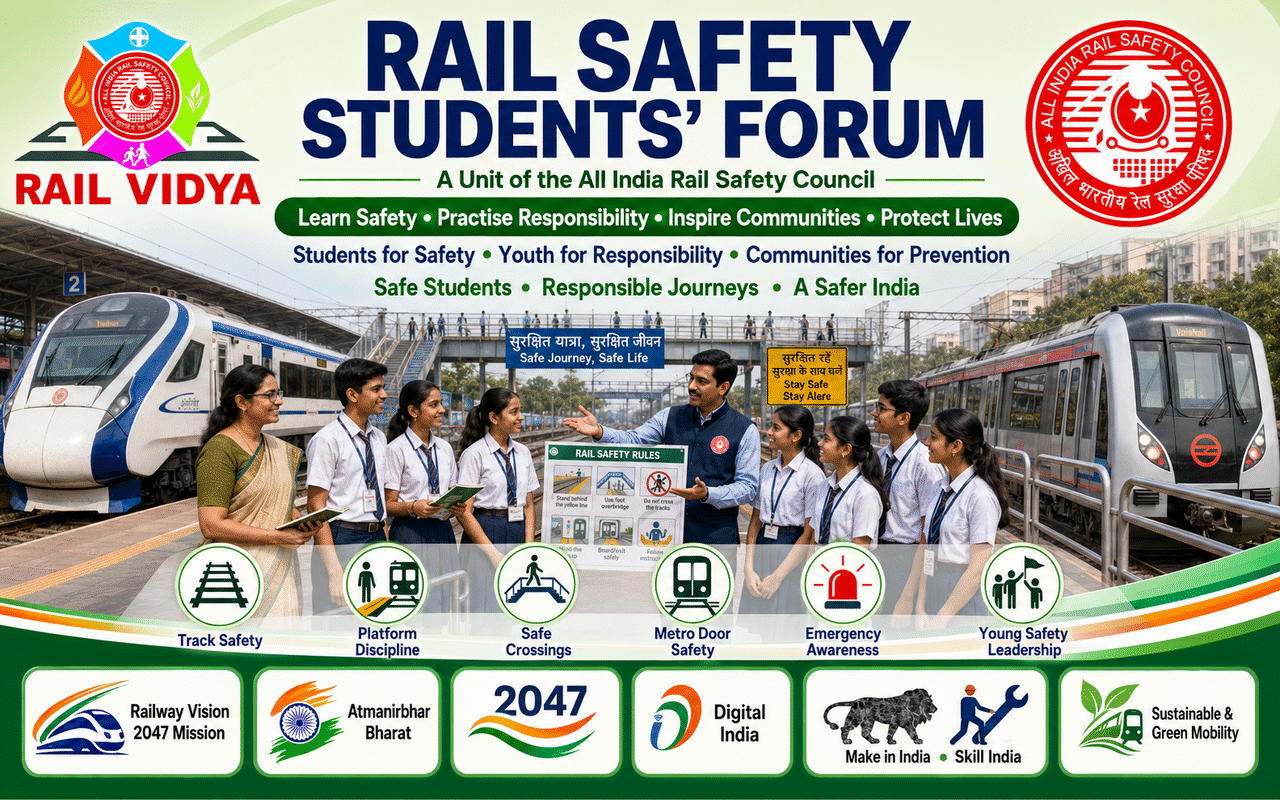
RAIL SAFETY STUDENTS’ FORUM A Unit of the All India Rail Safety Council LEARN SAFETY • PRACTISE RESPONSIBILITY • INSPIRE COMMUNITIES • PROTECT LIVES WELCOME TO THE RAIL SAFETY STUDENTS’ FORUM Welcome to the Rail Safety Students’ Forum (RSSF)—a specialised student safety-awareness and youth-engagement initiative of the All India Rail Safety Council (AIRSC).
RAIL SAFETY
STUDENTS’ FORUM
A
Unit of the All India Rail Safety Council
Learn Safety • Practise Responsibility • Inspire
Communities • Protect Lives
Welcome to the Rail Safety Students’ Forum
Welcome
to the Rail Safety Students’ Forum (RSSF)—a specialised student
safety-awareness and youth-engagement initiative of the All India Rail
Safety Council (AIRSC).
The Forum has been established to educate, encourage and empower school students to understand the importance of safe behaviour around railway stations, trains, tracks, level crossings, metro systems and other railway environments.
We believe that students can play an important role in creating a safer society. When children and young people receive accurate knowledge, age-appropriate guidance and positive opportunities to participate, they can become responsible safety ambassadors within their families, schools and communities.
The Rail Safety Students’ Forum provides a structured platform through which students can learn about railway safety, develop leadership qualities, participate in awareness activities and encourage others to adopt safe and responsible behaviour.
Our Vision
To develop a knowledgeable, safety-conscious and socially responsible generation of young people who understand railway risks, respect public-transport systems and actively support the prevention of avoidable accidents.
Our Mission
The mission of the Rail Safety Students’ Forum is to:
- Provide age-appropriate railway and metro safety education
- Promote safe behaviour near trains, tracks, stations and level crossings
- Prevent trespassing, unsafe track crossing and risky photography
- Develop student safety leadership and responsible citizenship
- Encourage peer-to-peer and family-level safety communication
- Support schools in conducting structured rail-safety activities
- Promote emergency awareness without exposing students to operational risks
- Build cooperation among students, teachers, parents and communities
- Encourage creativity, research and innovation in safety education
- Help students become informed and responsible users of public transport
Why Students Matter in Rail Safety
Students are not merely recipients of safety information—they can become responsible messengers of safety. A student who understands the dangers of trespassing, unsafe track crossing, approaching moving trains, touching electrical equipment or using mobile phones carelessly near railway environments can positively influence friends, family members and the wider community.
Through education and supervised participation, students can:
- Recognise dangerous situations
- Make safer personal decisions
- Challenge unsafe behaviour respectfully
- Communicate important safety messages
- Support school and community awareness programmes
- Encourage adults and peers to follow railway safety rules
- Become responsible passengers and future professionals
- Contribute ideas for safer and more inclusive transportation
The Forum aims to transform safety awareness into responsible everyday action.
Who Can Participate?
The specialised student programmes of RSSF are intended primarily for young people between 6 and 18 years of age, with activities organised according to age, learning level and safeguarding requirements.
Programme groups may include:
- Junior Safety Learners: 6–9 years
- Young Safety Explorers: 10–12 years
- Student Safety Ambassadors: 13–15 years
- Youth Rail Safety Leaders: 16–18 years
Participation by minors must be supported by appropriate parental or legal-guardian consent and coordinated through schools, recognised institutions or authorised adult supervisors wherever required.
Students will not be assigned operational railway duties or placed in unsafe, restricted or unsupervised railway environments.
Our Core Safety Message
Railway tracks, bridges, tunnels, yards, depots, electrical installations and operational areas are not places for playing, walking, filming or taking photographs.
Students must always remember:
- Never walk, play or take shortcuts on railway tracks
- Never cross tracks except at authorised crossing points
- Never climb on railway coaches, structures or electrical equipment
- Never touch fallen wires, signalling equipment or railway machinery
- Never attempt to board or leave a moving train
- Never stand beyond the safety line on a platform
- Never lean outside train doors or windows
- Never use headphones or mobile phones carelessly near railway areas
- Never take selfies, videos or photographs in dangerous locations
- Never throw stones or objects at trains
- Never place any object on railway tracks
- Never enter tunnels, bridges, yards, depots or restricted areas
- Always obey railway personnel, authorised signs and public announcements
- Immediately report dangerous behaviour or suspicious objects to a responsible adult or authorised official
- In an emergency, move to a safe place and seek assistance—do not attempt an unsafe rescue
Principal Areas of Learning
- 1. Safe Behaviour at Railway Stations
Students learn about platform safety lines, foot overbridges, subways, escalators, lifts, station announcements, passenger queues, crowd discipline and responsible boarding practices.
- 2. Railway-Track and Trespass Prevention
The Forum explains why railway tracks are dangerous and why trains cannot stop immediately. Students are taught never to use tracks as shortcuts or gathering places.
- 3. Level-Crossing Safety
Students learn to stop, look, listen and follow gates, barriers, lights, alarms, warning boards and instructions from authorised personnel. They are reminded never to pass under or around a closed barrier.
- 4. Safe Train Travel
Educational activities cover safe boarding, luggage awareness, emergency communication, respectful passenger conduct, travelling with responsible adults and helping vulnerable passengers appropriately.
- 5. Metro-Rail Safety
Students receive guidance concerning automated doors, platform-screen doors, escalators, security screening, emergency intercoms, prohibited areas and safe conduct in crowded metro environments.
- 6. Electrical Safety
Railway electrification systems can carry extremely dangerous voltage. Students are instructed never to approach, touch or climb near overhead wires, electrical installations or fallen cables.
- 7. Safe Use of Mobile Phones
The Forum addresses distracted walking, unsafe selfies, headphones near tracks and social-media challenges that may encourage dangerous behaviour.
- 8. Emergency Awareness
Students are taught how to identify an emergency, move to safety, seek adult assistance, provide clear information and use publicly notified emergency channels appropriately. They are not trained or encouraged to enter dangerous areas.
- 9. Environmental Responsibility
Programmes encourage students to protect railway environments by avoiding littering, conserving public property and supporting clean, accessible and sustainable transport.
- 10. Respectful and Inclusive Travel
Students learn to show consideration towards senior citizens, children, persons with disabilities and passengers requiring assistance, without placing themselves or others at risk.
Student Safety Ambassadors
Schools and educational institutions may nominate eligible students as Rail Safety Student Ambassadors, subject to programme requirements.
Student Ambassadors may:
- Share verified safety messages during school assemblies
- Support poster, quiz and essay competitions
- Encourage safe behaviour among classmates
- Participate in supervised awareness campaigns
- Help develop student-friendly educational materials
- Report unsafe practices to teachers or responsible adults
- Promote railway safety through approved school activities
- Participate in online learning, seminars and youth forums
The position is educational and voluntary. It does not provide authority to enforce railway rules, enter restricted areas, direct passengers or perform operational duties.
Proposed Activities
The Forum may organise or support:
- Rail-safety orientation programmes
- School safety assemblies
- Student workshops and webinars
- Poster, slogan and drawing competitions
- Essays, debates and public-speaking programmes
- Safety quizzes and knowledge challenges
- Short films, animations and digital-learning resources
- Storytelling and role-play activities
- Student research and innovation competitions
- Supervised visits to approved railway museums or educational facilities
- Interaction with safety professionals
- Teacher and parent orientation programmes
- Rail Safety Clubs in schools
- Student Safety Ambassador programmes
- National Rail Safety Awareness campaigns
- Recognition certificates for eligible participants
All physical activities will be subject to appropriate permissions, adult supervision, safeguarding arrangements and safety assessments.
Rail Safety Clubs in Schools
The Rail Safety Students’ Forum encourages schools to establish structured Rail Safety Clubs as part of their safety, citizenship or community-education activities.
A school Rail Safety Club may:
- Conduct monthly safety-learning sessions
- Display verified safety messages
- Observe Rail Safety Awareness Days
- Organise competitions and exhibitions
- Discuss local transport-safety concerns
- Encourage responsible passenger behaviour
- Develop creative safety-communication projects
- Promote environmental cleanliness
- Maintain a student safety-activity record
- Coordinate approved programmes with AIRSC
Every club should function under a nominated teacher or authorised adult coordinator.
Student Volunteering
RSSF welcomes students who wish to support educational and community-awareness activities within a safe, structured and supervised framework.
Student volunteers may assist with:
- Preparing posters and educational content
- Participating in school-awareness campaigns
- Supporting quizzes, exhibitions and cultural programmes
- Creating age-appropriate safety messages
- Conducting supervised peer-learning activities
- Participating in research and idea-generation programmes
- Promoting responsible digital safety communication
- Supporting environmental and cleanliness awareness
Student volunteers will not be assigned duties involving railway operations, crowd control, security enforcement, trackside activity, emergency rescue, machinery, electrical systems or access to restricted railway premises.
AIRSC Student Pathways Programme
Eligible applicants may be invited to participate in the AIRSC Student Safety Pathways Programme. This introductory programme may help participants understand:
- The objectives of AIRSC and RSSF
- Fundamental railway-safety principles
- Student roles and limitations
- Child-safeguarding requirements
- Responsible volunteering
- Communication and teamwork
- Digital conduct and privacy
- Reporting concerns to responsible adults
- Suitable educational and awareness activities
Following the orientation, participants may be matched with an age-appropriate, non-operational activity according to their interests, abilities, location and programme availability.
Participation does not constitute employment, professional appointment, railway recruitment, job placement or membership of Indian Railways.
Role of Parents and Guardians
Parents and guardians are essential partners in student safety. They are encouraged to:
- Discuss railway risks with children
- Model safe behaviour during journeys
- Supervise younger students
- Discourage track trespassing and unsafe photography
- Review programme information before providing consent
- Inform organisers of relevant medical or accessibility needs
- Monitor children’s online participation
- Report safeguarding, privacy or safety concerns promptly
Role of Schools and Teachers
Schools and teachers may support the Forum by:
- Nominating a responsible programme coordinator
- Integrating safety learning into school activities
- Supervising student participation
- Obtaining parental consent
- Ensuring inclusive participation
- Protecting student information
- Preventing unauthorised visits or activities
- Reporting incidents or safeguarding concerns
- Reviewing external speakers and programme materials
- Maintaining appropriate attendance and activity records
Child Safeguarding Commitment
The safety, dignity, privacy and well-being of every participating child are fundamental to the Forum.
RSSF programmes should follow the following principles:
- Participation must be voluntary and age-appropriate
- Parental or guardian consent must be obtained where required
- Children must be treated respectfully and without discrimination
- Activities must be supervised by authorised adults
- One-to-one unsupervised interaction should be avoided
- Photography and video recording require appropriate consent
- Personal information must not be publicly disclosed without lawful authority and consent
- Students must not be transported or taken to external locations without approved arrangements
- Any concern involving abuse, exploitation, bullying or unsafe conduct must be reported through appropriate safeguarding channels
- Students must never be encouraged to confront offenders or intervene physically in dangerous situations
Privacy and Responsible Use of Information
Personal information collected through applications, consent forms or programme participation will be used only for legitimate programme administration, communication, safeguarding and activity coordination.
Information should be handled in accordance with applicable Indian laws, including the Digital Personal Data Protection Act, 2023, and relevant child-protection requirements.
The Forum will seek to:
- Collect only information reasonably required
- Explain why information is being collected
- Obtain valid consent where necessary
- Restrict access to authorised persons
- Protect information against misuse or unauthorised disclosure
- Avoid publishing children’s contact details
- Obtain consent before using photographs, videos or testimonials
- Retain information only for an appropriate period
- Provide a channel for privacy-related questions or correction requests
Code of Conduct
Every student participant is expected to:
- Follow safety instructions and programme rules
- Respect teachers, parents, coordinators and fellow students
- Avoid bullying, discrimination or inappropriate behaviour
- Protect personal and confidential information
- Use social media responsibly
- Share only verified safety messages
- Never falsely represent AIRSC or any railway authority
- Never collect money or promise services in the organisation’s name
- Never enter railway property without permission
- Immediately report unsafe or inappropriate conduct
Recognition and Learning Opportunities
Subject to eligibility and programme requirements, participants may receive:
- Certificates of participation
- Student Safety Ambassador recognition
- Appreciation for school activities
- Opportunities to contribute to student publications
- Invitations to approved seminars or webinars
- Participation in competitions and exhibitions
- Recognition for outstanding safety-awareness projects
Certificates represent participation or achievement in the relevant educational activity. They must not be represented as government qualifications, railway recruitment credentials or professional licences.
How to Apply
Students, parents, guardians and educational institutions interested in participating may complete the prescribed application or registration form.
Applications should include:
- Student’s name and age
- School and class details
- Parent or guardian information
- Emergency contact details
- Areas of interest
- Relevant medical or accessibility information, where necessary
- Consent for participation
- Separate consent for photography or publication, if applicable
- Signature or verified approval of the parent or guardian
Submission of an application does not automatically guarantee enrolment. Participation remains subject to age eligibility, programme availability, verification, consent and safeguarding requirements.
Contact Information
Volunteer
and Student Programme Services
All India Rail Safety Council
No. 1/22,
Workspace
Asaf Ali Road
New Delhi – 110002
India
Direct
Line: +91
73974 27456
Email: contact@railsafety.co.in
Website: www.railsafety.co.in
Before publishing, the postal address and contact information should be verified and updated wherever necessary.
Join the Rail Safety Movement
Thank you for expressing an interest in becoming part of the All India Rail Safety Council family.
Students from different communities, educational backgrounds and areas of interest are welcome to participate in our safety-learning and public-awareness mission. Whether you are interested in science, engineering, art, communication, technology, environmental protection, public service or community leadership, there may be a meaningful way for you to contribute.
Together, we can encourage safer journeys, responsible behaviour and greater respect for the railway system that connects our nation.
Learn Today • Lead Tomorrow • Protect Every Journey
Safe Students • Safe Communities • Safe Railways
Every Student Can Carry the Message of Safety
The Rail Safety Students’ Forum is an educational and awareness initiative of the All India Rail Safety Council. Unless specifically authorised through a written institutional arrangement, RSSF and AIRSC should not be represented as departments, agencies, recruitment bodies or official units of Indian Railways, the Ministry of Railways, the Government of India, any State Government, metro-rail corporation or railway undertaking.
Participation in RSSF programmes does not provide employment, railway appointment, preferential recruitment, access to railway premises or authority to perform railway duties.
Students, volunteers and coordinators must not enter tracks, yards, depots, cabins, workshops, tunnels, bridges or other restricted railway locations without lawful permission and approved supervision. All activities must comply with applicable laws, railway rules, child-safeguarding standards and instructions issued by the relevant authorities.