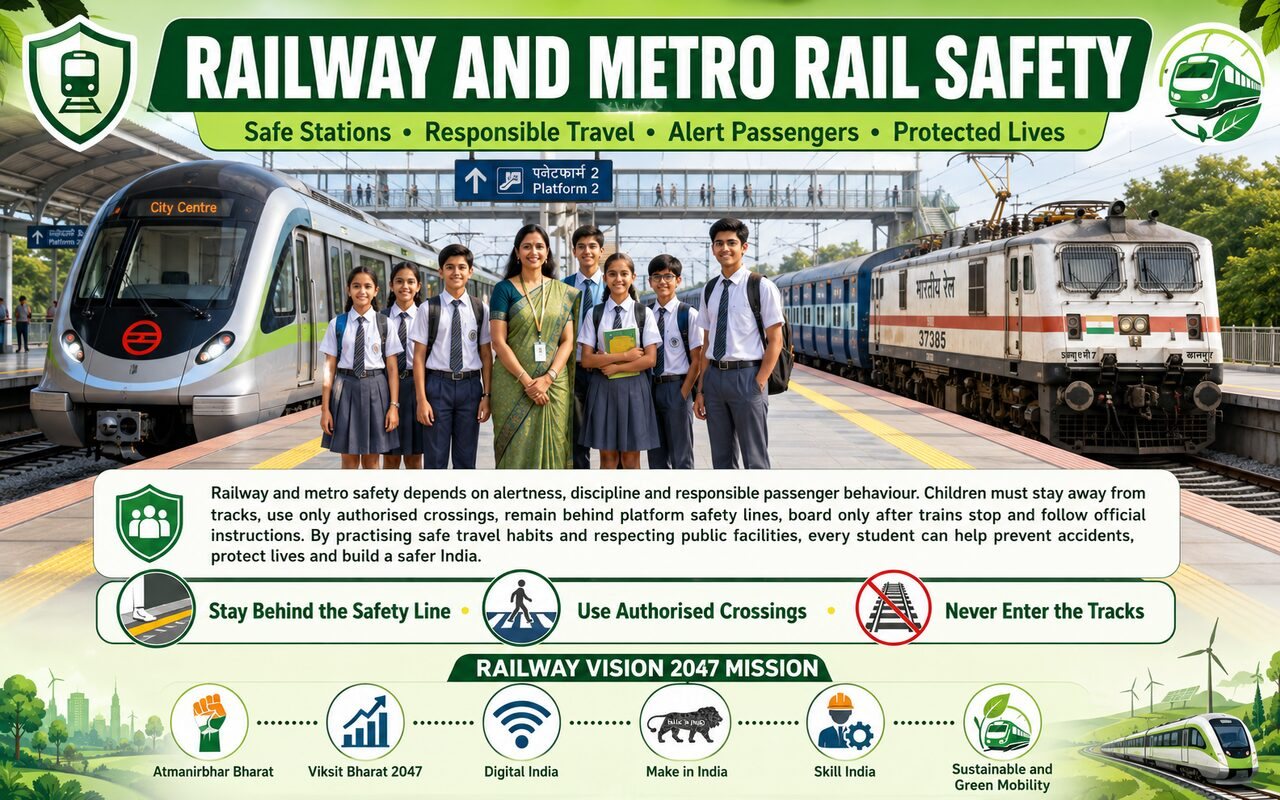
Railway and Metro Rail Safety Railway and metro safety depends on alertness, discipline and responsible passenger behaviour. Children must stay away from tracks, use only authorised crossings, remain behind platform safety lines, board only after trains stop and follow official instructions. By practising safe travel habits and respecting public facilities, every student can help prevent accidents, protect lives and build a safer India.
Railway and Metro Rail Safety
Safe Stations •
Responsible Travel • Alert Passengers • Protected Lives
Railways and metro rail systems are essential components of India’s public-transport network, connecting children, families, educational institutions, workplaces and communities across cities, towns and regions. Every day, millions of passengers use stations, platforms, trains, level crossings, foot overbridges, subways, escalators, lifts and other passenger facilities. While modern rail systems are supported by advanced engineering, signalling, surveillance and safety technologies, passenger safety also depends upon individual awareness, disciplined behaviour and respect for established rules.
The RailVidya National Children’s Integrated Safety Education Programme, an educational initiative of the All India Rail Safety Council (AIRSC), places railway and metro rail safety at the centre of its child-focused learning framework. The programme helps students recognise potential hazards, understand safety signs and announcements, follow authorised instructions and develop responsible habits that protect themselves, fellow passengers and public property.
Students must clearly understand that railway and metro tracks are dangerous and strictly restricted areas. Tracks must never be used for walking, playing, sitting, taking photographs or creating social-media content. Trains can approach quickly and quietly, and their stopping distance may be much greater than expected. Children should cross railway lines only through authorised facilities such as foot overbridges, subways, designated pedestrian crossings, road overbridges and road underpasses. Trespassing, crossing beneath stationary trains or taking shortcuts across tracks can result in fatal consequences.
At level crossings, students must stop at a safe distance, observe warning lights and alarms and wait patiently whenever the gate is closed or a train is approaching. They must never pass under or around a closed barrier. The safe principle of “Stop, Look, Listen and Cross Only When Permitted” should guide every authorised crossing. Mobile phones, headphones and other distractions must be avoided near tracks, crossings and station approaches because they can prevent a person from hearing or noticing an approaching train.
Safe station behaviour begins with calmness, patience and awareness. Students should walk carefully, avoid running or pushing and remain with their parents, teachers or guardians. Luggage should be kept under control without blocking entrances, stairways or passenger movement. Children should read safety signs, listen to official announcements and seek help only from authorised railway, metro, police, security or station personnel.
While waiting for a train, passengers must remain behind the marked safety line and avoid standing close to the platform edge. Leaning over the edge, sitting on the platform boundary, attempting to retrieve dropped objects or entering the track area is extremely dangerous. If an item falls onto the tracks, students should immediately inform station staff and never attempt to recover it themselves. At metro stations, platform screen doors and other protective barriers must never be leaned upon, blocked, forced open or misused.
Boarding and alighting should take place only after the train has stopped completely and the doors have opened. Students should first allow passengers to exit, then board in an orderly manner without pushing. They must mind the gap between the train and platform, avoid obstructing closing doors and never attempt to board or leave a moving train. Hanging from doors, travelling on footboards, climbing between coaches or occupying restricted areas can result in severe injury or death.
Inside trains, children should remain seated whenever possible or hold a secure handrail while standing. Aisles, doorways and emergency exits must remain clear. Passengers should avoid distracting train operators, tampering with equipment or misusing alarms and emergency communication systems. Reserved seats and accessible facilities should be respected and made available to senior citizens, persons with disabilities, pregnant women and passengers who genuinely require assistance.
Escalators, stairways and lifts must be used responsibly. On escalators, students should face forward, hold the handrail, keep footwear and loose clothing away from the edges and never sit, run or play. Younger children should remain under adult supervision. Lifts should not be overcrowded, and passengers must follow the displayed capacity and emergency instructions. In the event of a lift failure, users should remain calm, use the emergency communication facility and wait for trained assistance.
Railway electrification presents invisible but serious dangers. Overhead electrical equipment, power lines, third rails, cables and electrical installations may carry extremely high voltage. Students must never climb on coaches, poles, bridges, signal structures or other railway equipment, nor attempt to touch cables or retrieve objects located near electrical systems. Flying kites, carrying long metallic objects or throwing materials near overhead wires can lead to electrocution even without direct physical contact.
During an emergency, students should remain calm, protect themselves and follow the directions of authorised personnel. Smoke, fire, suspicious objects, damaged equipment, unsafe behaviour or a person entering the tracks should be reported immediately. Emergency alarms, intercoms and help points must be used only for genuine emergencies. Children should never attempt an untrained rescue in a track, electrical or fire-risk area, as this may create additional victims.
Responsible travel also includes cleanliness, environmental care and respect for public assets. Students should use waste bins, avoid damaging seats or equipment, follow queue systems and treat railway and metro employees respectfully. Photography and digital-device use must never interfere with safety, privacy, security restrictions or passenger movement.
Through classroom learning, audiovisual lessons, demonstrations, safety drills, station-awareness activities and family participation, RailVidya seeks to transform railway and metro safety from a set of instructions into a lifelong civic responsibility. Every safety-conscious student can influence friends, family members and the wider community by choosing disciplined behaviour and sharing accurate safety messages.
Stay Behind the Safety Line • Use Authorised Crossings • Never Enter the Tracks • Board Only After the Train Stops
Safe Child • Safe Passenger • Safe Railway • Safe Metro • Safe India
© 2026 Dr.R.Padmanabhan. All Rights Reserved All India Rail Safety Council - AIRSC - Rail Safety Council India –rail heritage- Railway Safety India -Railway Safety Education - All India Rail Safety Council AIRSC - AIRSC India- AIRSC rail safety training - AIRSC Academy of Safety and Disaster Management - AIRSC Rail Safety News - AIRSC Rail Vidya - AIRSC Rail Safety Research and Development Forum – Dr.R.Padmanabhan AIRSC - Chairman All India Rail Safety Council - Airsc Railway safety training courses - www.railsafety.co.in/ www.railsafety.in / www.airsc.in/ www.airsc.in/ www.railsafety.net.in/ https://www.railsafetyrecruitmentboard.com/
Railway and Metro Rail Safety
Railway and metro safety depends on alertness, discipline and responsible passenger behaviour. Children must stay away from tracks, use only authorised crossings, remain behind platform safety lines, board only after trains stop and follow official instructions. By practising safe travel habits and respecting public facilities, every student can help prevent accidents, protect lives and build a safer India.