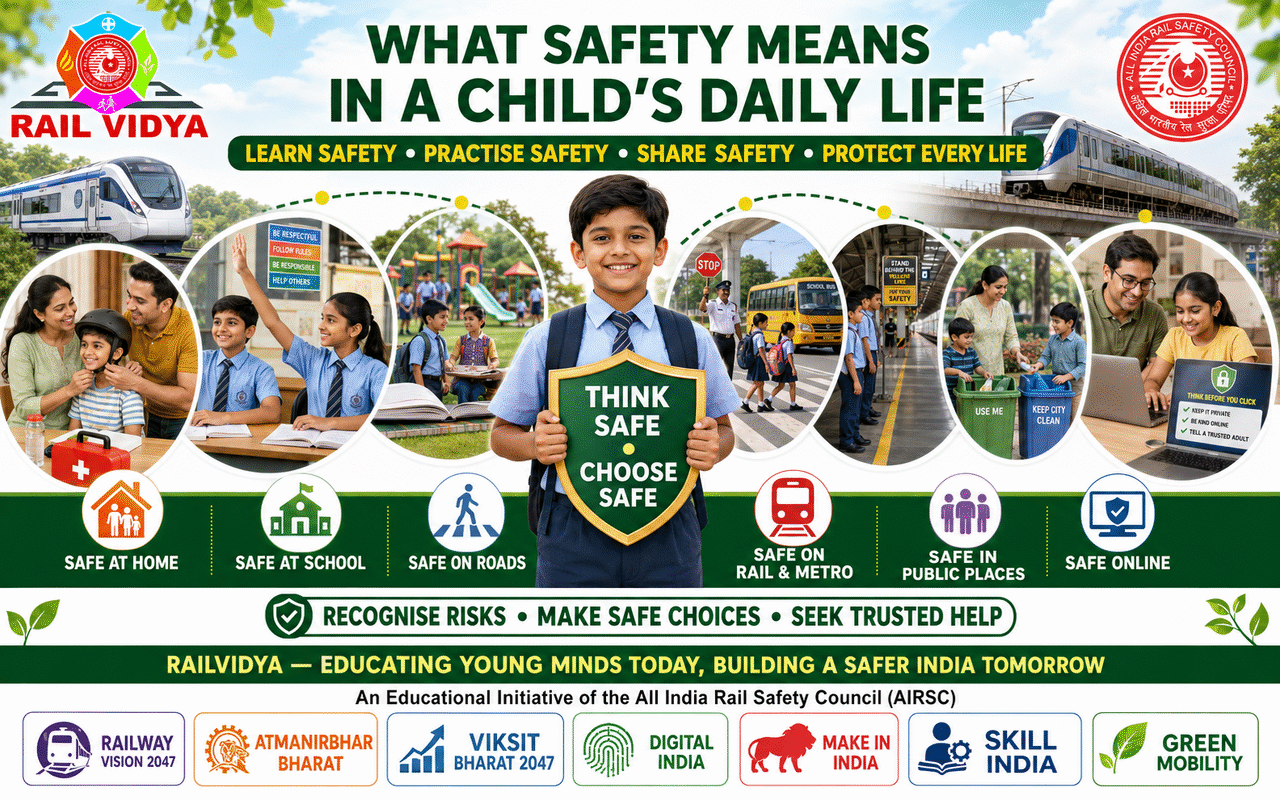
Safety in a child’s daily life means developing the awareness, confidence and responsible habits needed to recognise risks, make safe choices and seek help from trusted adults or authorised professionals. By practising safety at home, school, on roads, in railway and metro environments, public places and online, children learn to protect themselves, respect others and grow into alert, disciplined and compassionate citizens who contribute to safer families and communities.
What Safety Means in a Child’s Daily Life
Learn Safety • Practise
Safety • Share Safety • Protect Every Life
RailVidya – Educating
Young Minds Today, Building a Safer India Tomorrow
Safety in a child’s daily life means creating a secure, supportive and responsible environment in which every child can learn, travel, play, communicate and grow with confidence—free from preventable harm, intimidation and unnecessary risk. It is not limited to obeying a list of instructions; it is a positive way of thinking, observing and behaving. True safety education enables children to recognise possible dangers, understand the consequences of their choices and respond calmly and responsibly whenever they face an unfamiliar, uncomfortable or hazardous situation.
Every day presents children with different surroundings and safety responsibilities. From the moment they wake up, prepare for school, leave home and begin their journey, they may encounter household appliances, electrical equipment, stairways, busy roads, school buses, railway stations, metro systems, crowded public places and digital platforms. Each environment has its own risks. A safety-conscious child learns to remain alert, follow authorised instructions, avoid unsafe shortcuts and seek help before a small concern develops into a serious emergency.
At home, children should understand the importance of staying away from exposed electrical wires, overloaded sockets, medicines, chemicals, sharp objects, open flames and unsafe balconies or rooftops. They should know that electrical repairs, gas leaks and other technical hazards must be handled only by responsible adults or trained professionals. Good hygiene, safe food handling, proper storage of medicines and awareness of emergency contact numbers are equally important parts of home safety.
At school, safety means following classroom, laboratory, playground and transport rules; using equipment correctly; keeping corridors and exits clear; and avoiding running, pushing, bullying or dangerous play. Children should be encouraged to report damaged furniture, wet floors, exposed wiring, blocked emergency exits, fire hazards, unsafe behaviour or any situation that causes fear or discomfort. Reporting a concern is not complaining—it is a responsible action that may prevent injury and protect the entire school community.
Road and travel safety require constant attention. Children should use pedestrian crossings, footpaths and authorised crossing points wherever available. They must obey traffic signals, wear helmets and seat belts, avoid using mobile phones or earphones while walking near traffic and never cross between parked vehicles without carefully observing the road. When travelling by school bus or public transport, students should wait until the vehicle stops, board and alight in an orderly manner, remain seated where required and never distract the driver.
Railway and metro environments demand especially disciplined behaviour. Children must never walk, sit, play, film or take photographs on railway tracks, bridges, tunnels, yards or other restricted railway property. They should use foot overbridges, subways and authorised crossings; obey warning lights, bells and announcements; and never pass beneath or around a closed level-crossing gate. At stations, they should remain behind the platform safety line, stay with parents, teachers or guardians, avoid running and pushing, and never attempt to board or leave a moving train.
Railway and metro electrical systems can carry extremely dangerous voltages. Children must never touch overhead wires, electrical cabinets, exposed cables, signalling equipment or fallen power lines. They should not climb coaches, poles, structures or parked railway vehicles. If an electrical hazard is noticed, the correct response is to maintain a safe distance, warn others without approaching the danger and immediately inform a responsible adult or authorised official.
Personal safety is another essential part of a child’s daily life. Children should understand their right to feel safe, respected and heard. They must be encouraged to trust their instincts, refuse unsafe requests and move away from any person or situation that makes them feel frightened, threatened or uncomfortable. They should never follow strangers, accept unauthorised rides, share personal details carelessly or keep harmful secrets. A trusted parent, guardian, teacher, counsellor, police officer or child-protection professional should be approached whenever assistance is required.
Digital safety has become equally important. Children should protect passwords, personal photographs, school information, addresses and contact details. They must avoid suspicious links, unknown downloads, online challenges, cyberbullying and communication with unverified individuals. Any threatening message, financial request, inappropriate content or attempt to obtain private information should be shown immediately to a trusted adult. Responsible digital citizenship means using technology respectfully, securely and in a manner that protects both oneself and others.
Meaningful safety education also introduces children to basic emergency awareness. They should know how to recognise warning signs, remain calm, move towards a safe location, contact a trusted adult and follow official instructions. Age-appropriate learning in first aid, fire safety, disaster preparedness and emergency communication can develop confidence; however, children must understand their limits. They should never enter a fire, floodwater, railway track, electrical danger zone or unstable structure to attempt an untrained rescue. Personal safety must come first, and hazardous situations must be managed by trained professionals.
Safety is closely connected with kindness, inclusion and social responsibility. A safety-conscious child respects public property, avoids behaviour that may harm others and offers appropriate support to younger children, senior citizens and persons with disabilities. Children can assist responsibly by alerting an adult, keeping pathways clear, sharing accurate information and encouraging orderly conduct. They should never shame, frighten or force others in the name of safety; positive leadership is demonstrated through patience, respect and personal example.
Parents, teachers, schools and communities have a shared responsibility to build this culture. Children learn most effectively when adults consistently demonstrate the behaviour they expect. Open communication, practical demonstrations, supervised activities, emergency drills, safety clubs, storytelling, quizzes and age-appropriate digital resources can make learning meaningful and memorable. Children should be encouraged to ask questions and report concerns without fear of blame, punishment or embarrassment.
Through the RailVidya National Children’s Integrated Safety Education Programme, an educational initiative of the All India Rail Safety Council (AIRSC), safety is presented as an essential life skill and a foundation of responsible citizenship. RailVidya seeks to connect safety education across the home, school, road, railway, metro, public-transport and digital environments so that children receive clear, practical and consistent guidance throughout their development.
The programme encourages every child to become a Young Safety Ambassador—not by performing dangerous interventions or assuming the duties of trained officials, but by following safe practices, reporting hazards correctly and sharing verified safety messages. Through the principle of “One Child • One Family • One Safety Message,” a single student can carry valuable knowledge from the classroom into the home and inspire an entire family to adopt safer habits.
For every child, safety ultimately means possessing the knowledge to recognise risk, the confidence to make a responsible decision and the courage to seek appropriate help. When safety becomes part of everyday learning and behaviour, children grow into alert, disciplined, compassionate and socially responsible citizens. Every informed choice prevents avoidable harm, every responsible action protects life, and every safety-conscious child contributes to a safer family, a safer community and a safer India.
Safe at Home • Safe at School • Safe on the Road • Safe During Travel • Safe Online
Alert Children • Responsible Families • Safety-Conscious Communities • A Safer India
© 2026 Dr.R.Padmanabhan. All Rights Reserved All India Rail Safety Council - AIRSC - Rail Safety Council India –rail heritage- Railway Safety India -Railway Safety Education - All India Rail Safety Council AIRSC - AIRSC India- AIRSC rail safety training - AIRSC Academy of Safety and Disaster Management - AIRSC Rail Safety News - AIRSC Rail Vidya - AIRSC Rail Safety Research and Development Forum – Dr.R.Padmanabhan AIRSC - Chairman All India Rail Safety Council - Airsc Railway safety training courses - www.railsafety.co.in/ www.railsafety.in / www.airsc.in/ www.airsc.in/ www.railsafety.net.in/ https://www.railsafetyrecruitmentboard.com/