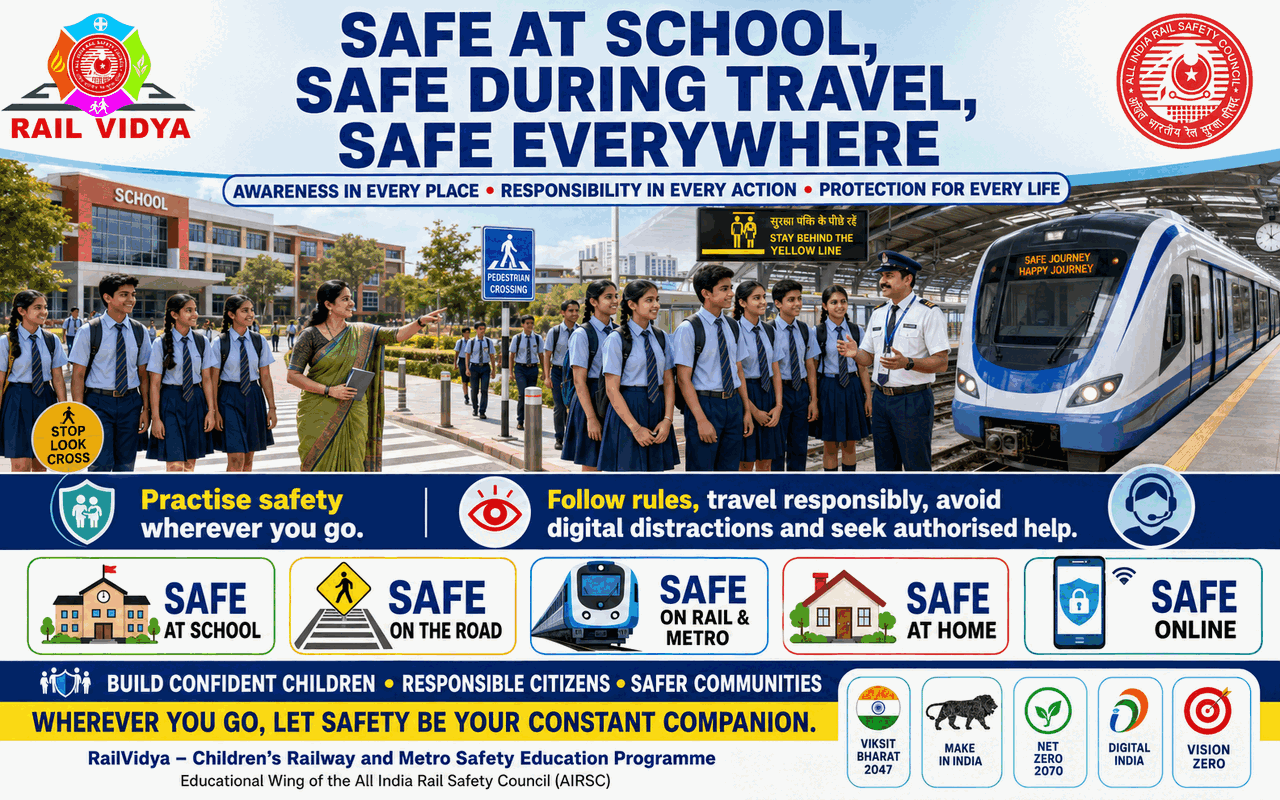
AWARENESS IN EVERY PLACE - RESPONSIBILITY IN EVERY ACTION - PROTECTION FOR EVERY LIFE
Safe
at School Safe During Travel, Safe Everywhere
Awareness in Every Place • Responsibility in Every Action • Protection
for Every Life
Dear Students,
Safety is not limited to one place, one activity or one set of rules. It is a continuous responsibility that travels with you—from your home to your school, from the classroom to the playground, from the road to the railway or metro station and from the physical world into the digital environment. RailVidya – Children’s Railway and Metro Safety Education Programme, the educational wing of the All India Rail Safety Council (AIRSC), encourages every child to develop the awareness, confidence and responsible habits required to remain safe everywhere.
Being safe begins with observing your surroundings and thinking carefully before taking action. A safety-conscious student recognises hazards, respects established rules, avoids unnecessary risks and seeks help whenever something appears unsafe, confusing or uncomfortable. Safety is not based on fear. It is founded on knowledge, discipline, patience and respect for human life.
A safe school is created when students, teachers, parents, administrators and supporting personnel work together. Students should walk calmly through corridors, use stairways carefully and keep emergency exits unobstructed. Classroom equipment, electrical installations, laboratory materials and sports facilities must be used only according to instructions. Running, pushing, unsafe play and careless handling of equipment can cause preventable injuries.
Students should participate seriously in fire drills, evacuation exercises and other emergency-preparedness activities. Every child should know the location of emergency exits, assembly points, first-aid facilities and trusted adults. Damaged equipment, exposed electrical wires, smoke, suspicious objects, unsafe structures, bullying or threatening behaviour must be reported immediately to a teacher or authorised school official.
Safety also means creating a respectful and inclusive school environment. Every child has the right to learn without fear, bullying, discrimination or humiliation. Students should support younger children and classmates with disabilities in safe and appropriate ways. Kindness, cooperation and respect for personal boundaries are essential parts of a strong school-safety culture.
The journey between home and school also requires constant attention. Children should follow routes approved by parents or teachers, use pavements and cross roads only at authorised pedestrian locations. Traffic signals and the directions of traffic personnel must always be obeyed. Mobile phones and headphones should be put away while walking, cycling or crossing roads because distraction can prevent children from noticing vehicles, signals and warning sounds.
When travelling in a school bus, car or other vehicle, students must remain seated, fasten seat belts where provided and keep their hands and belongings inside the vehicle. They must never distract the driver, stand near vehicle doors, travel on footboards or board and alight while the vehicle is moving. Certified helmets must always be worn when travelling on two-wheelers.
During railway and metro journeys, children should remain with their parents, teachers, guardians or authorised group leaders. They must walk carefully through stations, use designated entry and exit routes and follow all official signs, announcements and instructions. At platforms, students must remain behind the safety line until the train has stopped completely and boarding is officially permitted.
Passengers inside a train must be allowed to exit before others begin boarding. Children should stand to the side, keep the centre of the doorway clear and board in an orderly manner. They must never rush, push or attempt to enter when the door-closing warning has started. If warning sounds, flashing lights or announcements indicate that the doors are closing, the correct response is to stop, step back and wait for the next train.
Railway tracks are restricted operational areas and must never be used for walking, sitting, playing, cycling, photography or shortcuts. Children must use authorised foot overbridges, subways and designated crossings. They must never pass under or around a closed railway gate. Warning bells, lights, barriers, signals and instructions from authorised personnel must be obeyed without exception.
Overhead electrical wires, third rails, signalling equipment and other railway or metro installations may carry dangerous electrical energy. These systems must never be touched, approached or misused. Children should never climb railway structures, fly kites near overhead wires or attempt to retrieve objects that have fallen into restricted areas. Authorised personnel must always be informed.
At stations and other public places, children should know how to identify official help. Authorised metro and railway personnel may include station controllers, customer-care employees, platform staff, security personnel, police officers and emergency responders. Children should look for an official uniform, visible identity card or recognised help desk and should never depend upon an unknown person for assistance.
At home, safety requires awareness of electricity, fire, cooking gas, medicines, chemicals, balconies, water and unsafe storage. Children must never touch electrical switches with wet hands, play with matches or lighters, taste unidentified substances or attempt repairs. If they notice smoke, fire, exposed wiring, a gas smell or another danger, they should move to a safe place and alert a responsible adult immediately.
Safety in the digital world is equally important. Students must protect passwords, photographs, live locations and private family information. One-time passwords, PINs and banking details must never be shared. Suspicious links, unknown friend requests, fraudulent offers, cyberbullying and online threats should be reported promptly to a trusted parent, teacher or guardian. Responsible digital citizenship also requires respectful communication and verification of information before forwarding it.
Personal safety means understanding boundaries and trusting your instincts. If a person, place or situation makes you feel unsafe, move away and seek help from a trusted adult. Never accompany an unknown person without permission or keep threatening and uncomfortable experiences secret. Asking for help is a responsible and courageous decision.
During any emergency, your first responsibility is to protect yourself from immediate danger. Remain calm, move towards a safe location and alert a responsible adult, authorised official or emergency service. Communicate the location and nature of the emergency clearly. Never enter a hazardous area, touch an electrical casualty, crowd an injured person or attempt a dangerous rescue meant for trained professionals.
Every student can contribute to safety by leading through personal example. Follow rules even when nobody is watching, report hazards responsibly and share verified safety messages with family and friends. Encourage others to wear helmets, use seat belts, respect railway gates, avoid mobile-phone distraction and follow emergency instructions. A simple reminder given at the right moment may prevent an accident and protect a precious life.
RailVidya invites every student to become a Young Safety Ambassador—a learner who practises safety, respects others and inspires responsible behaviour. The role of a young ambassador is to educate, encourage, observe and report. It is never to enter dangerous situations, confront unknown persons or perform duties meant for trained professionals.
As India advances towards Viksit Bharat 2047, safety-conscious children will become responsible citizens who value life, respect public property, use technology wisely and contribute to sustainable national development. Modern infrastructure becomes truly successful only when it is supported by awareness, discipline and responsible public behaviour.
Dear students, let safety guide every journey and every decision. Remain alert at school, travel responsibly, follow safe practices at home and protect yourself online. Your life is precious, your future is important and your responsible choices can inspire an entire community.
Safe at School • Safe on the Road • Safe During Travel • Safe at Home • Safe Online • Safe Everywhere
“Wherever You Go, Let Awareness Be Your Guide and Safety Be Your Constant Companion.”
With care and best wishes,
RailVidya
– Children’s Railway and Metro Safety Education Programme
The Educational Wing of the All India Rail Safety Council (AIRSC)
© 2026 Dr.R.Padmanabhan. All Rights Reserved.
Chairman — All India Rail Safety Council (AIRSC)
Promoting Railway Safety, Education and Public Awareness
Email: admin@railsafety.co.in | Website: www.railsafety.co.in/ www.railsafety.in/ www.airsc.in